Pig Brig: Revolutionizing The Humane Capture of Wild Pigs
By Space Coast Daily // March 28, 2024
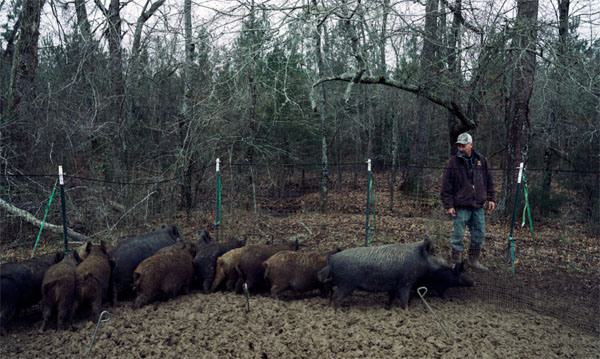
Anyone who has hiked the miles of beautiful trails and woods that the state of Florida has to offer has probably come across a wild boar — perhaps several. Florida, like Texas, Georgia, and many other southern states, has a wild pig epidemic.
These invasive animals tear through farmland, forests, and even golf courses. All the while, they destroy land and crops and even threaten the safety and health of other animals and humans.
Over the years, people have used various approaches in an attempt to control the population of destructive wild pigs, ranging from shooting the pigs from aircraft to SMART traps that require cellular service to trigger a gate to drop. However, the solutions that have been relied upon thus far have proven less effective than some would like.
The Pig Brig Trap Systems, developed by wildlife ecologists, is a patented net trap solution that can catch multiple groups of wild pigs, called sounders, and doesn’t require cell service. We sat down with Aaron Sumrall, Ph.D., the Director of Outreach, Education, and Research with Pig Brig, to find out how this trap is influencing the Florida wild pig problem.
Thanks for speaking with us, Aaron. Why are wild boars an invasive problem, especially in the state of Florida?
The first consideration is ecological. Florida has many niche ecosystems critical for sustaining threatened and endangered plants and animals, but even stable populations of native plants and animals classified as more generalist in their habitat preference are being forced to adapt to use whatever habitat is available. The human population spread within Florida is taking an increasing number of acres of habitat out of production, thus making the remaining habitat more valuable. Upon finding desirable resources within a given area, wild pigs will remain in that area until all valuable resources are exhausted.
Wild pigs are also an issue for Florida agriculture. Crops are increasing in value due to a decrease in available land, which requires a higher productivity of crops to be produced on less land. Wild pigs can destroy many acres of agricultural production in a single night and may not be able to meet their needs through available plant crops, often causing them to become more predatory on young livestock and wildlife species.
Wild boars, also known as wild pigs or feral hogs, are considered an invasive problem in many regions, including the state of Florida, due to several reasons:
-
Rapid Reproduction: Wild boars reproduce quickly, with sows giving birth to multiple litters each year, often containing several piglets. This rapid reproductive rate allows their populations to expand rapidly, outpacing efforts to control them.
-
Difficult to Control: Controlling wild boar populations can be challenging due to their intelligence, adaptability, and elusive nature. Traditional control methods such as trapping, hunting, and fencing may be ineffective or costly, particularly in areas with dense vegetation or difficult terrain.
-
Destructive Behavior: Wild boars are omnivores and opportunistic feeders, meaning they will consume a wide variety of plant and animal matter. Their foraging habits can cause extensive damage to agricultural crops, pastures, and native vegetation. They also root and dig for food, causing soil erosion and damaging habitats.
-
Impact on Native Species: Wild boars are not native to Florida or many other regions where they have become invasive. Their presence can disrupt ecosystems by outcompeting native species for food and habitat resources. They may also directly prey on small animals, birds, and reptiles, further impacting native wildlife populations.
-
Disease Transmission: Wild boars can carry and transmit various diseases to domestic livestock, wildlife, and even humans. This includes diseases such as swine brucellosis, pseudorabies, and various parasites, which can have significant economic and public health implications.
Overall, the combination of their reproductive capacity, destructive behavior, impact on native ecosystems, disease transmission, and difficulty of control measures contributes to wild boars being a significant invasive problem, particularly in states like Florida where they have established thriving populations.
How does Pig Brig differ from other trapping or mitigation measures?
The Pig Brig Trap System is set apart from all other management strategies — especially other traps — due to the system’s adaptability. It can be implemented on virtually all landscape types and topography.
The Pig Brig does not rely on technology for the trap to function properly and is the only true multi-catch trap. It is a passive catch system in that pigs can continually enter from any direction at any time, and it can be set up using readily available T-posts for any farm and ranch center. If a remote area has restricted access for vehicles, one can use existing trees and backpack the trap into the area.
How is Pig Brig so effective and efficient?
Pig Brig Trap Systems provides a more humane way of holding captured wild pigs. The Pig Brig is nearly silent in function while wild pigs enter the trap, which keeps the animals calm throughout the catch process. It is common with metal fabricated traps to find injured wild pigs in the trap. The activation of a conventional metal trap gate startles pigs, causing them to wildly attempt to escape such traps, increasing the possibility of injury to the animal.
Once wild pigs are in the Pig Brig, they calmly feed on available bait until full, or the bait is consumed. Upon trying to exit the trap, captured wild pigs push on the netting of the trap, which flexes in a dynamic manner, absorbing the force throughout the trap. Pigs commonly attempt to escape for a limited time before lying down and sleeping the remainder of the night.
Additionally, the Pig Brig can be adapted to any landscape, which allows the trapping practitioner to incorporate vegetation within the trap. They can also place the trap under a heavy shade cover. These options are critically important, especially in warm months, because pigs do not have the ability to sweat. Trap systems requiring a satellite signal can be limited in trap placement, making sites with very limited or no shade possibly the only option.
What else sets Pig Brig apart from the competition?
Pig Brig Trap Systems is not just a trap — it is a team. We are staffed with knowledgeable and experienced individuals ready to help in areas of customer support, trap support, technical assistance, management strategies, and subject matter expertise. Pig Brig Trap Systems is revolutionizing wild pig management, research, agriculture production, and species preservation through a humane and scientific approach.