Connected Fire Safety: How WiFi Smoke and CO Detectors Are Transforming Home Protection
By Space Coast Daily // December 13, 2025
We have crossed the threshold of just wanting to make our homes smarter. What began with automated lights and voice-activated thermostats has expanded to a full security ecosystem — one that can anticipate, sense and address threats as they happen. No matter where you decide to shop, the game changers in all of this are WiFi smoke and carbon monoxide sensors as these have radically shifted how we approach fire safety in the home today landing us with better merchandise.
The Evolution of Digital Fire Safety
Smoke and CO alarms, that have been warning families of danger for generations. But these devices usually work in a vacuum: blaring sirens that do you no good if nobody’s around to hear them. With the inclusion of WiFi and smart technology, that has all changed.
Today’s detectors can talk to your smartphone, notifying you immediately if they sense smoke or carbon monoxide, whether you’re at home, work or halfway around the world. This up-to-the second awareness fills the crucial time gap between threat discovery and response, greatly enhancing safety.
Under the Hood: The Tech Behind Smart Detectors
An alarm that warns of smoke and carbon monoxide is, fundamentally, a kind of super-sensitive sensor. It monitors the air particles and gas concentrations to sniff out fires or leaks early. With WiFi functionality, these detectors send information to cloud services or companion apps, so that home owners can view conditions off-site.
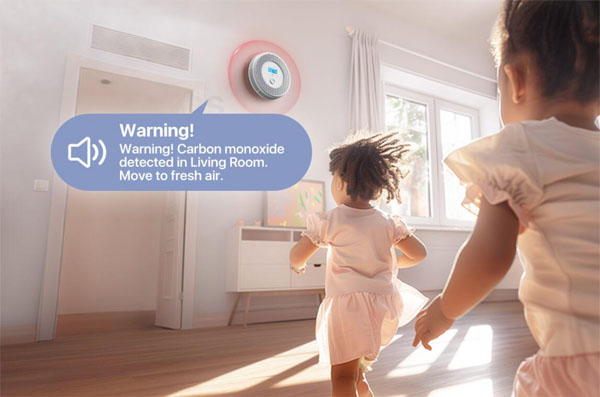
Devices like the X-Sense XP0A-MR WiFi Smoke and Carbon Monoxide Detector take this a step further with voice alerts that specify both the location and type of danger—for example, “Smoke detected in the kitchen” or “Carbon monoxide detected in the living room.” Such precision helps eliminate confusion and speeds up evacuation or mitigation actions.
Protecting Data: How Analytics is Keeping Us Safe from Flames
Connectivity is only part of the equation. (I should note that the real value of these devices comes not from the devices themselves but from the data they collect.) Wi-Fi or wireless alarms provide ongoing information about home air-quality and conditions, so you can make smart safety decisions.
Over time, aggregated data can show patterns that help homeowners identify and address underlying causes of potential risks before they grow into problems — say, frequent false alarms in one room or repeated low-level readings for CO. On a broader level, data that is anonymized from thousands of detectors could influence public safety policy or improve future fire protection.
Transparency of this kind is a source of greater peace of mind for the individual homeowner. You can check that all your alarms are working properly, view historical event logs and even share records with insurance companies or landlords — you know, should the need arise; all from your mobile.
Interlinked Systems: Strength in Connection
Interconnection is one of the advantages of interconnected alarms. In a linked system, if one alarm goes off all the other alarms are triggered to sound. And that means everyone in the house is going to get the warning of wherever this hazard starts.
The X-Sense XP0A-MR epitomizes this approach perfectly, making use of local radio-frequency communication between devices with WiFi for cloud alerts. Even if the internet is lost, locally protection doesn’t stop.
Striking The Right Balance Between Smart Innovation and Security And Privacy
As positive as the potential impact of connected safety devices are, there are still considerable concerns about data security. Manufacturers: it’s imperative that users’ information be protected with strong encryption and strict privacy policies. Top rated brands such as X-Sense structure their systems to minimize data acquisition and comply with tough cybersecurity standards so that your safety data is always kept confidential.
Homeowners can add an extra layer of security by being sure to update firmware, utilizing secure WiFi passwords and even checking in on permissions with devices. With great smart tech come great responsibility to make sure innovation is never at the expense of privacy.
The Future: Predictive Safety and Smart Homes
The fire safety systems of the future will probably be based on machine learning and automation to predict threats before they spread. Picture a network that shuts off HVAC systems and peels back smoke-allowing ceiling tiles during a fire so the building does not actually turn into an oven, or smart alarms in high-rises flashing responders your precise room-by-room information.
Voice assistant and other IoT device integration is also becoming increasingly common. You may soon be able to ask your home hub about air quality or quiet a false alarm with just a voice command.
As this technology grows and develops, connected alarms from brands like X-Sense are paving the way for smarter, safer living environments—where tech doesn’t just make life easier but actually works to keep people safer.
Conclusion
WiFi-enabled smoke and CO detectors are revolutionizing the way we think about household safety. By merging reliable detection technology with intelligent connectivity, devices such as the X-Sense XP0A-MR WiFi Smoke and Carbon Monoxide Detector offer early warnings, actionable insights, and real-time communication that traditional alarms simply can’t match.
In a fast-paced world — where seconds matter —telemetric fire safety is not simply a change, it’s an evolution. With smarter sensors, a secure network and an easy-to-use app, there is nothing but the bottom line. And much — much— more.