Health First Welcomes Eastern Florida State Students for a First Look at Careers in Laboratory Science
By Space Coast Daily // December 3, 2025
Provides give students a true first look into the day-to-day work that drives modern medicine
Growing partnership offers essential exposure as demand for laboratory professionals rises
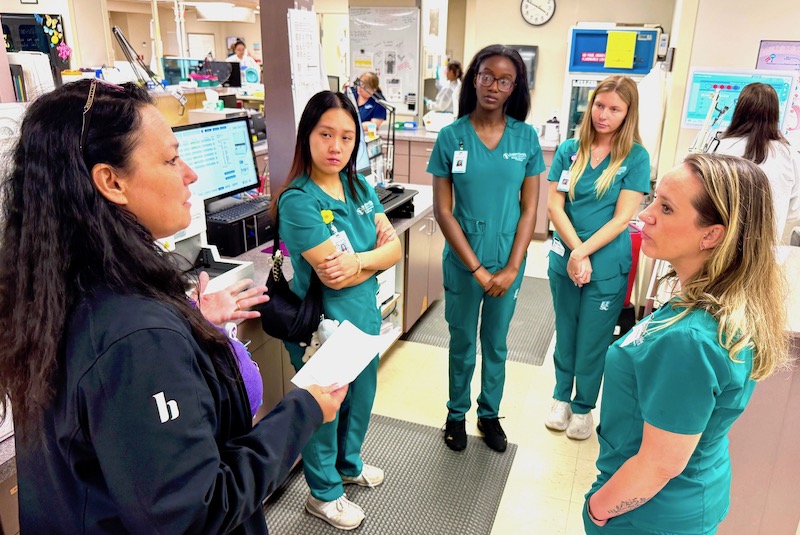
BREVARD COUNTY, FLORIDA — Health First welcomed students from Eastern Florida State College’s (EFSC) Associate Degree in Medical Laboratory Technology program into its state-of-the-art laboratories at Holmes Regional Medical Center (HRMC)—an unprecedented opportunity designed to strengthen a vital pipeline of future laboratory professionals and to give students a true first look into the day-to-day work that drives modern medicine.
While hospital laboratories operate largely behind the scenes, they are central to patient care across Health First’s Integrated Delivery Network (IDN).
More than 450 laboratory professionals process over seven million tests each year at 17 locations in Brevard County, including nine high-complexity labs within Viera, Cape Canaveral, Palm Bay and HRMC.
Earlier this year, all four Health First hospital labs earned re-accreditation from the College of American Pathologists (CAP), a widely recognized standard of excellence. 17 inspectors from CAP and HCA meticulously reviewed more than 10,000 regulatory checklist items, highlighting the critical role of diagnostic testing in guiding patient care and influencing an estimated 70 % of clinical decisions.
Against this backdrop, Health First’s decision to open its doors to Eastern Florida State College students carries extra meaning. These future laboratory technologists are preparing to enter a demanding field where precision and reliability are essential and hands-on experience is invaluable.
For Valerie Davies, MA, MT(AAB), EFSC medical laboratory technology instructor, who teaches the students in their instrumentation course, which is one of the last classes they take before starting clinicals, the tour was not just beneficial, it was essential.
“We can cover the material, we can show videos, and we can talk about the workflow all day long. But unless they see it—and they can link a specimen from collection to instrument reporting—they don’t connect all the dots. They needed this,” Davies explained.
Davies, who previously taught many of the students in microbiology [working at Health First], said the tour provided a crucial bridge between theory and application. The students will soon be stepping into clinical rotations across multiple Health First laboratories, in addition to other partner facilities.
“When they walk into a clinical lab for the first time in January, especially if they’ve never been in one before, the experience can be intimidating,” Davies said.
“Today’s visit not only gives them a feel for the layout, but it also helps remove that fear. We’re solving two problems at once: giving them exposure and preparing them for their clinicals.”
Some students are already working as lab assistants at Health First through the “Come Grow with Us” program.
This program offers students an opportunity to gain valuable experience on the job at Health First while going through school and equipping them with the skills needed to transition seamlessly into a rewarding career upon program completion.
Some students are already working as lab assistants, but several had never set foot inside a diagnostic laboratory prior to the tour — including student Lauren Machado, who begins her clinical rotations in January.
“It gives me a good perspective of what I’m walking into,” Machado said. “I didn’t want that shell-shock moment. Seeing how big the lab is, all the different sections, and how the work is divided really helped me understand what to expect.”
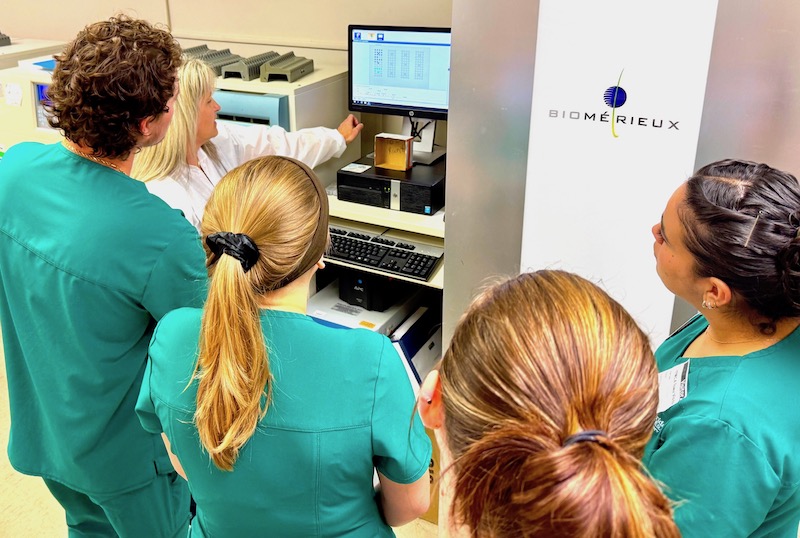
One of the highlights for students was seeing highly specialized instruments and workflows that are not commonly found in smaller hospital laboratories or their classrooms.
“A lot of hospitals don’t have instrumentation like MALDI-TOF (Matrix Assisted Laser Desorption Ionization – Time of Flight) or the level of automation and specimen handling these labs use,” Davies said.
“I wanted the students to see state-of-the-art equipment, especially in microbiology and core lab, because it broadens their understanding of what’s possible in their field.”
Beth Luna, Health First’s HRMC senior medical laboratory scientist, emphasized the importance of students observing the MALDI-TOF technology as part of Health First’s digital pathology tools, which provide exceptional accuracy and precision in tests for yeast, bacteria and fungi.
“While in college, they learn manual methods of testing, all of which are important foundational information. However, manual methods are tedious and generating results are slow. MALDI-TOF is a high throughput technology that allows us to generate lots of results with the highest level of specificity.”
Health First’s HRMC’s laboratory medicine supervisor, Andrea Brown, spoke directly to the students in specimen processing about the importance of careful work and accuracy. “It is important to utilize the power to pause and always stop and think about what you are doing,” she said.
The labs integrate advanced digital diagnostic platforms across microbiology, hematology, chemistry, transfusion services, molecular testing and more. The accuracy of these instruments—and the professionals who operate them—directly affects patient diagnoses, treatment plans, medication decisions, and ongoing monitoring.
“Every step matters,” said Jill Masloski, Health First’s HRMC senior medical lab scientist in microbiology. “From proper phlebotomy collection to specimen handling to making sure the instrument is calibrated, every detail affects the result. And those results are what physicians rely on for patient care.”
Masloski, who has worked as a laboratory scientist for more than 30 years, said collaborating with EFSC is critical to sustaining the profession.
“We’re often the unseen part of healthcare,” she said.
“People think of nursing or radiology, but the lab is the backbone of the hospital. I’ve always loved this career and I still use what I learned in college every single day. Showing students what their future looks like is incredibly important.”

Reflecting on her career, Angelica Rastegarlari, Health First chief operating officer, hospital division, said, “As someone who began my own journey in laboratory medicine as a phlebotomist and later advanced to medical lab scientist, I know firsthand the transformative power of a strong talent pipeline. That’s why we are committed to fostering sustainable pathways for our future professionals right here in Brevard County.”
Davies noted that the program at EFSC is expanding significantly. Next year’s incoming class will include 15 freshmen — one of the largest in recent years—and ensuring adequate clinical placement sites is becoming increasingly critical.
“That’s why this partnership is so valuable,” Davies said. “We have a big class coming up, and we need strong clinical affiliates like Health First. Some students will have to travel for their rotations, but being able to place students across all four Health First hospitals is a tremendous help.”
The career opportunities for graduates are diverse. Beyond hospital settings, students can work in reference labs, physician office labs, veterinary labs, research facilities, or even transition into roles in sales, education, or specialized testing.
Some go on to pursue bachelor’s degrees to expand their options further.
For Health First, the tour reinforces a long-term investment in community partnerships and in preparing future clinicians for critical roles in patient care. And as the demand for high-quality laboratory testing continues to rise — especially in a region with expanding healthcare needs—investing in the next generation of professionals is more important than ever.
Mavis P. Masuecos, Health First’s system director, laboratory medicine & pathology, stated, “Developing the next generation of laboratory professionals is a cornerstone of our long-term strategy. Strengthening partnerships with local academic institutions, such as Eastern Florida State College, will be crucial to sustaining high-quality diagnostic laboratory services in Brevard County. Investing in our workforce and establishing strong talent pipelines right here in Brevard is vital to our ongoing success.”
By giving EFSC students a firsthand look at the labs’ complexity and purpose, Health First is helping inspire the next generation of professionals who will maintain that quality for years to come.
As Davies put it, “You can’t really understand the importance of this career until you see it in action. Today, the students saw it.”
 Related Story:
HOT OFF THE PRESS! November 24, 2025 Space Coast Daily News – Brevard County’s Best Newspaper