Florida’s Space Coast Gears Up for Rapid-Fire Rocket Launches in January and February
By Space Coast Daily // January 4, 2026
missions range from routine satellite deployments to historic crewed lunar exploration and deep-space science
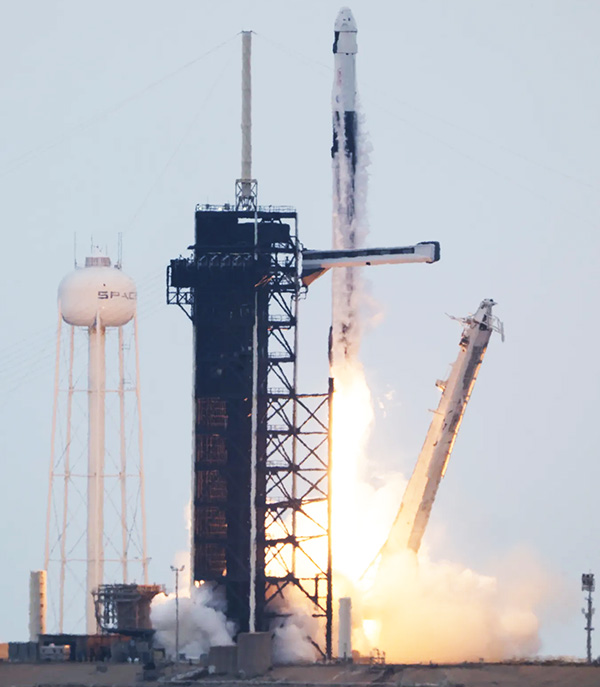
FLORIDA’S SPACE COAST – A packed launch calendar over the coming weeks and months underscores the accelerating pace of global spaceflight, with missions ranging from routine satellite deployments to historic crewed lunar exploration and deep-space science.
The next launch from Florida’s Space Coast is scheduled for no earlier than January 4, when a SpaceX Falcon 9 rocket lifts off from Space Launch Complex 40 at Cape Canaveral Space Force Station carrying 29 Starlink V2 Mini satellites.
The mission, designated Starlink 6-88, is set for 12 a.m. EST. After stage separation, the first-stage booster—flying for the first time and believed to be B1101—is expected to land about 8.5 minutes after liftoff on the drone ship A Shortfall of Gravitas in the Atlantic. The launch has been repeatedly delayed since mid-December due to schedule adjustments.
Just three days later, on January 7, SpaceX plans another Starlink mission, Starlink 6-96, with a 1:55 p.m. EST liftoff from the same launch pad. The Falcon 9 booster for this flight, B1069, will be making its 29th launch, highlighting SpaceX’s emphasis on reusability.
The booster is slated to land on the drone ship Just Read the Instructions.
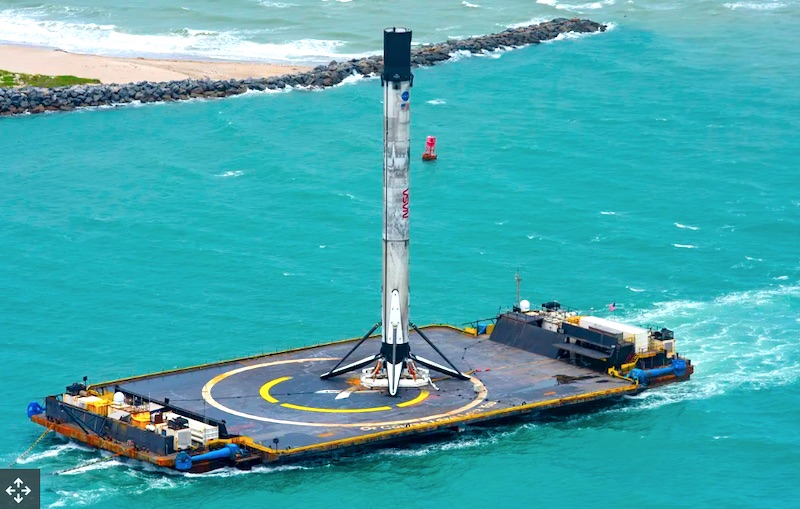
A third Starlink mission, Starlink 6-97, is currently targeted for January 10, though the launch time remains to be determined. That flight will use booster B1078 on its 25th mission, with a planned landing on A Shortfall of Gravitas.
Beyond Florida, Europe is preparing for a key test. Isar Aerospace is targeting January 12–13 for the second test flight of its Spectrum rocket from Andøya Spaceport in Norway. The launch window opens at 3 p.m. EST on January 12, and while no payload has been announced, the mission is a significant step for Europe’s emerging commercial launch sector.
In early February, attention turns to Asia and deep space exploration. On no earlier than February 1, Japan’s H3 rocket will launch the Michibiki No. 7 (QZS-7) satellite from Tanegashima Space Center, strengthening the country’s Quasi-Zenith Satellite System used for navigation services across the Asia-Pacific region.
The most closely watched mission of the winter is scheduled for no earlier than February 6, when NASA’s Space Launch System (SLS) rocket is set to launch Artemis 2 from Kennedy Space Center’s Launch Complex 39B.
The mission will mark the first crewed flight of the Artemis program, sending astronauts Reid Wiseman, Victor Glover, and Christina Koch, along with Canadian astronaut Jeremy Hansen, on a roughly 10-day lunar flyby. Their Orion spacecraft, named Integrity, is expected to splash down in the Pacific Ocean at the end of the mission.
Later in February, SpaceX will return to crewed operations with Crew-12, launching no earlier than February 15 from Cape Canaveral.
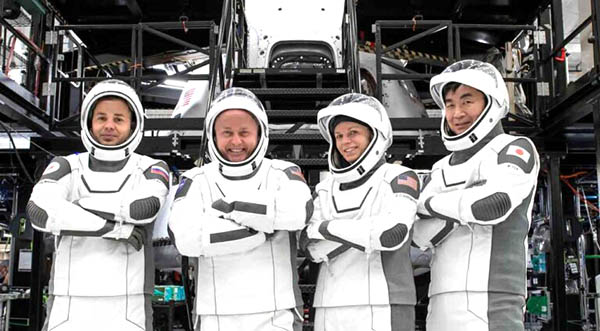
NASA astronaut Jessica Meir will command the mission aboard a Falcon 9, joined by pilot Jack Hathaway, ESA astronaut Sophie Adenot, and Roscosmos cosmonaut Andrey Fedyaev. The crew will conduct a long-duration mission aboard the International Space Station, while the booster returns to land near the launch site.
Other missions on the manifest include Russia’s delayed Proton-M launch of the Elektro-L No. 5 weather satellite, Boeing’s uncrewed Starliner-1 test flight aboard a ULA Atlas V in April 2026, and Sierra Space’s long-delayed Dream Chaser cargo spacecraft, now targeting late 2026 on a Vulcan Centaur rocket.
Looking further ahead, NASA and SpaceX are planning one of the decade’s most ambitious science missions. In July 2028, a Falcon Heavy is scheduled to launch Dragonfly, a nuclear-powered rotorcraft that will explore Saturn’s moon Titan. With a total mission cost of $3.35 billion, Dragonfly aims to search for clues about the origins of life in one of the solar system’s most intriguing environments.
Together, the missions reflect a rapidly evolving space industry—one balancing high-frequency commercial launches with landmark human exploration and robotic science that will shape spaceflight for years to come.

 Related Story:
HOT OFF THE PRESS! December 22, 2025 Space Coast Daily News – Brevard County’s Best Newspaper