PHOTO OF THE DAY: NASA’s Hubble Studies Potential Galactic Merger 14 Million Light-Years Away
By NASA information center // July 22, 2024
found in the constellation Canes Venatici
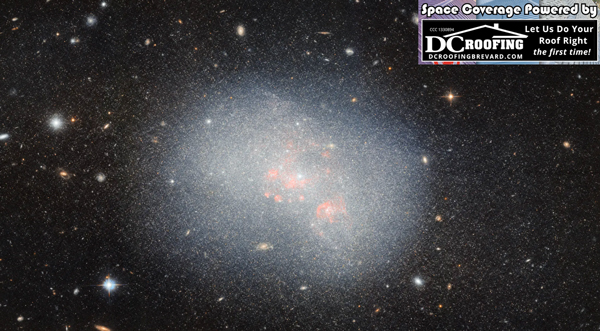

(NASA) – This NASA/ESA Hubble Space Telescope image features the dwarf irregular galaxy NGC 5238, located 14.5 million light-years from Earth in the constellation Canes Venatici.
Its unexciting, blob-like appearance resembles an oversized star cluster more than a classic image of a galaxy. Its lackluster appearance belies its complicated structure, which is the subject of much research.
As the image reveals, Hubble can pick out the galaxy’s countless stars and its associated globular clusters — glowing, bright spots both inside and around the galaxy swarmed by even more stars.
Astronomers theorize that NGC 5238 may have had a close encounter with another galaxy as recently as a billion years ago. NGC 5238’s distorted shape provides evidence for this interaction. As the two galaxies interacted, their gravity caused distortions in the distribution of stars in each galaxy.
There’s no nearby galaxy that could have caused this disturbance, so astronomers think NGC 5238 devoured a smaller satellite galaxy. Astronomers look for traces of the consumed galaxy by closely examining the population of stars in NGC 5238, a task made for Hubble’s excellent resolution.
One tell-tale sign of the smaller galaxy would be groups of stars with different properties from most of NGC 5238’s other stars, indicating they were originally formed in a separate galaxy. Another sign would be a burst of star formation that occurred abruptly at around the same time the two galaxies merged. The Hubble data used to create this image will help astronomers determine NGC 5238’s history.
Despite their small size and unremarkable appearance, it’s not unusual for dwarf galaxies like NGC 5238 to drive our understanding of galaxy formation and evolution.
One main theory of galaxy evolution is that galaxies formed ‘bottom-up’ in a hierarchical fashion: star clusters and small galaxies were the first to form out of gas and dark matter.
Over time, gravity gradually assembled these smaller objects into galaxy clusters and superclusters, which explains the shape of the largest structures we see in the universe today.
A dwarf irregular galaxy like NGC 5238 merging with a smaller companion is just the type of event that might have started the process of galaxy assembly in the early universe. Hubble’s observations of tiny NGC 5238 may help test some of our most fundamental ideas of how the universe evolves!
 Related Story:
NASA Celebrates James Webb Telescopes First Images with ‘Penguin and the Egg’ Spiral Galaxy
CLICK HERE FOR BREVARD COUNTY NEWS