WATCH REPLAY: Crewless Boeing Starliner Spacecraft Safely Returns to Earth at White Sands Space Harbor in New Mexico
By Space Coast Daily // September 7, 2024
uncrewed spacecraft will land at White Sands Space Harbor in New Mexico
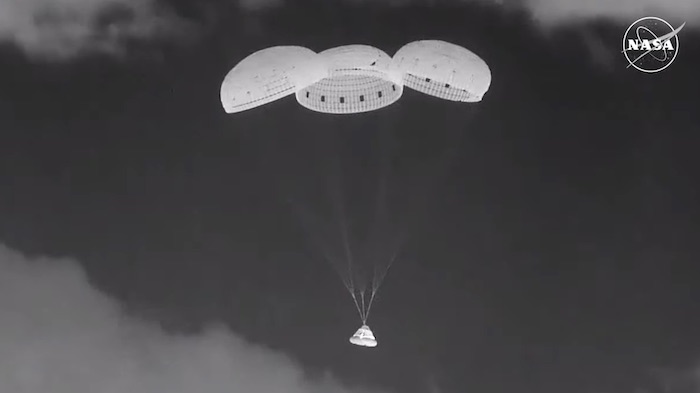
NASA and Boeing safely returned the uncrewed Starliner spacecraft following its landing at 10:01 p.m. MDT Sept. 6 at White Sands Space Harbor in New Mexico, concluding a three-month flight test to the International Space Station.
“I am extremely proud of the work our collective team put into this entire flight test, and we are pleased to see Starliner’s safe return,” said Ken Bowersox, associate administrator, Space Operations Mission Directorate at NASA Headquarters in Washington.
“Even though it was necessary to return the spacecraft uncrewed, NASA and Boeing learned an incredible amount about Starliner in the most extreme environment possible. NASA looks forward to our continued work with the Boeing team to proceed toward certification of Starliner for crew rotation missions to the space station.”
The flight on June 5 was the first time astronauts launched aboard the Starliner. It was the third orbital flight of the spacecraft, and its second return from the orbiting laboratory. Starliner now will ship to NASA’s Kennedy Space Center in Florida for inspection and processing.
NASA’s Commercial Crew Program requires a spacecraft to fly a crewed test flight to prove the system is ready for regular flights to and from the orbiting laboratory. Following Starliner’s return, the agency will review all mission-related data.
“We are excited to have Starliner home safely. This was an important test flight for NASA in setting us up for future missions on the Starliner system,” said Steve Stich, manager of NASA’s Commercial Crew Program. “There was a lot of valuable learning that will enable our long-term success. I want to commend the entire team for their hard work and dedication over the past three months.”
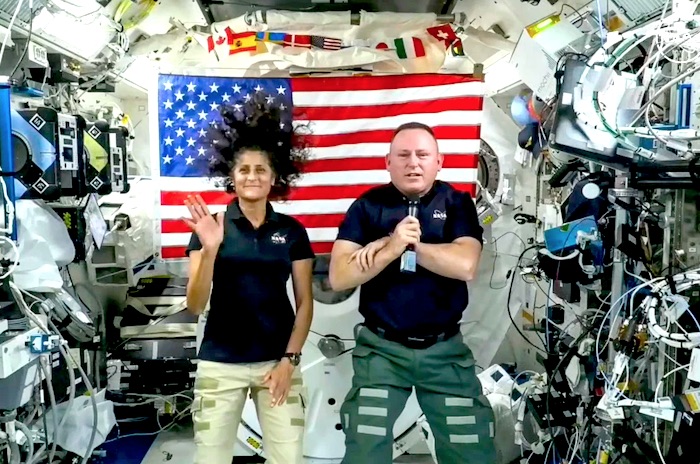
NASA astronauts Butch Wilmore and Suni Williams launched on June 5 aboard Starliner for the agency’s Boeing Crewed Flight Test from Cape Canaveral Space Force Station in Florida. On June 6, as Starliner approached the space station, NASA and Boeing identified helium leaks and experienced issues with the spacecraft’s reaction control thrusters.
Following weeks of in-space and ground testing, technical interchange meetings, and agency reviews, NASA made the decision to prioritize safety and return Starliner without its crew. Wilmore and Williams will continue their work aboard station as part of the Expedition 71/72 crew, returning in February 2025 with the agency’s SpaceX Crew-9 mission.
The crew flight test is part of NASA’s Commercial Crew Program. The goal of NASA’s Commercial Crew Program is safe, reliable, and cost-effective transportation to and from the International Space Station and low Earth orbit. This already is providing additional research time and has increased the opportunity for discovery aboard humanity’s microgravity testbed, including helping NASA prepare for human exploration of the Moon and Mars.

WATCH LIVE as Boeing’s uncrewed Starliner spacecraft leaves low Earth orbit, reenters Earth’s atmosphere, and touches down at White Sands Space Harbor in New Mexico. Starliner is scheduled to begin its deorbit burn at 11:17 p.m. EDT on Friday, Sept. 6 (0317 UTC Sept. 7), with landing scheduled for 12:03 a.m. EDT (0403 UTC) on Saturday, Sept. 7.
(NASA) – NASA astronauts Butch Wilmore and Suni Williams launched aboard Starliner on June 5 for its first crewed flight, arriving at the International Space Station on June 6.
As Starliner approached the orbiting laboratory, NASA and Boeing identified helium leaks and experienced issues with the spacecraft reaction control thrusters. For the safety of the astronauts, NASA announced on Aug. 24 that Starliner would return to Earth from the station without a crew.
Wilmore and Williams will remain aboard the station and return home in February 2025 on the SpaceX Dragon spacecraft as part of NASA’s SpaceX Crew-9 mission.
Following Starliner’s return to Earth, a post-landing news conference is scheduled for 1:30 a.m. EDT.
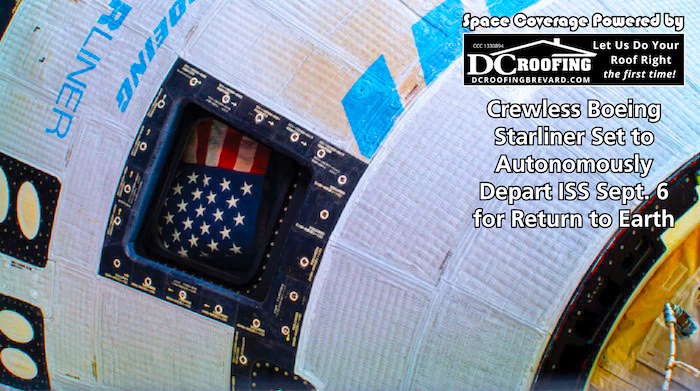
(NASA) – Boeing’s Starliner spacecraft is scheduled to autonomously undock from the International Space Station at approximately 6:04 p.m. EDT Friday, Sept. 6, to begin the journey home, weather conditions permitting. NASA and Boeing are targeting approximately 12:03 a.m., Saturday, Sept. 7, for the landing and conclusion of the flight test.
The uncrewed spacecraft will depart from the orbiting laboratory for a landing at White Sands Space Harbor in New Mexico.
NASA’s live coverage of return and related activities will stream on NASA+, the NASA app, and the agency’s website. Learn how to stream NASA programming through a variety of platforms including social media.
Ahead of Starliner’s return, NASA will host a pre-departure news conference at 12 p.m., Wednesday, Sept. 4, from the agency’s Johnson Space Center in Houston. NASA’s Commercial Crew and International Space Station Program managers and a flight director will participate.
NASA astronauts Butch Wilmore and Suni Williams launched aboard Boeing’s Starliner spacecraft on June 5 for its first crewed flight, arriving at the space station on June 6. As Starliner approached the orbiting laboratory, NASA and Boeing identified helium leaks and experienced issues with the spacecraft reaction control thrusters.
For the safety of the astronauts, NASA announced on Aug. 24 that Starliner will return to Earth from the station without a crew. Wilmore and Williams will remain aboard the station and return home in February 2025 aboard the SpaceX Dragon spacecraft with two other crew members assigned to NASA’s SpaceX Crew-9 mission.
NASA’s coverage is as follows (all times Eastern and subject to change based on real-time operations):
■ Friday, Sept. 6
5:45 p.m. – Undocking coverage begins on NASA+, the NASA app, YouTube, and the agency’s website.
6:04 p.m. – Undocking
10:50 p.m. – Coverage resumes for deorbit burn, entry, and landing on NASA+, the NASA app, YouTube, and the agency’s website.
■ Saturday, Sept. 7
12:03 a.m. – Targeted landing
1:30 a.m. – Post-landing news conference with the following participants:
• Joel Montalbano, deputy associate administrator, Space Operations Mission Directorate at NASA Headquarters in Washington
• Steve Stich, manager, Commercial Crew Program, NASA Kennedy Space Center in Florida
• Dana Weigel, manager, International Space Station, NASA Johnson
• John Shannon, vice president, Boeing Exploration Systems
• Mark Nappi, vice president and program manager, Boeing Commercial Crew Program
WATCH: NASA leadership hosted a live news conference on Saturday, Aug. 24 at the agency’s Johnson Space Center in Houston to give a status update about NASA’s Boeing Crew Flight Test. NASA will return Boeing’s Starliner to Earth without astronauts Butch Wilmore and Suni Williams aboard the spacecraft, the agency announced Saturday. (NASA video)
NASA and Boeing identified helium leaks and experienced issues with the spacecraft reaction control thrusters on June 6 as Starliner approached the space station.
NASA will return Boeing’s Starliner to Earth without astronauts Butch Wilmore and Suni Williams aboard the spacecraft, the agency announced Saturday. The uncrewed return allows NASA and Boeing to continue gathering testing data on Starliner during its upcoming flight home, while also not accepting more risk than necessary for its crew.
Wilmore and Williams, who flew to the International Space Station in June aboard NASA’s Boeing Crew Flight Test, have been busy supporting station research, maintenance, and Starliner system testing and data analysis, among other activities.
“Spaceflight is risky, even at its safest and most routine. A test flight, by nature, is neither safe, nor routine. The decision to keep Butch and Suni aboard the International Space Station and bring Boeing’s Starliner home uncrewed is the result of our commitment to safety: our core value and our North Star,” said NASA Administrator Bill Nelson.
“I’m grateful to both the NASA and Boeing teams for all their incredible and detailed work.”
Wilmore and Williams will continue their work formally as part of the Expedition 71/72 crew through February 2025. They will fly home aboard a Dragon spacecraft with two other crew members assigned to the agency’s SpaceX Crew-9 mission. Starliner is expected to depart from the space station and make a safe, controlled autonomous re-entry and landing in early September.
NASA and Boeing identified helium leaks and experienced issues with the spacecraft reaction control thrusters on June 6 as Starliner approached the space station.
Since then, engineering teams have completed a significant amount of work, including reviewing a collection of data, conducting flight and ground testing, hosting independent reviews with agency propulsion experts, and developing various return contingency plans.
The uncertainty and lack of expert concurrence does not meet the agency’s safety and performance requirements for human spaceflight, thus prompting NASA leadership to move the astronauts to the Crew-9 mission.
“Decisions like this are never easy, but I want to commend our NASA and Boeing teams for their thorough analysis, transparent discussions, and focus on safety during the Crew Flight Test,” said Ken Bowersox, associate administrator for NASA’s Space Operations Mission Directorate.
“We’ve learned a lot about the spacecraft during its journey to the station and its docked operations. We also will continue to gather more data about Starliner during the uncrewed return and improve the system for future flights to the space station.”
Starliner is designed to operate autonomously and previously completed two uncrewed flights. NASA and Boeing will work together to adjust end-of-mission planning and Starliner’s systems to set up for the uncrewed return in the coming weeks. Starliner must return to Earth before the Crew-9 mission launches to ensure a docking port is available on station.
“Starliner is a very capable spacecraft and, ultimately, this comes down to needing a higher level of certainty to perform a crewed return,” said Steve Stich, manager of NASA’s Commercial Crew Program.
“The NASA and Boeing teams have completed a tremendous amount of testing and analysis, and this flight test is providing critical information on Starliner’s performance in space. Our efforts will help prepare for the uncrewed return and will greatly benefit future corrective actions for the spacecraft.”
NASA’s Commercial Crew Program requires spacecraft fly a crewed test flight to prove the system is ready for regular flights to and from the space station. Following Starliner’s return, the agency will review all mission-related data to inform what additional actions are required to meet NASA’s certification requirements.
The agency’s SpaceX Crew-9 mission, originally slated with four crew members, will launch no earlier than Tuesday, Sept. 24. The agency will share more information about the Crew-9 complement when details are finalized.
NASA and SpaceX currently are working several items before launch, including reconfiguring seats on the Crew-9 Dragon, and adjusting the manifest to carry additional cargo, personal effects, and Dragon-specific spacesuits for Wilmore and Williams.
In addition, NASA and SpaceX now will use new facilities at Space Launch Complex-40 at Cape Canaveral Space Force Station in Florida to launch Crew-9, which provides increased operational flexibility around NASA’s planned Europa Clipper launch.
The Crew-9 mission will be the ninth rotational mission to the space station under NASA’s Commercial Crew Program, which works with the American aerospace industry to meet the goal of safe, reliable, and cost-effective transportation to and from the orbital outpost on American-made rockets and spacecraft launching from American soil.
For more than two decades, people have lived and worked continuously aboard the International Space Station, advancing scientific knowledge and demonstrating new technologies, making research breakthroughs not possible on Earth.
The station is a critical testbed for NASA to understand and overcome the challenges of long-duration spaceflight and to expand commercial opportunities in low Earth orbit. As commercial companies focus on providing human space transportation services and destinations as part of a robust low Earth orbit economy, NASA’s Artemis campaign is underway at the Moon where the agency is preparing for future human exploration of Mars.

About the Astronauts
Are Butch and Suni stuck on the space station?
No, Butch and Suni are safe aboard the space station working alongside the Expedition 71 crew. They also have been actively involved in Starliner testing and technical meetings. Butch and Suni could return home aboard Starliner if an emergency arises. The agency also has other return options available, if needed, for both contingency and normal returning planning.
Are Suni and Butch prepared for a longer stay on the station?
Butch and Suni each have previously completed two long-duration stays aboard the station. NASA astronauts embark on missions fully aware of the various scenarios that may become reality. This mission is no different, and they understood the possibilities and unknowns of this test flight, including being aboard station longer than planned.
How long would an extended stay for Butch and Suni compare to other space station mission lengths?
A typical stay aboard the International Space Station is about six months, and NASA astronauts also have remained on the space station for longer duration missions. Previous missions have given NASA volumes of data about long-duration spaceflight and its effects on the human body, which the agency applies to any crew mission.
Do the astronauts have what they need (e.g., food, clothing, oxygen, personal items, etc.)?
Yes. The International Space Station is well-stocked with everything the crew needs, including food, water, clothing, and oxygen. Additionally, NASA and its space station partners frequently launch resupply missions to the orbiting complex carrying additional supplies and cargo.
Recently, a Northrop Grumman Cygnus spacecraft carrying 8,200 pounds of food, fuel, supplies, and science and a Progress resupply spacecraft carrying three tons of cargo arrived at the station. NASA has additional SpaceX resupply missions planned through the end of 2024.
What are they doing aboard the space station?
The crew continues to monitor Starliner’s flight systems and gather performance data for system certification. NASA also is taking advantage of Butch and Suni’s extra time aboard the orbital laboratory, where they have completed various science experiments, maintenance tasks, and assisted with spacewalk preparations. Some of the science they’ve recently completed includes new ways to produce fiber optic cables and growing plants aboard the orbiting complex.
Can they talk to their family and friends?
Butch and Suni enjoy many of the same comforts we have here on Earth. They can email, call, and video conference with their family and friends when they have “free time” aboard the International Space Station.

About the Return Plan
What are the other options for bringing Butch and Suni back?
NASA has two unique American space transportation systems capable of carrying crew to and from station. Although no decisions have been made, NASA is considering several options to return Butch and Suni from the space station, including returning aboard Starliner, if cleared, or as part of agency’s SpaceX Crew-9 mission in February 2025.
Is it safer to bring them home aboard a SpaceX Dragon?
Crewed test flights are inherently risky, and although rotation missions may seem routine, they also are not without risk. It is NASA’s job to evaluate that risk and determine whether it is acceptable for crew ahead of each flight.
What other steps is NASA taking to bring them home?
NASA adjusted SpaceX Crew-9 launch and the agency’s SpaceX Crew-8 return, allowing more time to finalize Starliner return plans. NASA also is looking at crew assignments to ensure Butch and Suni can return with Crew-9, if needed.
 Related Story:
HOT OFF THE PRESS! August 12, 2024 Space Coast Daily News – Brevard County’s Best Newspaper