Baseball ‘Archaeologists’ Uncover Priceless Long Lost Game-Used Bats of the 1950s in Cocoa Garage
By Tom Palermo, President & Publisher // October 27, 2024
CELEBRATING AMERICA'S RICH BASEBALL HISTORY

 Related Story:
Fox News Spotlights Brevard County Resident and Hospitality Visionary Jimmy Palermo as Originator of the Sports Bar
BREVARD COUNTY, FLORIDA – The year was 2004, and it was your classic American holiday gathering: The bounty was plentiful, multiple generations of family and friends were assembled – and casual discussion around the table alternated between Thanksgivings past and current affairs, such as politics, entertainment, and sports.
After a short exchange about who might be the front-runner to win the Heisman Trophy, our sports discussion turned to baseball – as it inevitably did.

We discussed the unlikely sweep of the Cardinals in the World Series by the Red Sox.
Then the tone turned more somber as the conversation gravitated to the headline news of the day – the steroid scandal involving high-profile major league players, including career home run king heir apparent Barry Bonds.
As we moved from the dining room to the kitchen table to enjoy dessert and coffee, Dad, who was 85 at the time, launched into a discourse about the absolute mismanagement and disarray of his beloved game.
EDITOR’S NOTE: Vincent “Jimmy” Palermo died December 1, 2010, at age 90 after moving to Brevard County, Florida, with his wife Nadine from St. Louis, Missouri in 1986. SEE OBITUARY HERE
My brother Jim and I looked at each other knowingly and moved our chairs closer to the table to hear what he had to say because of our father’s first-hand experience and perspective of the game that few living human beings at the time had.
From the time he was six years old in 1927 until just before World War II in 1941, Dad was part of the St. Louis Browns organization.
His first job with the Browns was as the team’s mascot. At the age of nine, he was made the batboy, and by 16, he was managing the visitor’s clubhouse at Sportsman’s Park, home to both the Browns and Cardinals.
 Related Story:
The Decline of Lou Gehrig and Rise of Ted Williams: Seven Unforgettable Days In May 1939

My father’s recollections of how baseball was almost 80 years ago have not been clouded by living through the Great Depression, fighting as a medic in Europe during World War II, and raising four children with my mother, Nadine.

Upon returning from the war, my Dad had to give up a promising professional umpiring career to assist his ailing father in the family businesses.
Among the family’s holdings was a neighborhood tavern across the street from Sportsman’s Park. The tavern opened in 1923 and was also the family homestead for four decades.
The tavern, located at the intersection of Spring and Sullivan Avenues and adjacent to the left-field gates of Sportsman’s Park, is America’s Original Sports Bar.
As early as 1946, patrons gathered every Friday night to watch the fights on the newest technology – a 12-inch Farnsworth television.
In the early 1950s, the tavern was remodeled and decorated with game-used equipment from all 16 major league teams, including uniforms, caps, gloves, balls, and hundreds of cracked bats brought over from the ballpark by a good friend of Dad’s who worked as a batboy for the Browns and Cardinals from 1950-1955.
Players, managers, and coaches from both leagues frequented the establishment – mainly for my grandmother’s cooking – and, during prohibition, my grandfather’s homemade wine.
During our passionate conversation about the condition of the game, my brother and I, who are products of the Baby Boom Era and have our baseball perspective rooted in the 1950s and 1960s, made the case that Aaron, Musial, Mays, Snider, Mantle, Williams and Banks would have hit perhaps 800 or more home runs if they had taken performance-enhancing substances.
Dad, showing his age and ever the Babe fan, said Ruth would have hit 1,000.
The conversation then became a discourse on the history and culture of baseball and how the game has degenerated into nothing more than a bunch of spoiled cartoon characters (commissioner, players, owners, and agents) who have little regard for the game and even less for the fans. We all yearned for the time when it was a game.
My mother, Nadine, listening on the periphery as she tended to her two-year-old granddaughter, made a comment about “those old bats.”
Almost in unison, my brother Jim and I asked, “Whatever happened to those bats!?”
Mom replied that she had packed them up in a refrigerator box sometime in the early 1960s and had the movers put them “somewhere” in the garage after relocating to Florida from St. Louis in 1985.
Neither my brother nor I had seen those bats in more than 40 years, but we vividly remembered when they adorned the tavern walls on Sullivan Avenue. Our curiosity led us to agree to head over to our parents’ house early the next morning to check it out.

‘OH MY GOD!’
Upon arriving the following morning, Mom had coffee ready, but we made a beeline for the garage. The area was more of a storage room than a garage. The roll-up door hadn’t been open for at least 15 years, and, to our chagrin, the single light fixture was out of order.
Mom came up with a well-used flashlight, and we started moving boxes and crates around, looking for the bat box in semi-darkness. We finally uncovered the old refrigerator box behind a wall of smaller boxes and hanging clothes.
The bat box was bound by twine and dried-out masking tape.
While cutting the twine and ripping away what was left of the tape holding the box closed, by the dull light of a single flashlight, we joked that this must have been what it was like for Howard Carter when he discovered King Tut’s tomb deep inside the Egyptian desert.
Jim pulled the well-packed bats out of their container one at a time, and in the darkened garage, he passed them to me over the wall of boxes to take inventory.
I was stunned.
“Oh my God, Jim, here’s a Snider! Holy smokes, look here’s Aaron, Big Klu, Hodges, Handsome Ransom, Musial and Mays too!”
Mom, hearing the ruckus, stuck her head in the garage to see if everything was OK.
After a cursory but high-spirited inspection of several bats, we quickly decided it was too dark in the garage to give our rediscovered treasures the proper examination they deserved.
INTO THE LIGHT
It was out of the question to move the entire box because it was much too bulky, so we brought them into Mom and Dad’s sun-drenched Florida Room two at a time until 42 bats were lying in neat rows on the floor – labels up.
Dad, just arising, walked into the room, coffee in hand, and surveyed the bats.

“I see you guys didn’t waste any time,” he said.
As my brother and I gave him a briefing about our “who’s who” lineup of ’50s baseball, he reached down and picked up “The Man’s” bat – the only unbroken one in the lot.
“I remember when Freddie brought this bat over to the saloon,” he said. “This is a bat Musial used the day he hit five home runs.”
Freddie Buchholtz was the Cardinal batboy that day in May 1954 when Stan Musial hit five home runs during a doubleheader, and Dad knew him well through his longtime connections at the ballpark and the tavern.
Seeing and touching the bats must have jogged his memory as Dad recalled there were “a bunch” of photos, letters, and notes somewhere that chronicled his days in baseball from the beginning. Mom, ever the pack rat, said they were probably in some of those boxes we had already moved around, so back to the dark garage we went.
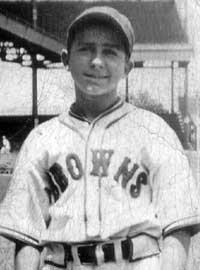
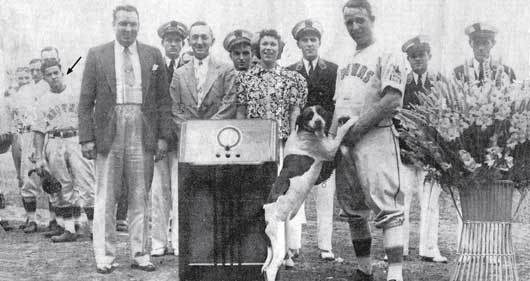
Grabbing about a dozen boxes, we brought them all into the bright light of day – but the contents were even more illuminating: Newspaper clippings with Dad’s photos from the 20s and 30s out of the St. Louis Daily Globe-Democrat; old photos of Dad in a Browns uniform, and sitting at Goose Goslin’s feet in the Brown’s 1931 team photo; Dad in San Antonio during the Brown’s spring training in 1938; and Dad during his professional umpiring career before the war.
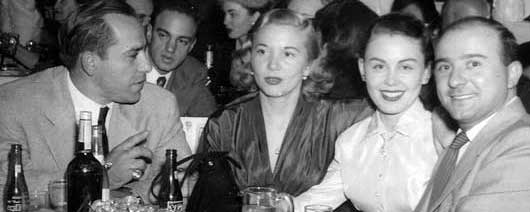
There were also letters of recommendation from Brown’s owner, William DeWitt, to the War Department for Dad to go to Officer Candidate School and a photo of Mom and Dad with my mom’s sister, Carmen Berra, and her husband, Yogi, at the Copacabana Club in New York City in 1952.
And then, there was the jackpot – notes about the bats and other artifacts, which we found out later we unfortunately no longer had, such as Rogers Hornsby’s baseball shoes, Roy Campanella’s mitt, an original Pirate batting helmet, various uniforms and a lot more.
We also discovered signed scorecards from the 1950s and 1960s, old Brownie and Cardinal original headshot photos that once hung in the tavern, a picture taken by Dad of Musial, Red Schoendienst, Uncle Yogi and Joe Louis, an original reel of 16 mm film of the 1950 World Series, a signed baseball from the 1964 series, and more.

As we read Dad’s notes, Jim and I realized that this collection and the combination of bats at our feet were significant baseball artifacts from an era gone by.
For years, we talked about writing a book featuring the many fascinating stories about the “Golden Age” of baseball in the 1920s and 1930s, which we had heard from Dad all our lives.
This rediscovered group of game-used bats from the 1950s provided us another platform and incentive to share our stories and passion for our national pastime, thus WhenItWasaGame.net was born.

ABOUT THE AUTHOR
A Brevard County, Florida, resident for the past 40 years, Tom Palermo has more than 42 years of experience in the media business as a publisher, editor, and industry consultant. During his career in corporate and small business entrepreneurial environments, he has founded dozens of local, state, regional, and national print and digital publications.
Palermo has written thousands of articles and columns for daily and weekly newspapers, magazines, trade publications, and websites and hosted a weekly radio talk show for seven years.
In 2005, Palermo founded Maverick Multimedia, Inc., which specializes in media-specific IT development, niche multimedia, and custom publishing, and devising comprehensive strategic business and digital marketing plans.
Maverick Multimedia, Inc. is a Brevard County, Florida-based company that includes properties in digital marketing, publishing, special events and production, sports management, hospitality, and business/marketing consulting. Among the company’s holdings are SpaceCoastDaily.com and Space Coast Daily magazine.
He is the proprietor of the website WhenItWasAGame.net, founded in 2004 to celebrate the Palermo family’s rich baseball history. The site’s themes and content are dedicated to recalling, celebrating, and preserving our baseball heritage.

 Related Story:
HOT OFF THE PRESS! Oct. 28, 2024 Space Coast Daily News – Brevard County’s Best Newspaper
CLICK HERE FOR BREVARD COUNTY NEWS