
BREVARD HISTORY: 1715 Silver Fleet Wreck Lost in Hurricane Between Present-Day Melbourne Beach and Vero Beach
By Space Coast Daily // January 9, 2025
survivors were stranded On Brevard beaches
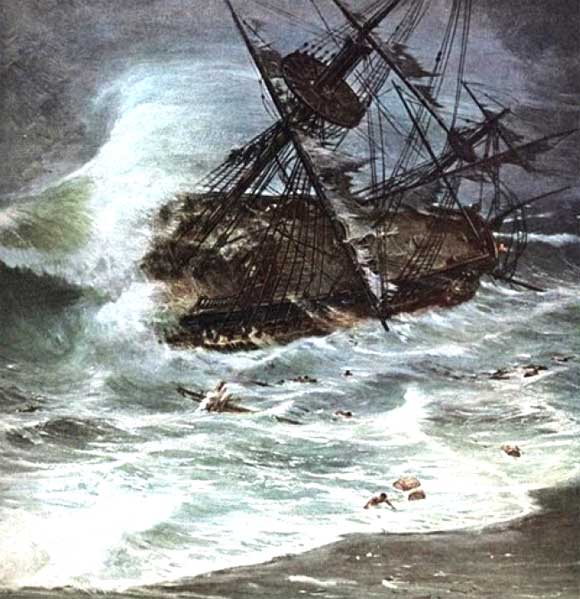
BREVARD COUNTY, FLORIDA – Early on the morning of July 31, 1715, an event took place along Florida’s east-central coast that shook the royal courts of Europe.
At approximately 4 a.m., a powerful hurricane struck Spain’s plate (from “plata,” the Spanish word for “silver”) fleet and wrecked it on Florida’s “coast of the Ays,” between present-day Melbourne Beach and Vero Beach.
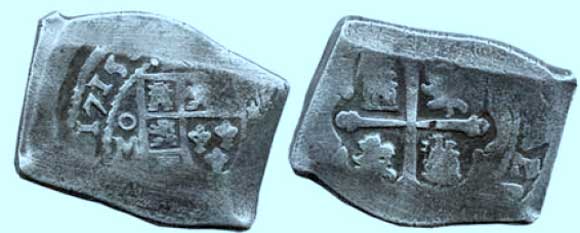
Eleven vessels, an estimated 15 million silver pesos in treasure – along with the cargo of gold, jewels, spices, tobacco, porcelain, etc. – and over 1,000 lives were lost in the disaster, which left some 1,500 survivors stranded along the Florida coast south of Cape Canaveral.
The 1715 loss of Spain’s annual plate fleet on Florida’s coast triggered economic chaos and collapse across Europe and its New World empires.
During that early morning in July 1715, the Spanish treasure fleet was caught by a severe hurricane while exiting the Bahama Channel. As a result, 11 ships of the fleet were either sunk or foundered on reefs along the Florida coast.
With the end of the War of Spanish Succession in 1714, the Spanish Crown desperately needed funds. No major shipment of goods from Spain’s New World colonies had been undertaken during the War, so a fleet of galleons was organized to visit various ports of call around the Spanish Main to gather Royal and private treasure to be shipped to Cadiz.
Since most goods consisted of silver coins and bullion, the venture was dubbed the Spanish Plata (Silver) Fleet. Due to numerous delays, the fleet of 12 ships didn’t leave Havana harbor until July 27, 1715, well into hurricane season.
The voyage began with fair weather, but the ships encountered contrary northeasterly winds once they turned north into the Bahama Channel. As the winds strengthened, the fleet was forced to crawl and tacked into the wind in the narrow channel.
A French ship, the Grifon, forced by security concerns to sail with the fleet, made good time and broke with the fleet to speed ahead to a rendezvous point off the Carolinas. But the heavy-laden Spanish ships were left to lumber on, and they began to experience the signs of an oncoming hurricane.
Captain General Don Juan Esteban de Ubilla found himself trapped between the uninhabited, reef-strewn Florida shore to his west and the shallow, English pirate-strewn Bahama Bank to his east and had no choice but to try to clear the Channel before the worst of the storm struck.
It was a race he lost, and the hurricane overtook the fleet just as it emerged from the Channel.
Three ships were sunk in deep water; the other eight were driven onto the Florida east coast, where they wrecked upon rocks and reefs.
Story continued below>>>

Of the 2,500 sailors and passengers, 1,000 perished in the storm, including Ubilla. The rest struggled for survival on an inhospitable coast.
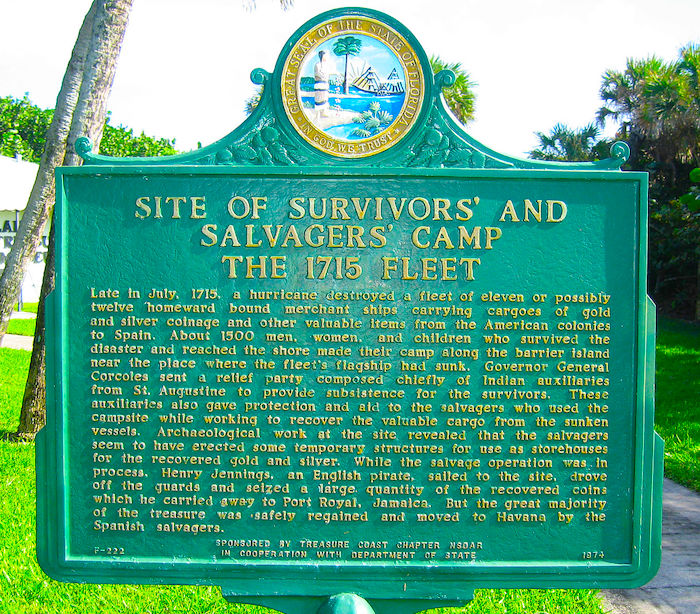
Two boats were salvaged from the wrecks and were sent for help, one to St. Augustine and the other back to Havana. Most of the survivors were rescued, and salvage operations were begun almost immediately.
Meanwhile, the Grifon made Brest, France, by September 2, unaware of the fate of the rest of the fleet.
Much of the treasure was recovered and shipped to Spain. But word of the disaster reached English ears, and privateer Henry Jennings carried out a daring raid on the Spanish salvage camps, claiming what treasure they had stored for shipment home.
Eventually, the Spanish abandoned salvage operations, and English opportunists occupied their camps to claim what was left in the wrecks. When the pickings became slim, even the English left the site.
The memory of the wrecks eventually fell from common knowledge. It wasn’t until the early 1940s that amateur archeologist Charles Higgs discovered evidence of the salvage camps in the dunes near the Sebastian Inlet.
Later, work by the Florida Park Service associated the camps with the Silver Fleet wrecks. A passing hurricane in 1955 washed away some dunes around the camps, revealing many artifacts and silver coins.
This touched off renewed salvage efforts by local builder Kip Wagner and his Real 8 Company. They eventually recovered thousands of coins, pieces of jewelry, and several cannons. The discovery led to the establishment of a state park and museum.
 Related Story:
HOT OFF THE PRESS! Dec. 23, 2024 Space Coast Daily News – Brevard County’s Best Newspaper















