How to Choose a Flat Roof Solar Mounting System Under European Renewable Energy Policies?
By Space Coast Daily // July 23, 2025

Europe maintains global leadership in the renewable energy transition, with photovoltaic technology serving as a key driver. In 2024, the share of electricity generated from renewable sources in the EU[1] reached a record high of 46.9%. This achievement is attributed to the EU’s ambitious climate goals and policy framework, which create unprecedented opportunities for the deployment of commercial and industrial (C&I) solar power.
Under Europe’s strict renewable policies and building codes, compliant flat-roof solar mounting systems are crucial for safe, reliable, and cost-effective C&I PV projects. Given the regulatory complexity, varied climates, and architectural requirements across member states, selecting a suitable flat-roof solar mounting system requires a thorough understanding of both policy frameworks and technical specifications.
European Renewable Energy Policies and Building Regulations
-
EU Fit for 55[2]
The “Fit for 55” climate policy package, formally enacted by the European Commission on July 14, 2021, as a core instrument to achieve the European Green Deal, has been fully implemented through the legislative process by the end of 2023. The package establishes a binding target for the EU to reduce greenhouse gas emissions by a minimum of 55% below 1990 levels by 2030 while also raising the renewable energy target in the overall energy mix from 32% to 42.5%. This has created substantial demand for high-efficiency solar installations, especially for flat-roof solar mounting systems.
-
REPowerEU Plan[3]
In response to the energy security crisis, the REPowerEU plan, launched in 2022, has significantly accelerated the deployment of renewable energy.
The strategy aims for renewables to comprise 45% of the EU’s energy portfolio by 2030, with a particular focus on solar panels on flat roofs as a form of decentralized energy.
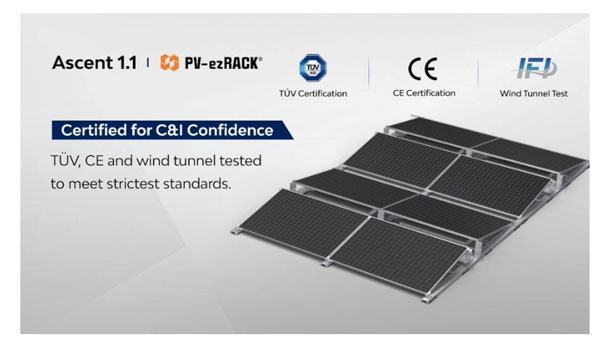
The plan also introduces a licensing exemption for rooftop photovoltaic projects below 1 MW, simplifying the approval process and reducing administrative burdens. However, it simultaneously strengthens certification standardization requirements. Flat roof solar mounting systems must hold both the EU CE certification and country-specific certifications (such as Germany’s VDE-AR-N 2100). This dual compliance requirement has prompted manufacturers to develop solar mounting solutions that can adapt to multiple national standards.
-
Energy Performance of Buildings Directive (EPBD)[4]
According to the EPBD, all new public and commercial buildings with a floor area of more than 250 m2 must install rooftop solar systems by 2026, while existing commercial buildings are required to complete retrofitting by 2027[5]. This regulation has created a surge in demand for standardised types of solar mounting systems, especially those that meet rapid deployment conditions, such as pre-assembled components and tool-based installation interfaces, to adapt to the time requirements of large-scale promotion.
Notably, this stipulation now forms part of European construction law following the EPBD’s recent modification, making photovoltaic systems a mandatory element in building retrofits.
Benefits of Installing Flat-roof Solar Mounting Systems
-
Subsidies and Tax Incentives
Many EU countries offer financial support for flat-roof solar mounting systems in the form of subsidies, tax credits, and investment grants. These subsidies include direct funding and reduced value-added tax (VAT). However, these incentives often come with conditions, such as the requirement to use certified and compliant components. In addition, some countries have implemented net metering policies, which permit businesses to sell excess electricity back to the grid, thereby further enhancing the return on investment.
-
Grid Connection and Approval Process
The EU is pushing countries to simplify, standardise, and digitalise the grid connection process for PV systems. For small-scale systems, most countries only require notification to the grid operator after installation for grid connection; large-scale systems, however, need to apply in advance and undergo a technical assessment, but the approval period is strictly limited, usually not exceeding 45 days.
Renewable energy projects like solar mounting systems for flat roofs are granted priority access to the grid, and grid companies are required to provide connection solutions.
Factors in Choosing Flat-roof Solar Mounting Systems
-
Complete Certification
- CE certification ensures the flat-roof solar mounting system complies with relevant European standards for mechanical strength, electrical safety, and environmental protection.
- TÜV certification confirms the system has passed rigorous tests for quality and safety, including load-bearing capacity, corrosion resistance, and long-term durability.
- ISO 9001 and 14001 certifications demonstrate stable product quality and environmentally compliant production processes.
-
Roof Adaptability
Flat roofs come in various types, such as concrete, asphalt, and metal, each with its own characteristics and challenges. The flat roof mounting system for PV panels must be able to adapt to different roof types without causing damage to the roof structure.
-
Installation Efficiency and Cost
A solar mounting system for flat roofs that facilitates straightforward installation and rapid deployment can cut down on labor expenses and compress project durations. Modular and pre-assembled mounting systems can minimize the need for on-site fabrication.
Additionally, the weight and size of the mounting system components can affect transportation and handling costs. Lightweight and compact systems are generally better.
-
Long-term Maintenance and Warranty
A high-quality flat-roof solar mounting system should be built to last, with minimal upkeep needs and comprehensive warranty coverage. It should be resistant to corrosion, UV radiation, and other environmental factors to prevent degradation.
Flat-roof Solar Mounting System from Clenergy
Clenergy PV-ezRack Ascent 1.1 is a flat-roof solar mounting system specifically designed for the unique architectural characteristics of Europe, with comprehensive certification and qualification:
- The system offers a variety of geometric shape options to maximise energy output. Tested in a boundary layer wind tunnel, its aerodynamically optimised structure reduces ballast requirements while ensuring optimal ventilation.
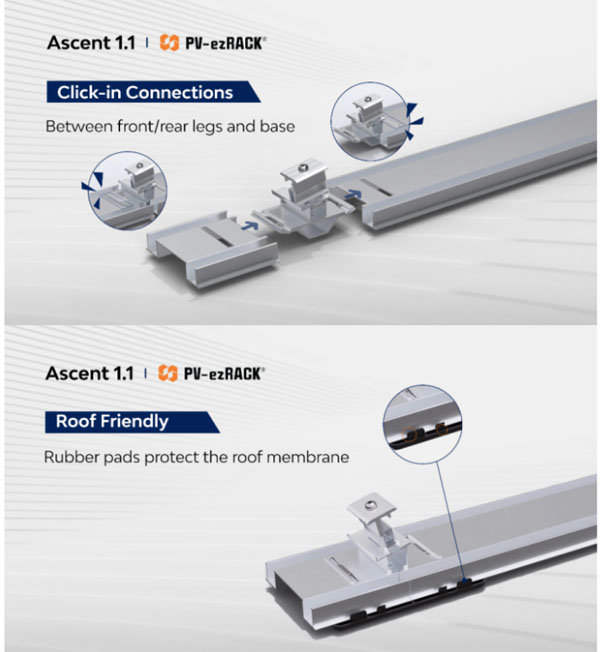
- The click-in technology allows for easy installation of the base rails without the need for tools. Equipped with protective rubber pads and optimised support surfaces, the system minimises impact on roof membranes while ensuring secure contact. This roof-friendly design enables broad compatibility with flat foil, asphalt, and concrete roofs.
- Additionally, pre-assembled middle and end clamps with legs reduce the number of stock-keeping units (SKUs), thereby saving on storage and handling costs.

Conclusion
As Europe accelerates its energy transition, investing in a certified, high-quality solar mounting system is critical to maximising ROI, ensuring regulatory compliance, and contributing to a sustainable future. Clenergy PV-ezRack Ascent 1.1 meets stringent safety, durability, and installation standards while aligning with Europe’s decarbonization goals.
Ready to optimise your solar project? Explore the Clenergy flat-roof solar mounting system today.