THIS DAY IN SPACE COAST HISTORY: NASA Born 67 Years Ago Amid Cold War and Sputnik 1 Fears, Puts Brevard on Global Map
By Space Coast Daily // July 29, 2025
National Aeronautics and Space Act signed into law by President Dwight D. Eisenhower on July 29, 1958
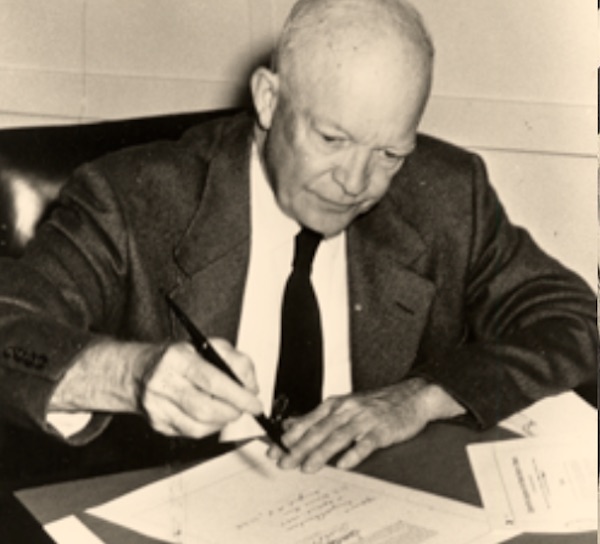
BREVARD COUNTY • SPACE COAST OF FLORIDA — A pivotal moment in American and Brevard County history unfolded as President Dwight D. Eisenhower signed the National Aeronautics and Space Act into law, officially establishing the National Aeronautics and Space Administration—NASA.
Born out of Cold War anxieties and a rapidly escalating technological rivalry with the Soviet Union, the agency would go on to become the backbone of the United States’ exploration of outer space.
The launch of the Soviet satellite Sputnik 1 on October 4, 1957, sent shockwaves through the United States.
Weighing just 184 pounds and about the size of a beach ball, the satellite was small in scale but massive in geopolitical implications. It was the first human-made object to orbit the Earth, and it demonstrated Soviet capabilities that the American public and political leadership had not fully anticipated.
At the heart of the alarm was the fear that if the Soviet Union could launch a satellite into space, it might also have the ability to launch intercontinental ballistic missiles armed with nuclear warheads from Europe to the U.S. homeland.
The so-called “Sputnik crisis” not only ignited a panic over a possible missile gap but also served as a wake-up call to boost American investment in science, engineering, and defense technology.

In response, the U.S. government moved swiftly to consolidate and coordinate the nation’s aerospace efforts.
The result was the National Aeronautics and Space Act, passed by Congress and signed into law on July 29, 1958. The act transformed the National Advisory Committee for Aeronautics (NACA)—a 43-year-old organization that had previously led research in aeronautical engineering—into the core of the new space agency.
NASA officially began operations on October 1, 1958, with a mandate to lead the nation’s civilian space program and conduct peaceful space exploration. From the start, the agency inherited a number of existing research facilities and personnel from NACA, as well as various military projects transferred from the Department of Defense.
Among those was Project Mercury, the first U.S. program to put a human in space and launched from Cape Canaveral here in Brevard County. Over the next decade, NASA would accelerate its space exploration efforts in an attempt to match—and surpass—Soviet advances.
In Brevard County, Cape Canaveral was known as Cape Canaveral Launch Area upon its foundation in 1949, but was renamed to LRPG Launching Area in 1950. It was known as Cape Canaveral Auxiliary Air Force Base from 1951 to 1955, and Cape Canaveral Missile Test Annex from 1955 to 1964.
The facility was known as Cape Kennedy Air Force Station from 1964 to 1974, and as Cape Canaveral Air Force Station from 1974 to 1994 and from 2000 to 2020, taking the designation Cape Canaveral Air Station from 1994 to 2000. The facility was renamed “Cape Canaveral Space Force Station” in December 2020.
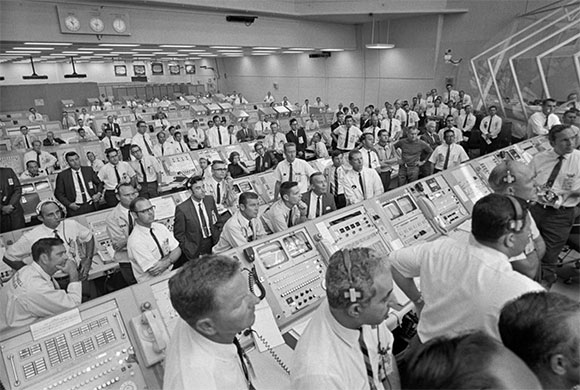
The space race reached its dramatic climax on July 20, 1969, when American astronaut Neil Armstrong became the first human to set foot on the Moon during the Apollo 11 mission. The event was watched by millions around the globe and is still seen by many as NASA’s most iconic achievement.
Though the government claims that the lunar landing happened just 11 years after Sputnik and barely five years after President John F. Kennedy’s 1961 challenge to land a man on the Moon “before this decade is out,” the feat has continued to inspire awe—and some skepticism—in the decades since.
Today, NASA remains a symbol of scientific innovation and national ambition.
From robotic missions to Mars, to powerful space telescopes that peer across the universe, and upcoming plans to return humans to the Moon under the Artemis program, the agency’s founding in 1958 set the course for a new frontier—not only in space but in the American imagination.

 Related Story:
HOT OFF THE PRESS! July 28, 2025 Space Coast Daily News – Brevard County’s Best Newspaper