THIS DAY IN HISTORY: A Milestone in Space History, Gemini VII Launched 60 Years Ago Today
By Space Coast Daily // December 4, 2025
DEcember 4, 1965
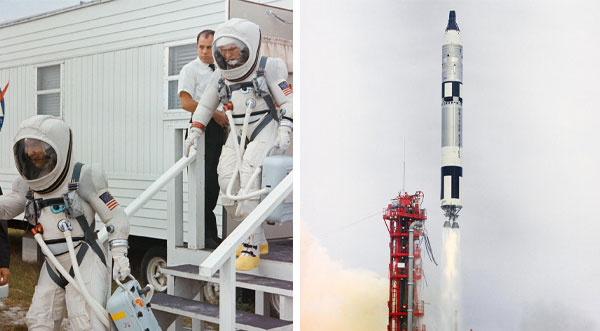
BREVARD COUNTY, FLORIDA – Sixty years ago today, astronauts Jim Lovell and Frank Borman blasted off from Cape Kennedy aboard Gemini VII, embarking on a mission that would redefine the limits of human endurance and pave the way for the future of space exploration.
Launched on December 4, 1965, Gemini VII was designed as both a long-duration flight and a crucial stepping-stone toward the Apollo missions. For 14 days, Borman and Lovell remained in orbit—an unprecedented achievement at the time and the longest crewed spaceflight in U.S. history until Skylab missions eclipsed it in 1973. Their endurance provided vital biomedical data on how the human body adapts to extended periods in microgravity.
But the mission’s significance did not end there. Gemini VII was also central to the first-ever rendezvous of two crewed spacecraft.
On December 15, the crew of Gemini VI-A, Wally Schirra and Tom Stafford, successfully maneuvered their spacecraft to within a few feet of Gemini VII. This feat proved that controlled orbital rendezvous—a requirement for future lunar missions—was not only possible but feasible with precision.
Throughout the mission, Borman and Lovell conducted experiments, evaluated spacecraft systems, and demonstrated the practicality of long-duration space travel. Their work laid essential groundwork for NASA’s ultimate goal: landing humans on the Moon.
As we look back 60 years later, we salute Jim Lovell and Frank Borman for their pioneering contributions that pushed the boundaries of human spaceflight and helped shape the course of NASA’s success.