Florida Ranks as America’s Most Vulnerable Digital Landscape – Residents Face 38% Higher Risk Than Baseline Security Standards
By Space Coast Daily // January 14, 2026
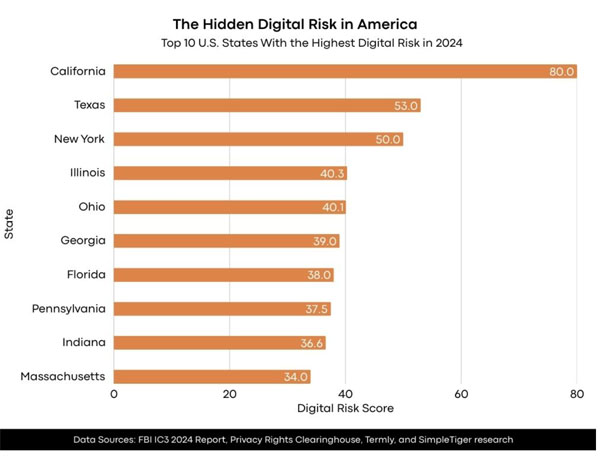
A new study reveals that Florida faces the seventh-highest level of digital risk in the U.S..
One ordinary morning, you log into your email, scroll through banking alerts, and open a message that looks legitimate — a delivery update, a password reset, a tax notice. Within minutes, your identity, financial details, or private data could be compromised. For millions of Americans, that moment is far more likely to happen simply because of the state they live in.
The research by performance marketing agency SimpleTiger analyzed FBI IC3 cybercrime complaints, data breaches reported in 2024, and the strength of each state’s data privacy law to identify where residents face the greatest combined exposure to cybercrime, breach activity, and privacy protection gaps. The study scored states based on Cyber Crimes Reported 2024 (Score out of 40) and Data Breaches Reported 2024 (Score out of 40), then added a Data Privacy Risk Score (out of 20) based on Data Privacy Law Points (out of 10), to produce a Total Risk Score used to rank all 50 states.
Florida ranks seventh with a Total Risk Score of 38/100. The Sunshine State reported 52,191 cyber crimes in 2024, with a Cyber Crimes Report Score of 22/40, and 499 data breaches in 2024, with a Data Breaches Report Score of 16/40. Florida earned 10/10 Data Privacy Law Points with a Data Privacy Risk Score of 0/20.
Looking at the study, a spokesperson from SimpleTiger commented,
“Florida’s position is driven by high cybercrime volume even with strong privacy-law points in the dataset. That often correlates with high scam contact rates. Consumers should treat unexpected calls and texts as suspicious, and businesses should train support teams to resist social engineering attempts.
“Recent incidents underscore just how real this threat has become — including a newly disclosed breach at the University of Phoenix that exposed the personal and financial data of nearly 3.5 million students, staff, and suppliers, demonstrating how even large institutions can become high-value targets overnight.
“What’s particularly concerning is the compound effect: states with high cybercrime rates and weak privacy protections create an environment where stolen data remains exploitable long after the initial breach, leading to cascading victimization through identity theft, financial fraud, and account takeovers. The data suggest that comprehensive state-level privacy legislation combined with mandatory rapid breach disclosure requirements could significantly reduce the window of opportunity for criminals to monetize stolen information.”
2025: A Year of Historic Cyber Devastation
The timing of this study coincides with year-end reviews confirming 2025 as a watershed moment in cyber threats:
- Change Healthcare breach: 192.7 million individuals affected—the largest healthcare data compromise in history, impacting nearly 2/3 of the U.S. population
- Salesforce/Salesloft-Drift attack: 1 billion records stolen in what experts call “the SolarWinds moment for SaaS”
- Jaguar Land Rover attack: £1.9 billion ($2.5 billion) in economic damage, making it the UK’s most financially devastating cyberattack
- 16 billion credential “mega leak”: The largest password exposure in history, affecting multiple lifetimes worth of login credentials
- Cryptocurrency theft: $2.7 billion stolen in 2025 alone
A Cybersecurity Action Plan That Could Save Your Digital Life
Here’s your action plan:
Before You Go Online: Secure Your Foundation, Not Just Your Passwords
- Enable multi-factor authentication on all critical accounts, especially banking, email, and social media platforms, to prevent unauthorized access even if passwords are compromised
- Download a reputable password manager (1Password, Bitwarden, or Dashlane) and generate unique, complex passwords for each account
- Review your state’s data privacy laws at termly.io/us-data-privacy-laws/ to understand your rights regarding data collection, breach notifications, and opt-out provisions
- If living in California, Texas, or New York, sign up for credit monitoring services and enable breach alerts
The Digital Health Check
- Credit monitoring: Request free annual credit reports from all three bureaus (Equifax, Experian, TransUnion) at AnnualCreditReport.com
- Account audit: Review bank statements and credit card transactions weekly for suspicious activity
- Privacy settings: Check Facebook, Google, and Apple privacy settings to limit data collection
- Software updates: Enable automatic updates for operating systems, browsers, and security software
The Reporting Protocol
- Report cybercrime incidents immediately to the FBI’s Internet Crime Complaint Center at ic3.gov, as timely reporting helps authorities track patterns and potentially recover losses
- Place fraud alerts or credit freezes if you live in states with high data breach rates
- Document everything: Screenshot suspicious emails, save transaction records, note dates and times
- Contact your bank immediately if you suspect financial fraud – many institutions have 60-day dispute windows core
The Safest Digital Haven
On the opposite end of the spectrum, Delaware emerged as America’s safest state for digital security, reporting a Total Risk Score of just 3 out of 100 – the lowest rate in the entire nation.
Table for Extended Results:
| Top 10 U.S. States With the Highest Digital Risk in 2024 | ||
| U.S. State | Digital Risk Score | Rank |
| California | 80 | 1 |
| Texas | 53 | 2 |
| New York | 50 | 3 |
| Illinois | 40.3 | 4 |
| Ohio | 40.1 | 5 |
| Georgia | 39 | 6 |
| Florida | 38 | 7 |
| Pennsylvania | 37.5 | 8 |
| Indiana | 36.6 | 9 |
| Massachusetts | 34 | 10 |
The study was conducted by SimpleTiger, a performance-driven marketing agency specializing in SaaS growth. SimpleTiger focuses on delivering high-quality results quickly through strategic SEO and content marketing tailored to each product’s market.
Methodology
The research compiled state-level Cyber Crimes Reported 2024 figures from the FBI’s IC3 2024 annual reporting and Data Breaches Reported 2024 totals from the Privacy Rights Clearinghouse. Each state’s data privacy law strength was scored as Data Privacy Law Points (out of 10) using Termly’s state-by-state privacy law summary. The study then assigned a Cyber Crimes Reported Score (out of 40) and a Data Breaches Reported Score (out of 40), and calculated a Data Privacy Risk Score (out of 20) from the privacy-law points. These components were combined into a Digital Risk Score used to rank states from highest to lowest.
Data Sources
-
- Data Breaches: https://privacyrights.org/data-breaches
- Cyber Crimes (FBI IC3 2024 Report): https://www.ic3.gov/AnnualReport/Reports/2024_IC3Report.pdf
- State Privacy Laws: https://termly.io/us-data-privacy-laws/
- Research Dataset: https://docs.google.com/spreadsheets/d/1JRWr1TDoEZT82xzIUvMb1VIfyhrIq1TUI_3PJ4i5nrw/edit?gid=0#gid=0
- Research by: https://www.simpletiger.com/