
Florida Ranks Top 5 as 5.1M Face Social Security Squeeze
By Space Coast Daily // April 27, 2026
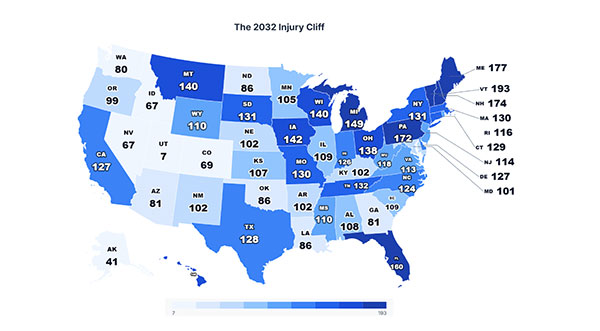 KEY HIGHLIGHTS
- Florida ranks fifth on the 50-state Injury Cliff Index with a composite score of 160.28 out of 300, finishing 11.19 points ahead of sixth-place Michigan.
- Florida holds the second-largest Social Security beneficiary population in the country at 5,161,992, behind only California and ahead of Texas.
- Florida recorded 70 fatal occupational injuries to workers aged 65 and over in 2024, the fifth-highest figure in the nation.
With the Congressional Budget Office’s February 2026 baseline projecting the Social Security Old-Age and Survivors Insurance trust fund’s depletion in 2032, new state-level analysis identifies Florida as the fifth most exposed state in the country should retirees be forced to re-enter or remain in the workforce.
According to an analysis by Ladah Injury & Car Accident Lawyers Las Vegas, the Injury Cliff Index equally weights three variables drawn from the Social Security Administration’s 2024 OASDI State Statistical Supplements, the US Census Bureau’s American Community Survey Table B23001, and the US Bureau of Labor Statistics’ 2024 Census of Fatal Occupational Injuries. Each variable is min-max normalized to a 0 to 100 scale, then summed into a 0 to 300 composite.
Florida Ranks Fifth on the 50-State Injury Cliff Index With a Composite Score of 160.28
| Rank | State | % on Social Security | % of Workforce Aged 65+ | Fatal Injury Rate, Workers 65+ | Composite Score |
| 1 | Vermont | 25.40% | 6.14% | 7 | 192.82 |
| 2 | Maine | 26.75% | 5.44% | 4 | 176.76 |
| 3 | New Hampshire | 24.35% | 5.97% | Not reported* | 174.13 |
| 4 | Pennsylvania | 22.80% | 4.64% | 73 | 172.15 |
| 5 | Florida | 22.09% | 4.51% | 70 | 160.28 |
| 6 | Michigan | 23.07% | 3.90% | 73 | 149.09 |
| 7 | Hawaii | 20.92% | 5.87% | 3 | 147.84 |
| 8 | Iowa | 21.63% | 4.49% | 51 | 142.10 |
| 9 | Montana | 23.24% | 5.04% | 8 | 140.43 |
| 10 | Wisconsin | 22.91% | 4.14% | 51 | 139.58 |
Florida’s fifth-place finish rests on the interaction of three factors that each land comfortably above the national average rather than any single extreme. Its 22.09% Social Security dependency rate exceeds the national average of 20.85%, its 4.51% senior workforce share edges above the 4.34% national figure, and its 70 fatal occupational injuries to workers aged 65 and over rank fifth nationally. No single variable pushes Florida above the top-three New England states, but all three pull in the same direction.
Looking at the Florida findings, Ramzy Ladah, Founder & CEO of Ladah Injury & Car Accident Lawyers, Las Vegas, commented.
“Florida is the scale story. More than five million people in one state are already drawing Social Security, which is the second-largest beneficiary population in the country. Pair that with seventy fatal injuries to workers over 65 in a single year, and the arithmetic on a 2032 benefit reduction gets uncomfortable quickly. This is not a state with a small exposed population, it is a state with millions of people sitting directly in the path of whatever happens to the trust fund.”
Florida Holds the Nation’s Second-Largest Social Security Beneficiary Population at 5,161,992
| Rank | State | OASDI Beneficiaries (2024) | % on Social Security |
| 1 | California | 6,544,000 | 16.60% |
| 2 | Florida | 5,161,992 | 22.09% |
| 3 | Texas | 4,802,392 | 15.35% |
| 4 | New York | 3,838,030 | 19.32% |
| 5 | Pennsylvania | 2,981,684 | 22.80% |
Florida’s 5,161,992 OASDI beneficiaries are second only to California’s 6,544,000, and unlike California, Florida pairs that large absolute base with a dependency rate of 22.09% that sits above the national average. California’s beneficiaries account for 16.60% of its population, and Texas sits at 15.35%, both meaningfully below the 50-state mean. Florida is the only top-three beneficiary state with a dependency share above the national average, which is why its composite score, at 160.28, outpaces California’s 126.71 and Texas’s 128.07 despite holding fewer beneficiaries in absolute terms than both.
Florida Recorded the Fifth-Highest Fatal Injury Count for Workers Aged 65 and Over at 70
| Rank | State | Fatal Injuries, Workers 65+ (2024) | Composite Score |
| 1 | Texas | 134 | 128.07 |
| 2 | California | 104 | 126.71 |
| 3 | Pennsylvania | 73 | 172.15 |
| 3 | Michigan | 73 | 149.09 |
| 5 | Florida | 70 | 160.28 |
Florida’s 70 fatal occupational injuries to workers aged 65 and over in 2024 place it fifth nationally, behind Texas, California, and the tied pair of Pennsylvania and Michigan. What separates Florida from the two larger states above it in raw count is the combination of that fatality figure with a much higher share of the population already on Social Security. Texas reported 134 fatalities but a dependency rate of only 15.35%; Florida reported 70 fatalities with a 22.09% dependency rate. The composite weights both, which is why Florida lands in the top five and Texas lands at 18th.
Methodology
The Injury Cliff Index equally weights three variables, each min-max normalized across the 50-state range to a 0 to 100 scale and summed into a 0 to 300 composite. Social Security dependency is OASDI beneficiaries from the SSA’s 2024 State Statistical Supplements divided by the 2024 US Census Bureau state population estimates. The senior workforce share comes from the US Census Bureau ACS Table B23001. The BLS 2024 Census of Fatal Occupational Injuries state tables provide the fatal occupational risk for workers 65 and over. BLS suppressed six state cells for the fatal injury variable: New Hampshire, Delaware, Rhode Island, New Mexico, Louisiana, and Idaho. For normalization purposes only, we scored these suppressed cells with the minimum value, potentially understating the true vulnerability in those states.
Data Sources
-
- US Bureau of Labor Statistics, Census of Fatal Occupational Injuries, state tables, 2024 → https://www.bls.gov/iif/state-data/fatal-occupational-injuries-in-alabama-2024.htm (Alabama shown; other state pages follow the same URL pattern.)
- Social Security Administration, OASDI Beneficiaries by State and County, State Statistical Supplement 2024 → https://www.ssa.gov/policy/docs/statcomps/oasdi_sc/2024/al.html
- US Census Bureau, American Community Survey, Table B23001: Sex by Age by Employment Status for the Population 16 Years and Over → https://data.census.gov/table?q=B23001:+Sex+by+Age+by+Employment+Status+for+the+Population+16+Years+and+Over&g=010XX00US$0400000
- Research Dataset → https://docs.google.com/spreadsheets/d/1US2RE_19JEFauW43e-fXmVwSDaUqZtuXNvW2lXpRRT8/edit?gid=675934997#gid=675934997
- Study by → https://www.ladahlaw.com/
About Ladah Injury & Car Accident Lawyers Las Vegas
The study was conducted by Ladah Injury & Car Accident Lawyers Las Vegas, an experienced personal injury law firm dedicated to protecting clients’ rights and maximizing claim value.















