
PERFECT LANDING! Artemis II Astronauts Splash Down in Pacific, Concludes Historic Journey Around the Moon
By Space Coast Daily // April 10, 2026
mission has been closely supported by teams at Kennedy Space Center, where launch operations originated
WATCH: Artemis II Astronauts Splash Down, Concluding Historic Journey Around the Moon. The NASA flight parachuted into the Pacific Ocean near San Diego, bringing to an end a journey that sent humans into deep space for the first time since 1972.
KSC, the cornerstone of NASA’s human spaceflight program, has played a key role in coordinating pre-launch, mission support, and post-flight analysis efforts for Artemis II.
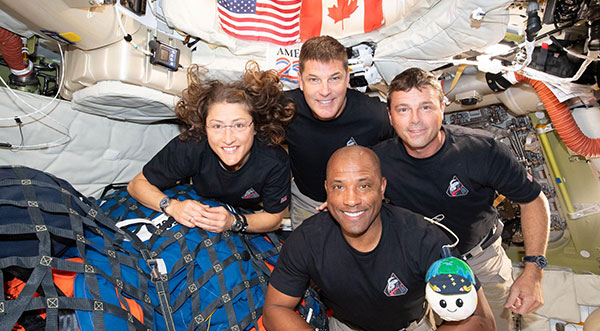
NASA – After a 10-day journey around the moon and back, NASA’s Artemis II mission is entering its final phase, with four astronauts aboard the Orion spacecraft scheduled to return to Earth Friday evening.
The mission has been closely supported by teams at Kennedy Space Center, where launch operations originated, and by engineers and flight support personnel, who have remained actively involved throughout.
KSC, the cornerstone of NASA’s human spaceflight program, has played a key role in coordinating pre-launch, mission support, and post-flight analysis efforts for Artemis II.
The capsule is expected to reenter Earth’s atmosphere and splash down in the Pacific Ocean off the coast of San Diego at approximately 8:07 p.m. EDT on April 10, marking the conclusion of a mission that has pushed human spaceflight farther than it has gone in decades.

Mission controllers, working in coordination with teams at Johnson Space Center and Kennedy Space Center, outlined a precise, rapid sequence of events that will unfold over the final 42 minutes before splashdown.
The Orion crew module will separate from its service module at about 7:33 p.m., sending the discarded section into a destructive burn-up in Earth’s atmosphere.
The remaining crew capsule will then perform a final “raise burn” maneuver roughly 16 minutes before entry to fine-tune its trajectory, followed by a series of controlled rolls.
At about 7:54 p.m., the spacecraft will begin atmospheric entry at roughly 400,000 feet over the Pacific Ocean, traveling at nearly 23,864 miles per hour.
The entry point is expected to occur southeast of Hawaii, about 1,950 miles from the targeted landing zone.
Just 24 seconds later, the crew will lose contact with mission control as intense heat and plasma build around the spacecraft, creating a six-minute blackout.
During this time, astronauts are expected to endure forces up to 3.9 times Earth’s gravity, while temperatures outside the capsule soar to nearly 5,000 degrees Fahrenheit.
“It’s only 13 minutes from entry interface until splashdown, so it’s going to happen pretty quick,” said Rick Henfling, Artemis II entry flight director, during a NASA news conference earlier this week.
“We’re going to be without comms with the flight crew for six of those minutes.”
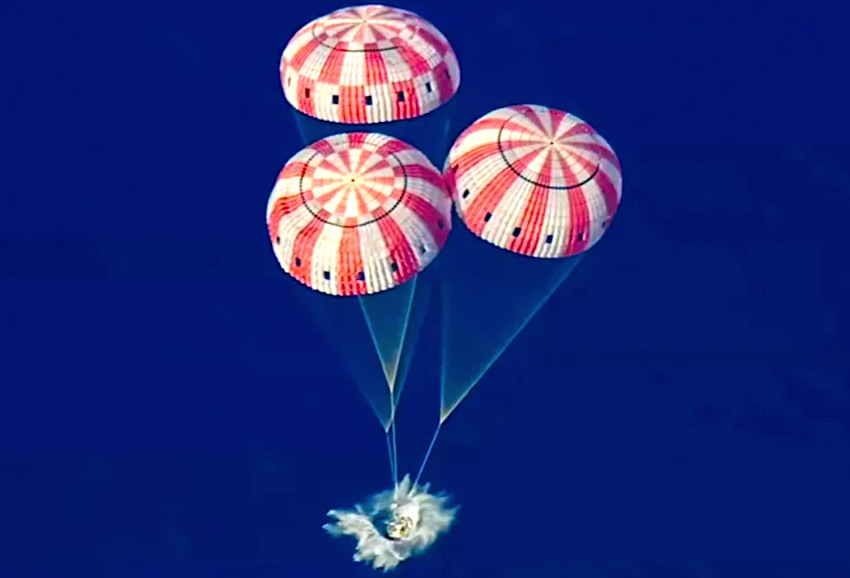
As Orion descends through the atmosphere, a series of parachute deployments will dramatically slow the spacecraft. The forward bay cover protecting the parachutes will jettison between 35,000 and 24,000 feet above the ocean.
Two drogue parachutes will deploy at approximately 22,000 feet, reducing the spacecraft’s speed to about 200 miles per hour.
One minute later, three large orange main parachutes will open at around 6,000 feet, slowing the capsule further to a gentle 20-mile-per-hour descent.
“That’ll slow the spacecraft and her four inhabitants down to a gentle splashdown,” Henfling said.
Following splashdown, recovery teams will move quickly to secure the capsule and retrieve the astronauts. NASA officials said the crew is expected to be extracted and transported by helicopter to the USS John P. Murtha (LPD-26) within two hours.

Engineers and mission teams at Kennedy Space Center are also expected to support post-flight data analysis and spacecraft processing, contributing insights that will shape upcoming Artemis missions, including future launches planned from Florida’s Space Coast.
The Artemis II mission represents a major milestone in NASA’s Artemis program, serving as the first crewed flight of the Orion spacecraft and a critical step toward future missions that aim to return humans to the lunar surface and eventually send astronauts to Mars.
As Henfling noted, the mission’s dramatic conclusion will unfold in a matter of minutes.
“It’s going to start quickly,” he said, “and it’s going to be over even faster.” “It’s going to start quickly,” he said, “and it’s going to be over even faster.”















