STORM READY: NOAA’s New Mobile Radar Fleet Bridges Gap From Research to Weather Safety
By Space Coast Daily // April 6, 2026
cutting-edge mobile weather radars unveiled by the NOAA National Severe Storms Laboratory
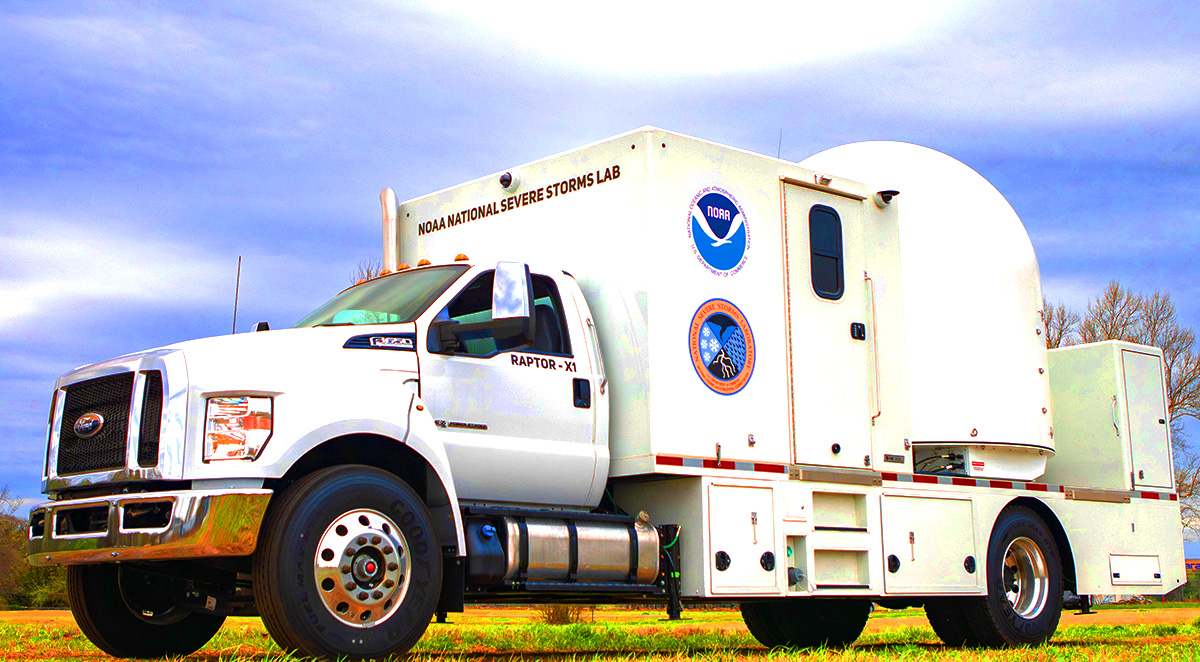
BREVARD COUNTY, FLORIDA – Three cutting-edge mobile weather radars unveiled by the NOAA National Severe Storms Laboratory will enable NOAA researchers to deploy research-grade technology to the front lines of tornadoes, wildfires, hailstorms, flash flooding, and severe wind events, significantly expanding critical insights into hazardous weather threats in real time.
“This is a game changer for public safety,” said DaNa Carlis. Ph.D., director of NOAA’s National Severe Storms Laboratory.
“We aren’t just increasing our numbers from one radar to three; we are fundamentally upgrading the quality of data we can provide to forecasters and decision makers. These tools allow us to observe and document extreme hazards with a level of detail and confidence that was previously impossible.”
These state-of-the-art mobile radars are designed to be rapidly deployed wherever dangerous weather is occurring, allowing scientists to position the instruments closer to storms and wildfires to get a high-quality view of what is really happening.
This proximity allows researchers to close the radar gap with detailed views of atmospheric processes that are difficult or impossible to capture with our fixed radar network alone.
The mobile radars are mounted on heavy-duty trucks and equipped with a work area for researchers to operate.
Each truck carries an X-band (3-cm wavelength) radar unit, and one truck will carry a C-band (5-cm wavelength) radar unit.
Shorter-wavelength X-band radars are more sensitive and can detect smaller drops and particles more effectively, but large drops or dense concentrations of drops can degrade data quality.
While it does not provide as much detail in its data, the longer-wavelength C-band radar performs better for heavy precipitation and large particles.

Mobile radars see storms where people live, and damage occurs
Mobile radars allow us to scan the lowest levels of the storm where hazards like tornadoes occur,” said Pam Heinselman, Ph.D., deputy director of NSSL.
“This gives us the most detail possible in the areas where people are impacted.”
This improved data collection is particularly valuable for studying tornadoes and severe storms, where small-scale features can have major impacts. High-resolution radar data can reveal rapid changes in wind patterns and storm organization that influence storm strength and longevity.
“Having multiple radars scanning one storm also gives us vastly better data,” said Kurt Hondl, NSSL associate director.
“A radar can only measure wind speeds towards or away from the radar. If you have two radars looking at the same area from different viewpoints, you can use the two observations to determine the wind speed and direction.”

Mobile radars will provide data on wildfires, flash floods, and hailstorms
Beyond tornadoes and thunderstorms, the new radars will also support research into other high-impact hazards. In wildfire situations, mobile radars can help monitor smoke plumes, fire-induced winds, and changing weather conditions that affect fire behavior and firefighter safety.
During flash-flooding events, the new radars can pinpoint where the heaviest rain is falling in real time, helping communities prepare for sudden and life-threatening floods.
Much of this important work falls under the Verification of the Origins of Rotation in Tornadoes EXperiment-United States program, which just marked its 10th year of pioneering research.
Led by NSSL, VORTEX-USA brings together meteorologists and social scientists from universities, foundations, private industry, and government to study tornadoes and severe thunderstorms.
The three new radars strengthen NSSL’s mobile observing fleet, joining assets that include mobile mesonets, precipitation monitoring tools, uncrewed aerial systems, a lightning mapping array, the HailCam, and LiDAR.
Researchers from NSSL take these tools into the field and collect detailed measurements of wind, precipitation, and storm structure at critical moments.
By sampling weather systems at closer range and from multiple angles, researchers can better understand how severe weather forms, evolves, intensifies, and dissipates.
“The data collected by the new mobile radars won’t just sit in the lab,” said Carlis.
“It will help refine NOAA weather forecasts and protect lives and property by giving people more time to seek shelter ahead of an oncoming severe storm.”
 Related Story:
HOT OFF THE PRESS! February 23, 2026 Space Coast Daily News – Brevard County’s Best Newspaper