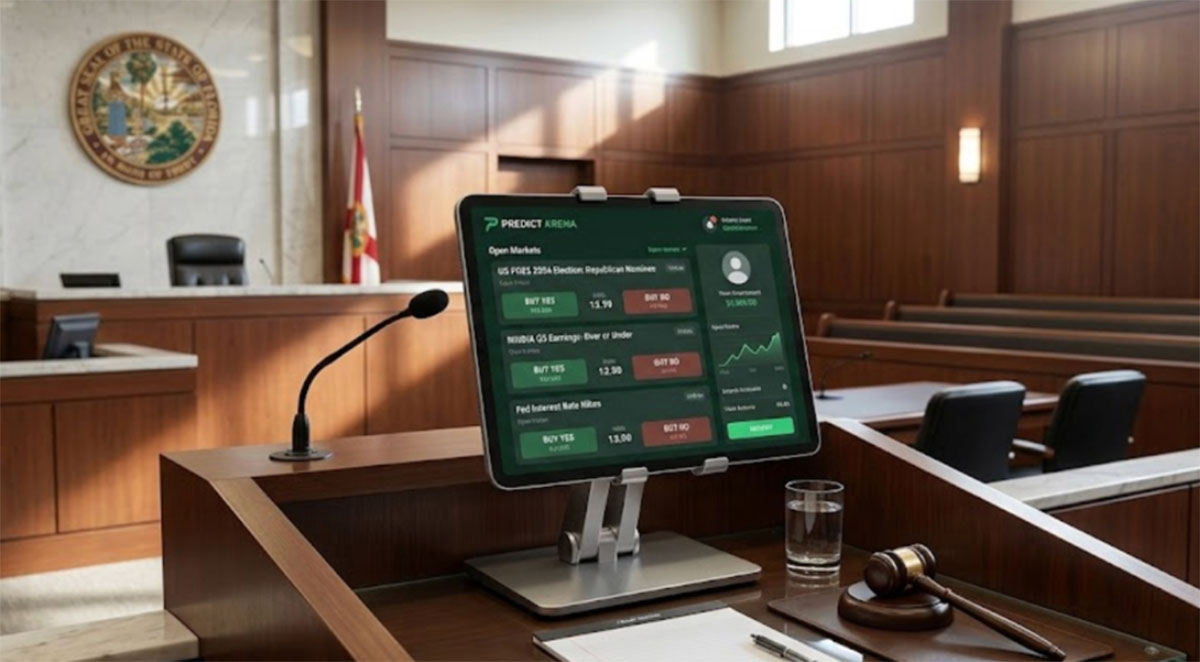
It seems like not that long ago that Florida finished one years long online gambling drama, with the conclusion of the legal saga around the Seminoles offering online sports betting in the state. That long-running court battle ended in 2024 with the legal monopoly launch of Hard Rock Bet. However, the Sunshine State may soon be gripped by another legal betting drama – prediction markets.
These platforms that mix wagering on outcomes of sports (and just about anything else) with financial trading, have exploded in popularity across the US since 2024. Operators like Kalshi and Polymarket are regulated by the Commodity Futures and Trading Commission, and so despite offering “contracts” where people can put money down on the next Super Bowl winner, they aren’t federally considered gambling. And they have proved very popular. Recent estimates say they may now have passed the monthly dollar activity of all US sportsbooks. So what does this mean in Florida?
Monopoly Sportsbook Hard Rock Bet is Not Happy
Well, it now means more competitors for Hard Rock Bet. Although the main operators Kalshi and Polymarket take pains to paint themselves as not gambling, and aren’t considered so by federal law, the similarities are clear. And even more so when you consider the recently launched prediction market apps from leading national sportsbooks DraftKings and FanDuel.
While the CFTC backs prediction markets nationally, many states (around 16 at last count) have filed legal challenges against the model. Florida is not yet among them, but many business experts suggest the key players are simply waiting to see which way some key cases might swing before deciding on their arguments.
It is almost certain the Seminole Tribe of Florida will not be happy with encroachment on their sports betting monopoly. Hard Rock Bet spent many years and millions of dollars fighting for its legal right to provide sports betting in its home state. It now makes billions of dollars a year in revenues from the operation, as the only locally licensed sportsbook in Florida.
However, that exclusivity has now been threatened by prediction markets. The Florida legislature may also not be happy with the situation either, as the Seminoles pay $750 million a year to the state from their gambling revenues – and so anything that eats into that eats into state taxes too.
Florida Financial Traders Take Notice
It’s difficult to say how much custom prediction markets have in Florida, but they are a huge business nationally. The two main players recently passed a collective $50 billion in monthly trading volume, which is far above the $10 billion to $15 billion usually wagered monthly across all regulated US sportsbooks.
They went from a niche political polling tool to multibillion business in just a few years, and (in the case of Kalshi even more so) a lot of that revenue was built on sports contracts. Now, the major players branding exploits – from free stores to wagering on controversial international events – have catapulted them into the public consciousness.
For a live example right now, consider the Polymarket bonus code page at Sportsbookreview.com. The number of offers and the depth of analysis, from a website that was not long ago more associated with reviewing sportsbooks, is a practical example of just how much interest there is in prediction markets. Traders use these sites to find the best bonuses, terms and site features in an increasingly competitive sector.
Although these markets only appeared a few years ago, they already have much of the same online infrastructure and community that online sportsbooks took decades to form properly.
Even traditional financial institutions and traders are noticing and getting involved. Florida-based hedge fund Tyr Capital is apparently actively recruiting for prediction market traders, as have other across the US like Moreton Capital. Even big institutions that aren’t using them outright are looking into prediction markets for data analysis and predictive modelling.
Florida’s Lawmakers Haven’t Moved Yet
As previously mentioned, 16 states have moved against prediction markets in some form or other. Some have successfully banned them, such as Nevada, and those have been upheld in courts, while other courts have disagreed.
Broadly though, the CFTC supports the prediction market model as financial trading – and it has been willing to defend that decision in court.
In Florida it seems the Seminoles have little willingness to take on a possible nationally-significant possibly policy-defining court case at this point, given their recent experiences with their long journey towards launching Hard Rock Bet. The initial gaming compact that allowed them to offer sports betting to Floridians, as long as servers were on tribal land, was passed in 2021. But Hard Rock Bet did not launch properly until late 2023, after a series of court cases from local card room operators and other gambling business interests challenged their right to a monopoly.
Prediction markets could be another legal drama that is almost as lengthy. The Seminoles will likely not weigh in until some of those cases reach top decisions at the Supreme Court, which could play out through 2027 and beyond.