temperatures may allow liquid water to exist on the surface
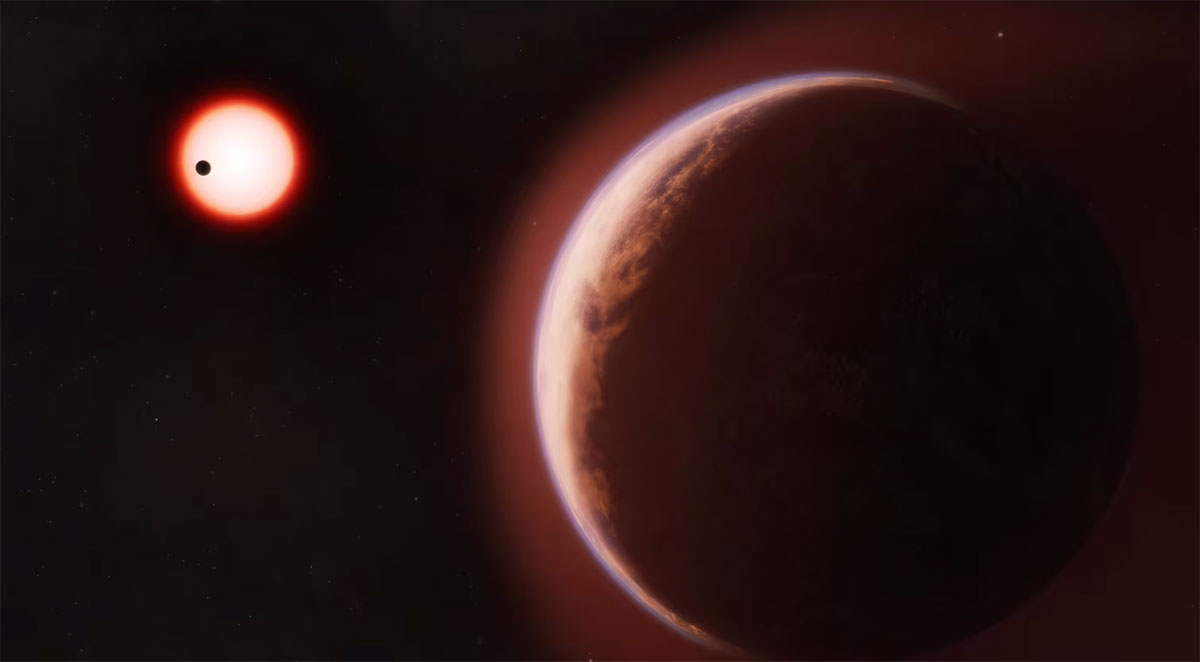
Known as LHS 1140b, the planet is roughly five times the mass of Earth, placing it in a class of planets commonly called “super-Earths.”
Scientists have detected promising evidence that a rocky planet located 49 light-years from Earth could have an atmosphere, potentially making it one of the most compelling places to search for conditions suitable for life.
Known as LHS 1140b, the planet is roughly five times the mass of Earth, placing it in a class of planets commonly called “super-Earths.”
It orbits its host star within the habitable, or “Goldilocks,” zone—where temperatures may allow liquid water to exist on the surface.
Researchers believe the planet is predominantly rocky based on measurements of its mass, radius, and estimated density.
“We believe it is also predominantly a rocky planet, based on its mass and its radius measurements, which gives us a density estimate,” said Collin Cherubim, a planetary scientist and lead author of the study published July 16 in the journal Science.
Cherubim said the planet appears to have an Earth-like internal structure that could include an iron core, a silicate mantle and a lower-density component consisting of water and an atmosphere.
“It appears to be consistent with Earth, meaning it might have an iron core and a silicate mantle, plus some sort of low-density component, which is probably a combination of water and, now we know, an atmosphere,” he said.
Cherubim is a NASA Sagan Fellow at the University of Chicago and conducted the research while completing his doctoral studies at Harvard University.
If additional observations confirm the results, LHS 1140b could become the first known rocky planet with an atmosphere located in the habitable zone of a star beyond the solar system.
Astronomers have discovered more than 6,200 exoplanets since the first confirmed discoveries during the 1990s. In 2001, the Hubble Space Telescope detected evidence of an atmosphere surrounding a gas giant exoplanet approximately 150 light-years from Earth.
Studying the atmospheres of distant rocky worlds is considerably more challenging because the planets are relatively small and their atmospheres are thin.
Astronomers typically observe a planet as it passes in front of its host star. During the transit, some starlight filters through the planet’s atmosphere, allowing instruments to search for the chemical signatures of gases.
Researchers emphasized that the latest findings do not constitute evidence of life—or even confirmation that LHS 1140b has a life-supporting atmosphere. More observations will be required to verify the atmosphere and determine its composition.
Still, Cherubim described LHS 1140b as a formidable candidate in the search for potential signs of extraterrestrial life.