
Today is 61st Anniversary of JFK’s Assassination, Left Enormous Legacy on Brevard and Nation’s Space Program
By Space Coast Daily // November 22, 2024
ASSASSINATED NOV. 22, 1963
WATCH: In a speech to Congress on May 25, 1961, President John F. Kennedy challenged the nation to send a man to the moon and return him safely to Earth by the end of that decade. This video includes historical footage of the launches of Yuri Gagarin and Alan Shepard, whose flights helped prompt Kennedy’s speech, plus comments from Mercury astronauts John Glenn and Scott Carpenter and Mercury Flight Director Chris Kraft.
Friday marks the 61st anniversary of JFK’s assassination. Kennedy was shot and killed on Nov. 22, 1963, in Dallas, and many still question who killed the president.
KENNEDY SPACE CENTER, FLORIDA—On the 61st anniversary of President John F. Kennedy’s assassination, Space Coast Daily invites you to reflect on JFK’s impact on Brevard County and the nation’s space program.
President Kennedy will no doubt be remembered as the U.S. leader who, in 1961, asked the country to commit to sending Americans to the moon “before this decade is out.” However, Kennedy’s attitude toward the space program was complex.
He entered the White House thinking space could be an area for tension-reducing cooperation with the Soviet Union, and he never gave up that hope even as he approved the peaceful mobilization of the substantial human and financial resources needed to meet the lunar landing goal he had proposed.
At his June 3-4, 1961 summit meeting in Vienna with Soviet Premier Nikita Khrushchev, Kennedy suggested, “Why don’t we do it together?” After responding positively, Khrushchev reportedly said “no” the next day because an agreement on disarmament must come first.
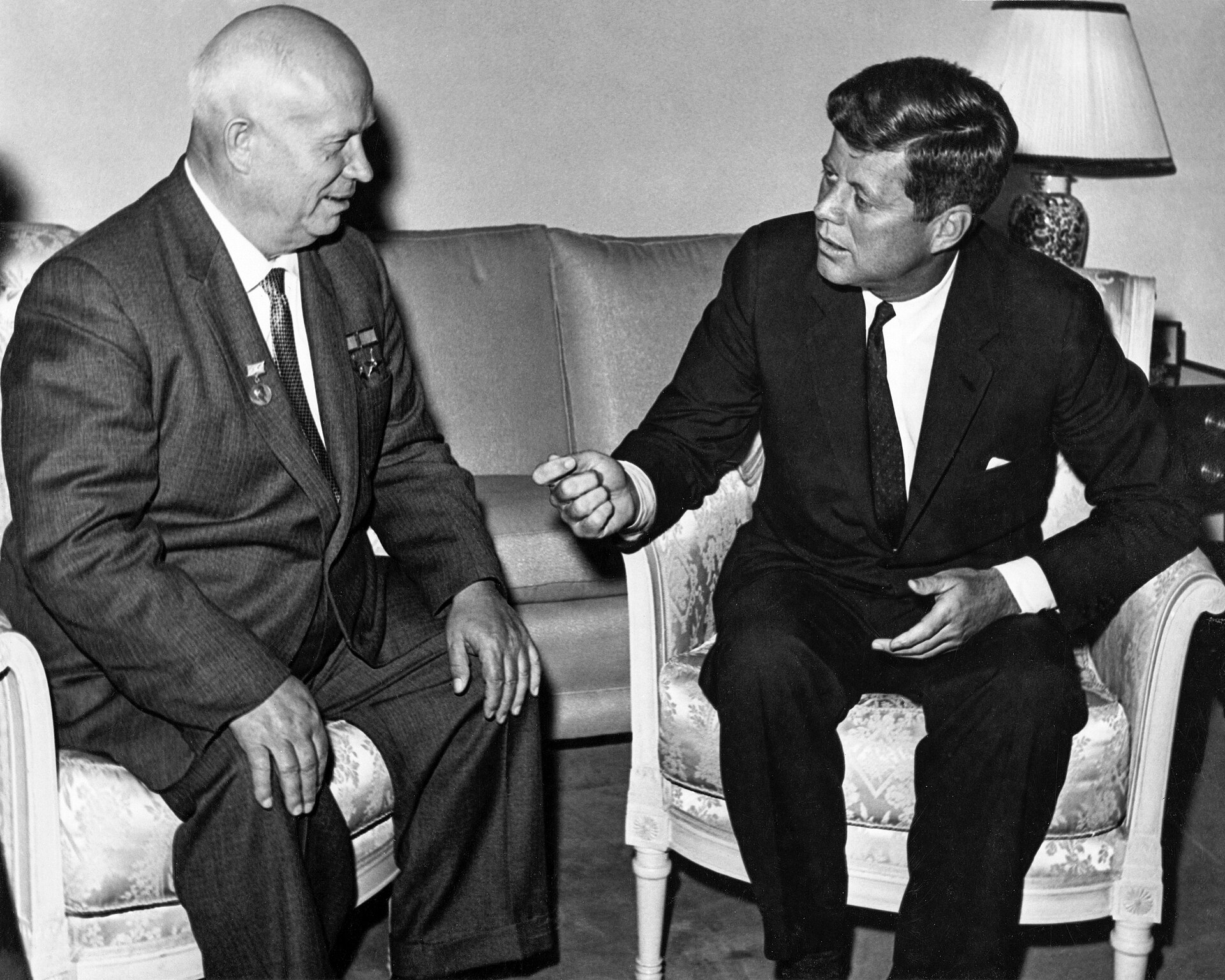
One positive development of the Vienna summit came when Jacqueline Kennedy talked to Khrushchev about the Soviet space effort at a state dinner. She innocently asked if the premier could send her one of the puppies of a dog the Soviets had flown in orbit.
According to Kennedy advisor Arthur M. Schlesinger, Jr., two months later, “two nervous Russians came with Ambassador Menshikov into the Oval Office at the White House bearing a terrified small dog. The president said, “How did this dog get here?”
His wife said, “I’m afraid I asked Khrushchev for it in Vienna. I was running out of things to say.”
Near the end of his presidency, Kennedy returned to the idea of superpower cooperation in space. Speaking before the United Nations on Sept. 20, 1963, he proposed “a joint expedition to the moon” and asked, “Why should man’s first flight to the moon be a matter of national competition?”
However much he might have wished to cooperate, Kennedy, in 1961, had set the United States on a course to enter and win the race to the moon.
This decision came after the huge global and domestic reaction to the Soviet launch of Yuri Gagarin, the first human to orbit Earth, on April 12, 1961.
Eight days later, Kennedy asked for a crash review to identify a “space program which promises dramatic results in which we could win.”
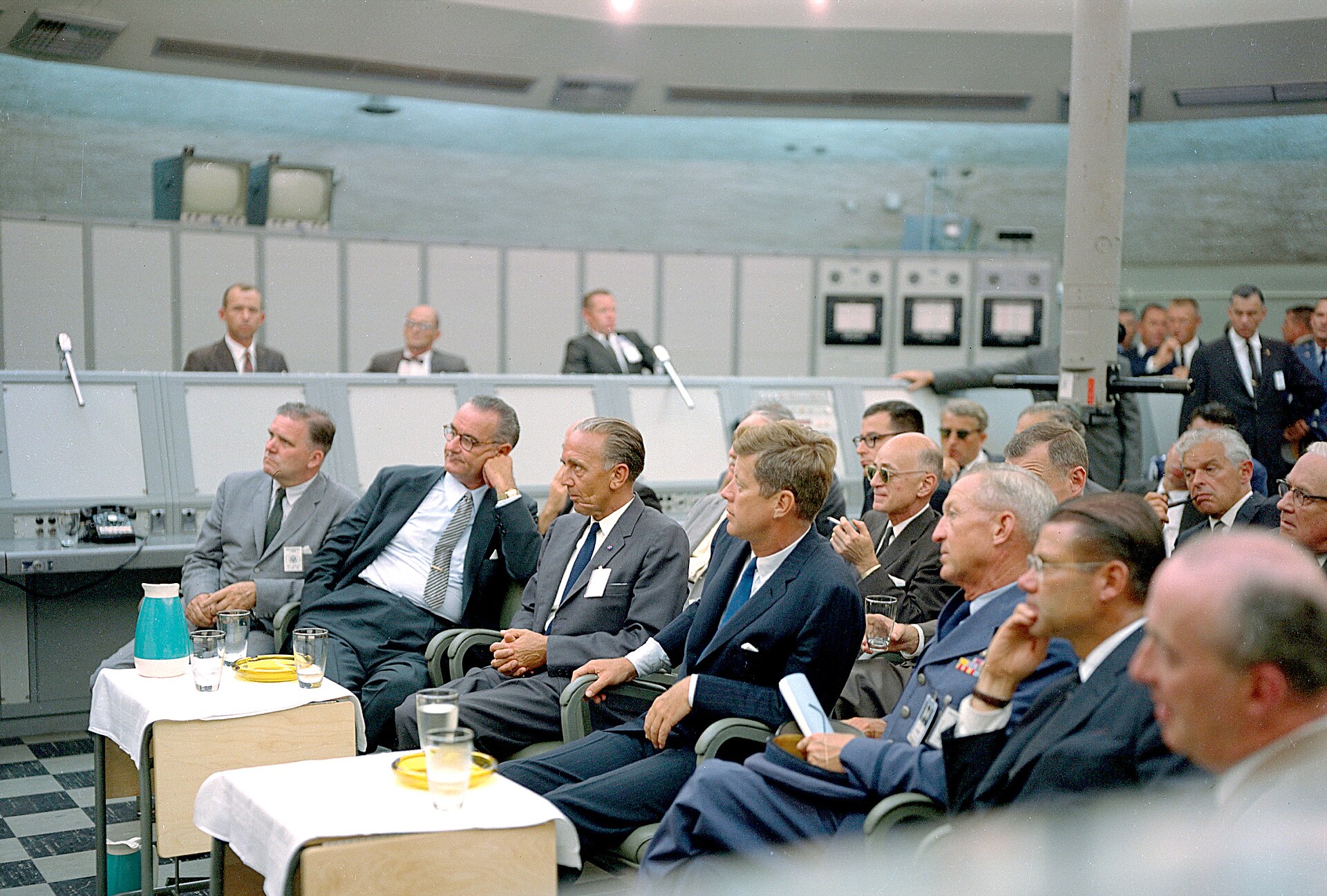
As part of the crash review the president had ordered, Vice President Lyndon B. Johnson met with Wernher von Braun, among others.
After that meeting, von Braun wrote a letter stating that, regarding a moon landing goal, “We have a sporting chance. With an all-out crash program, I think we could accomplish this objective in 1967-68.” Johnson quickly reported this judgment to Kennedy, and in effect, the die was cast.
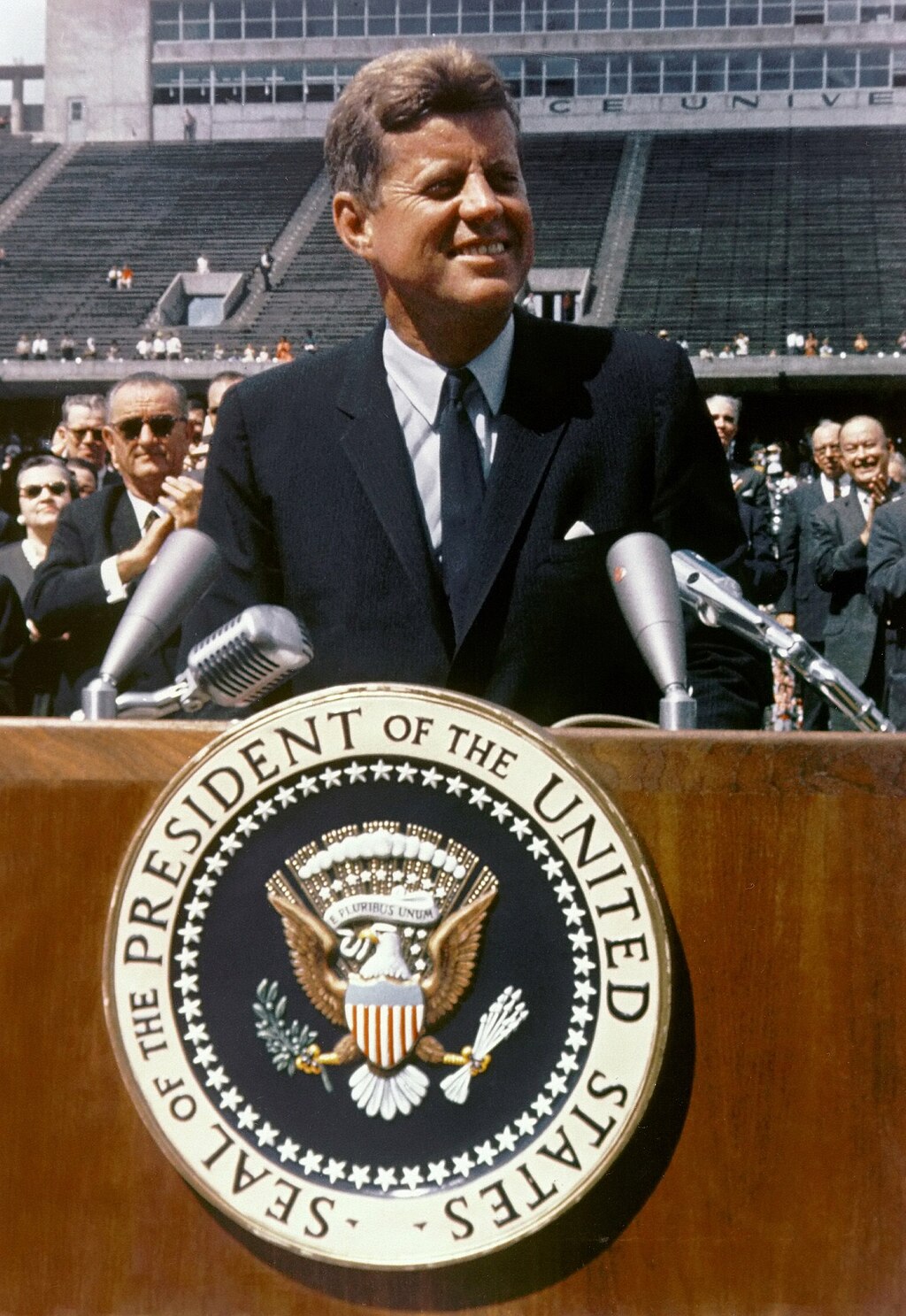
On May 25, 1961, Kennedy addressed a joint session of Congress to announce his decision to go to the moon. He backed up this decision with remarkable financial commitments.
In the immediate aftermath of his speech, NASA’s budget increased by 89 percent and another 101 percent the following year. To carry out Apollo, NASA became the large engineering organization centered on developing capabilities for human space flight that it is today.
Kennedy was particularly drawn to the astronauts, who became popular symbols of an administration that embraced the New Frontier. John Glenn was a frequent visitor to the Kennedys’ Hyannisport, Mass., compound, where he water skied with Jacqueline Kennedy and successfully lobbied the president on behalf of the astronauts’ right to sell their exclusive stories to Life magazine.
When Glenn’s Friendship Seven mission launched on Feb. 20, 1962, on live national television, Kennedy watched raptly along with millions of his fellow countrymen.
Kennedy was deeply committed to the political goal of beating the Soviets but privately lacked a visionary interest in space despite his often stirring public rhetoric (“We choose to go to the moon in this decade and do the other things, not because they are easy, but because they are hard”).
This contradiction is apparent in a tape recording of a White House meeting on Nov. 21, 1962. The recording, released in 2001 by the John F. Kennedy Library in Boston, documents Kennedy fending off NASA Administrator James Webb’s concerns that the United States risked a public failure in its push to achieve the lunar landing goal. Webb asserted that we should have broader goals in space activities.
“This is, whether we like it or not, a race,” Kennedy said. “Everything we do [in space] ought to be tied into getting to the moon ahead of the Russians.” Kennedy told Webb that winning the moon race “is the agency’s top priority and, except for defense, the top priority of the United States government. Otherwise, we shouldn’t be spending this kind of money, because I’m not that interested in space.”
After the United States forced the Soviet Union to remove nuclear missiles from Cuba, Kennedy started to believe there was a possibility of less tense relations between the two countries.
His 1963 proposal for a joint mission to the moon was likely a product of that belief. With the possibility of superpower confrontation diminished, he could return to his original concept of space as an arena for enhanced cooperation between the superpowers.
WATCH: John F. Kennedy’s “We choose to go to the moon” speech at Rice University on Sept. 12, 1962.
That possibility quickly disappeared with Kennedy’s assassination on Nov. 22, 1963. What might have happened to Apollo and NASA overall had Kennedy spent another five years in the White House can only be a matter of speculation.
We know the public’s association of the space program with Kennedy was so strong that six days after Kennedy was assassinated, the new president, Lyndon Johnson, announced in a nationwide television address that the NASA center from which our moon voyagers would launch would be named in Kennedy’s honor. (NASA’s Manned Spacecraft Center was named in Johnson’s honor in 1973, shortly after his death.)
A less grand but very fitting tribute to the assassinated president took place on the evening of July 20, 1969, when an anonymous citizen placed a small bouquet on the Kennedy gravesite at Arlington National Cemetery with a note that read, “Mr. President, the Eagle has landed.”
 Related Story:
HOT OFF THE PRESS! Nov. 11, 2024 Space Coast Daily News – Brevard County’s Best Newspaper















