Parker Solar Probe Reports Good Status After Close, Record-Setting Solar Approach
Parker Solar Probe is alive and well after skimming by the Sun at just 15 million miles from our star’s surface. […]
Early in the morning of Nov. 7, 2018, NASA launches the Ionospheric Connection Explorer, or ICON, a spacecraft that will explore the dynamic region where Earth meets space: the ionosphere. […]
Julie Brisset, an associate scientist in planetary sciences at UCF’s Florida Space Institute, was recently awarded a $250,000 grant from NASA to study levitating dust clouds in microgravity. […]
What’s Up for November? Planets, asteroid Juno, comet 46P, and a morning meteor shower. […]
Shadows on Earth can be mysterious and foreboding, but when they occur in space, they can convey information we otherwise could not know. In a stellar nursery called the Serpens Nebula, nearly 1,300 light-years away, a young star’s game of shadow play is revealing secrets of its unseen planet-forming disk. […]
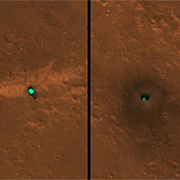
Every Mars landing is a knuckle-whitening feat of engineering. But each attempt has its own quirks based on where a spacecraft is going and what kind of science the mission intends to gather. […]
A new record for our mission to “touch” the Sun, the end of an era for a prolific planet hunter, and our next mission to Mars is closing in on its destination … a few of the stories to tell you about – This Week at NASA! […]
Fans of science in space now can experience fast-moving footage in even higher definition as NASA and ESA (European Space Agency) deliver the first 8K ultra high definition (UHD) video of astronauts living, working and conducting research from the International Space Station. […]
This summer and early fall, beachgoers and residents along Florida’s central Gulf Coast endured an unpleasant and, at worst, debilitating aquatic annoyance: a dangerous red tide caused by the harmful algae Karenia brevis. […]
Astronauts are teaching scientists how they grip and manipulate objects in space to help engineers design intelligent controls and interfaces aboard spacecraft. NASA also delivered the first 8K video of the crew working in space this week. […]
Two vastly different NASA spacecraft are about to run out of fuel: The Kepler spacecraft, which spent nine years in deep space collecting data that detected thousands of planets orbiting stars outside our solar system, and the Dawn spacecraft, which spent 11 years orbiting and studying the main asteroid belt’s two largest objects, Vesta and Ceres. […]
The module is scheduled to depart Germany on November 5, arriving at Kennedy on November 6. […]