New Bill Filed in Florida Would Designate American Flamingo as State Bird, Would Replace Mockingbird
By WFTV // December 11, 2023
Flamingo known as a Florida year-round resident
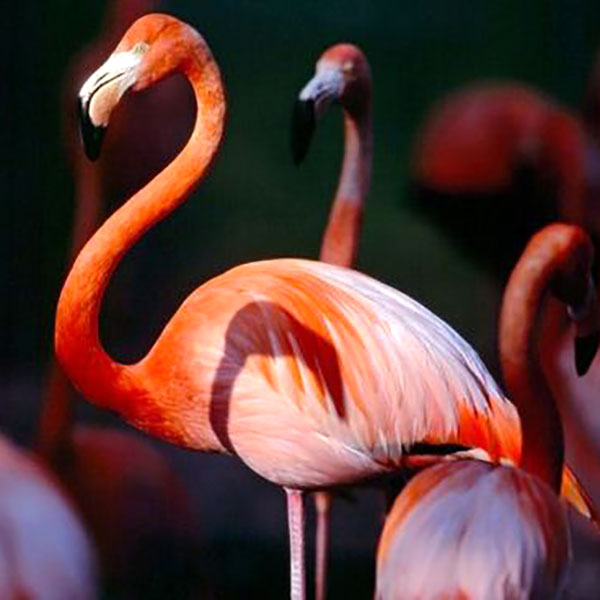
TALLAHASSEE, FLORIDA (WFTV) – Move over mockingbird. Here comes the flamingo.
Rep. Jim Mooney, R-Islamorada, and Rep. Linda Chaney, R-St. Pete Beach, filed a bill (HB 753) this week that would designate the American flamingo as the Florida state bird.
The designation would take the place of the mockingbird, which was approved in 1927, according to the bill.
The mockingbird is also the state bird for Arkansas, Mississippi, Tennessee and Texas.
Also known as a Florida year-round resident, the mockingbird fiercely protects its family nest, and is a talent of music and mimic.
CLICK HERE TO READ FULL ARTICLE ON WFTV
MORE ABOUT MOCKINGBIRDS
Mockingbirds are a group of New World passerine birds from the family Mimidae. They are best known for the habit of some species mimicking the songs of other birds and the sounds of insects and amphibians,[1] often loudly and in rapid succession. There are about 17 species in two genera, although three species of mockingbird from the Galapagos Islands were formerly separated into a third genus, Nesomimus. The mockingbirds do not appear to form a monophyletic lineage, as Mimus and Melanotis are not each other’s closest relatives; instead, Melanotis appears to be more closely related to the catbirds, while the closest living relatives of Mimus appear to be thrashers, such as the sage thrasher.[2][3]
Fledgling stage of the northern mockingbird
The only mockingbird commonly found in North America is the northern mockingbird (Mimus polyglottos). The Greek word polyglottos means ‘multiple languages’. Mockingbirds are known for singing late at night, even past midnight.
MORE ABOUT FLAMINGOS
It is a cultural icon for the U.S. state of Florida, where it was formerly abundant in the southernmost regions, although it was largely extirpated by 1900 and is now only an uncommon visitor with a few small, potential resident populations.
The American flamingo is considered an iconic symbol of the state of Florida in the United States, and is widely featured on merchandise from the state. Although the species was a former resident and a possible breeder in Florida until the early 20th century, the strong association of flamingos with Florida likely originates from the Flamingo Hotel, a popular 1920s hotel in Miami Beach, which was named after an exotic bird for marketing purposes. The hotel’s strong association with South Florida led to the popularity of flamingo souvenirs from the state, which was further boosted by the captive flamingos kept in Hialeah Park.[7]
South Florida and the Florida Keys were likely the northernmost strongholds of the American flamingo’s distribution until they suffered a population collapse around 1900. Large flocks of flamingos reaching up to a thousand individuals (with one potential sighting of up to 2,500 individuals) were sighted throughout the 19th century by naturalists such as Audubon and Wurdemann, although such spectacles were restricted to a small portion of southern and western Florida, at sites including Marco Island, Cape Sable and the Florida Keys. Many of these early reports note that Florida’s flamingos suffered from heavy hunting, first by Native Americans and later early settlers; this hunting may have already affected numbers prior the earliest population estimates. The last report of a large flock was by Howe (1902), who reported a flock of over 500 to 1,000 flamingos east of Cape Sable. Following this report, flamingo observations in Florida only ranged in the single digits at a time for many decades.[3]
A small number of museum specimens exist of flamingo eggs allegedly collected in Florida, all from the 1880s. Three of these (including one collected by Edward Wilkinson) are labeled as originating from the Florida Keys, while one is labeled as having been collected around Tampa. However, none of these specimens have specific collection notes, and the provenance of the Tampa specimen is considered highly erroneous. However, the collection dates are consistent with nesting seasons for other American flamingo populations, bolstering their accuracy. There is a single potential sight record of nesting flamingos in Florida: a 1901 report from a Keys resident mentions a flock of 40-50 flamingos on Sugarloaf Key standing by “whitish stumps”, which may potentially refer to the flamingos’ mud nests. Despite the ambiguity of these reports, the geomorphology of these sites closely resembles that of flamingo nesting sites elsewhere in the Caribbean, supporting their accuracy. It is thus largely agreed that flamingos were likely former nesters in Florida.
Sightings of flamingos in Florida had reached a low by the 1940s, with no registered records for the entire decade. During the 1950s, wild flamingo sightings started to tick up again, but birds from the captive population at Hialeah Park frequently escaped, leading to the conclusion that the majority of flamingo sightings in Florida were of escapees; until 2018, the Florida Fish and Wildlife Conservation Commission listed it as a nonnative species. From a distance, untrained eyes can also confuse it with the roseate spoonbill, leading to further confusion.[3][8][9] This belief persisted into the 21st century even as flamingo sightings started to become more and more frequent, although at least one bird banded as a chick in the Yucatán Peninsula was recorded in 2012 in Everglades National Park. The maximum sizes of observed flocks also increased over time, with the largest increase between 1990 and 2015. The largest flock of Florida flamingos since the early 20th century was spotted in 2014, when a very large flock of over 147 flamingos temporarily stayed at Stormwater Treatment Area 2 on Lake Okeechobee, with a few returning the following year.
A 2018 study confirmed the native status of flamingos in Florida and called for their federal protection as a threatened species, which had been debated by agencies during the prior decades. The study found that the growing flamingo sightings likely represent wild individuals and not escapes, and that at least some of these individuals are year-round residents in Florida. The status of flamingos as a former resident species was proven with the observations and breeding records by early naturalists, while the existence of modern resident populations was based on an abandoned young flamingo named Conchy found in Key West, who was radio-tagged and found to stay in Florida Bay year-round with other flamingos. The study also indicated that as flamingo populations around the Caribbean recover, more flamingos may join the resident populations and recolonize Florida, as has happened elsewhere in the Caribbean.[12][13][14][15]
In 2023, Hurricane Idalia blew in large numbers of flamingos across the eastern United States, with records from Florida, Georgia, North Carolina, South Carolina, Virginia, Kentucky, Tennessee, as far north as Ohio and Pennsylvania, and as far northwest as Wisconsin. These vagrant populations likely originated from the Yucatan Peninsula, were caught in the storm while enroute to Cuba, and carried until the storm’s landfall in the United States, after which they dispersed.
*Wikipedia contributed to this report