
THIS DAY IN HISTORY: Space Shuttle Columbia Lifts Off for STS-28 Mission from Kennedy Space Center 35 Years Ago
By Space Coast Daily // August 8, 2024
August 8, 1989
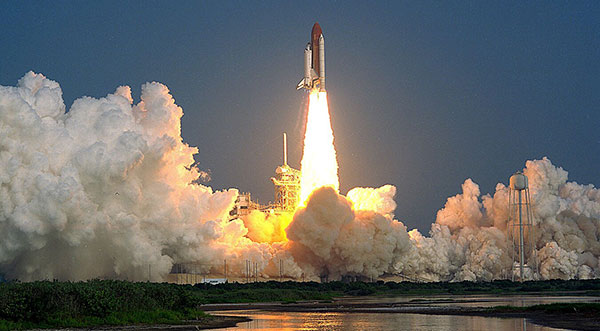

BREVARD COUNTY, FLORIDA – Space Shuttle Columbia (OV-102) lifted off from Pad 39B, Launch Complex 39 at Kennedy Space Center, Florida, on August 8, 1989. The launch took place at 8:37 a.m. EDT.
During STS-28, Columbia deployed two satellites: USA-40 and USA-41. Early reports speculated that STS-28’s primary payload was an Advanced KH-11 photo-reconnaissance satellite.
Later reports, and amateur satellite observations, suggest that USA-40 was instead a second-generation Satellite Data System (SDS) relay, similar to those likely launched on STS-38 and STS-53. These satellites had the same bus design as the LEASAT satellites deployed on other shuttle missions, and were likely deployed in the same fashion.
The mission marked the first flight of a 5 kg (11 lb) human skull, which served as the primary element of “Detailed Secondary Objective 469”, also known as the In-flight Radiation Dose Distribution (IDRD) experiment. This joint NASA/DoD experiment was designed to examine the penetration of radiation into the human cranium during spaceflight. The female skull was seated in a plastic matrix, representative of tissue, and sliced into ten layers.
Hundreds of thermoluminescent dosimeters were mounted in the skull’s layers to record radiation levels at multiple depths.
This experiment, which also flew on STS-36 and STS-31, was located in the shuttle’s mid-deck lockers on all three flights, recording radiation levels at different orbital inclinations.
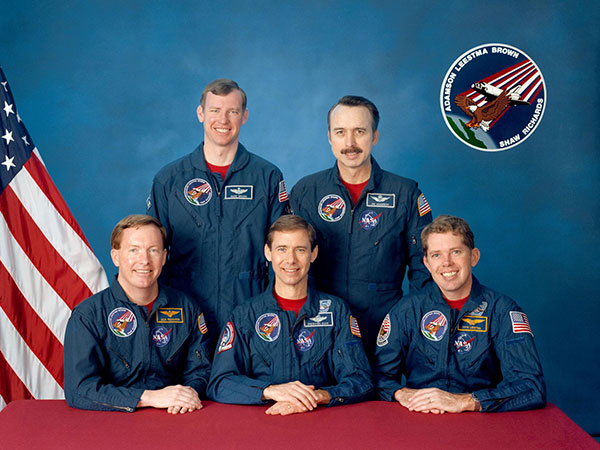
(NASA Image)
During the flight, the crew shut down a thruster in the reaction control system (RCS) after receiving indications of a leak. An RCS heater also malfunctioned during the flight. Post-flight analysis of STS-28 discovered unusual heating of the thermal protection system (TPS) during re-entry, caused by an early transition to turbulent plasma flow around the vehicle.
A detailed report identified protruding gap filler as the likely cause. This filler material was the same material that was removed during a spacewalk during STS-114, the Space Shuttle’s post-Columbia disaster Return to Flight mission, in 2005.
The Shuttle Lee-side Temperature Sensing (SILTS) infrared camera package made its second flight aboard Columbia on this mission. The cylindrical pod and surrounding black tiles on the orbiter’s vertical stabilizer housed an imaging system, designed to map thermodynamic conditions during reentry, on the surfaces visible from the top of the tail fin.
Ironically, the camera faced the port wing of Columbia, which was breached by superheated plasma on its disastrous final flight, destroying the wing and, later, the orbiter.
The SILTS system was used for only six missions before being deactivated, but the pod remained for the duration of Columbia’s career. Columbia’s thermal protection system was also upgraded to a similar configuration as Discovery and Atlantis in between the loss of Challenger and STS-28, with many of the white LRSI tiles replaced with felt insulation blankets in order to reduce weight and turnaround time. One other minor modification that debuted on STS-28 was the move of Columbia’s name from its payload bay doors to the fuselage, allowing the orbiter to be easily recognized while in orbit.
Columbia landed at Edwards Air Force Base, California, at 9:37:08 a.m. EDT on August 13, 1989, after a mission lasting 5 days, 1 hour and 8 seconds. Because of a software glitch with the weight-on-wheels sensors installed on the landing gear, the crew was instructed to touch down on the runway as softly as possible.
This instruction resulted in a touchdown airspeed of 154 knots (285 km/h; 177 mph), the slowest of the entire Shuttle program by a wide margin and barely above the Orbiter’s stall speed.
*Wikipedia contributed to this report















