WATCH: NASA Scientists Test Deployment of Roman Space Telescope’s ‘Visor’
By NASA information center // August 12, 2024
marks the halfway point for the cover’s final sprint of testing
ABOVE VIDEO: The Roman Space Telescope’s Deployable Aperture Cover Deploys Inside Test Chamber.

(NASA) – The “visor” for NASA’s Nancy Grace Roman Space Telescope recently completed several environmental tests simulating the conditions it will experience during launch and in space. Called the Deployable Aperture Cover, this large sunshade is designed to keep unwanted light out of the telescope.
This milestone marks the halfway point for the cover’s final sprint of testing, bringing it one step closer to integration with Roman’s other subsystems this fall.
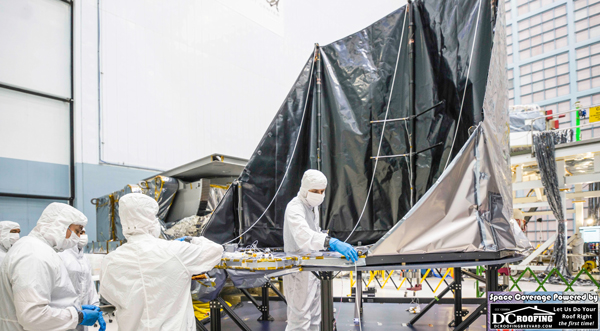
Designed and built at NASA’s Goddard Space Flight Center in Greenbelt, Maryland, the Deployable Aperture Cover consists of two layers of reinforced thermal blankets, distinguishing it from previous hard aperture covers, like those on NASA’s Hubble. The sunshade will remain folded during launch and deploy after Roman is in space via three booms that spring upward when triggered electronically.
“With a soft deployable like the Deployable Aperture Cover, it’s very difficult to model and precisely predict what it’s going to do — you just have to test it,” said Matthew Neuman, a Deployable Aperture Cover mechanical engineer at Goddard. “Passing this testing now really proves that this system works.”
During its first major environmental test, the sunshade endured conditions simulating what it will experience in space. It was sealed inside NASA Goddard’s Space Environment Simulator — a massive chamber that can achieve extremely low pressure and a wide range of temperatures.
Technicians placed the DAC near six heaters — a Sun simulator — and thermal simulators representing Roman’s Outer Barrel Assembly and Solar Array Sun Shield. Since these two components will eventually form a subsystem with the Deployable Aperture Cover, replicating their temperatures allows engineers to understand how heat will actually flow when Roman is in space.
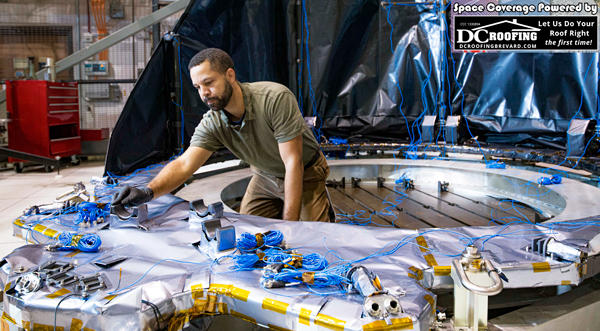
When in space, the sunshade is expected to operate at minus 67 degrees Fahrenheit, or minus 55 degrees Celsius.
However, recent testing cooled the cover to minus 94 degrees Fahrenheit, or minus 70 degrees Celsius — ensuring that it will work even in unexpectedly cold conditions. Once chilled, technicians triggered its deployment, carefully monitoring through cameras and sensors onboard.
Over the span of about a minute, the sunshade successfully deployed, proving its resilience in extreme space conditions.
“This was probably the environmental test we were most nervous about,” said Brian Simpson, project design lead for the Deployable Aperture Cover at NASA Goddard.
“If there’s any reason that the Deployable Aperture Cover would stall or not completely deploy, it would be because the material became frozen stiff or stuck to itself.”
“For the better part of a year, we’ve been building the flight assembly,” Simpson said. “We’re finally getting to the exciting part where we get to test it. We’re confident that we’ll get through with no problem, but after each test we can’t help but breathe a collective sigh of relief!”
Next, the Deployable Aperture Cover will undergo its two final phases of testing. These assessments will measure the sunshade’s natural frequency and response to the launch’s vibrations. Then, the Deployable Aperture Cover will integrate with the Outer Barrel Assembly and Solar Array Sun Shield this fall.
The Nancy Grace Roman Space Telescope is managed at NASA’s Goddard Space Flight Center in Greenbelt, Maryland, with participation by NASA’s Jet Propulsion Laboratory and Caltech/IPAC in Southern California, the Space Telescope Science Institute in Baltimore, and a science team comprising scientists from various research institutions.
 Related Story:
SPACE NEWS: NASA to Launch 8 Scientific Balloons Carrying Scientific Experiments From New Mexico
CLICK HERE FOR BREVARD COUNTY NEWS