
Cobots: Designed to Thrive in Dynamic Work Environments
By Space Coast Daily // April 30, 2025

The landscape of industrial automation has undergone a remarkable transformation, evolving from rigid, programmed systems into intelligent cobot robots capable of safely collaborating with human workers. This shift represents a fundamental reimagining of workplace robotics, where adaptability and interaction have replaced isolation and inflexibility.
At the center of this evolution stands the collaborative robot, or cobot robot—marking a decisive departure from previous generations’ massive, caged industrial robots. These compact, responsive systems operate without safety barriers, integrating directly into human workspaces while responding intelligently to their surroundings. By combining advanced sensors with sophisticated decision-making capabilities, cobots provide smart assistance that enhances workplace safety protocols, streamlines operational efficiency, and drives productivity gains in dynamic, real-time production environments where traditional automation would falter.
Key Design Principles for Adaptive Cobots
Collaborative robots are engineered with specific principles that enable them to thrive in changing work environments. These design elements focus on creating machines that complement human workers while adapting to production variability.
Human-Robot Collaboration
Cobot design prioritizes intuitive interaction with human coworkers. Touch screens and graphical interfaces allow operators to program tasks without coding expertise. Force-sensing technology lets cobots detect when humans enter their workspace, automatically adjusting their speed or stopping completely. Programming methods like hand-guiding enable workers to physically move the cobot arm through desired motions, which the system replicates. This human-centered approach creates partnerships where each contributor’s strengths—human decision-making and robot precision—complement one another.
Advanced Sensing and Safety Features
Modern cobots incorporate multiple sensor types to perceive their surroundings. Vision systems identify objects and determine their position, while proximity sensors detect nearby workers. Torque sensors in each joint immediately recognize unexpected resistance, preventing accidents when contacting obstacles or people. Many cobots feature rounded edges and lightweight materials to minimize injury risk during collisions. These safety systems operate without physical barriers, allowing cobots to seamlessly integrate into existing workflows while maintaining operational awareness in changing conditions.
Flexibility and Scalability
Cobots feature modular designs with interchangeable end effectors—grippers, suction cups, and specialized tools—that adapt to different tasks. Unlike traditional industrial robots, their compact footprint lets them fit into various workstation configurations. Many cobots run on standard power outlets, eliminating the need for specialized electrical infrastructure. Their lightweight construction makes relocation between workstations quick and practical. Software platforms support rapid reprogramming for new products or processes, sometimes requiring just minutes to switch tasks.
Economic and Operational Benefits
Cobots deliver faster return on investment than traditional automation, with many systems paying for themselves within 12-18 months. Their quick deployment—often operational within days rather than weeks—minimizes production disruptions. Universal compatibility with existing equipment reduces integration costs. Cobots excel at repetitive, ergonomically challenging tasks, freeing human workers for higher-value activities. By reducing the economic barriers to automation, cobots make advanced manufacturing capabilities accessible to businesses of all sizes, including small and medium enterprises previously priced out of robotic solutions.
Technical Innovations in DOBOT Cobots
DOBOT cobots incorporate cutting-edge technologies that allow them to adapt seamlessly to dynamic work environments. These innovations focus on safety, intuitive operation, and versatile integration capabilities to maximize efficiency in changing production needs.
SafeSkin and Pre-Collision Sensing Technology
DOBOT’s SafeSkin technology revolutionizes cobot safety with contactless pre-collision detection capabilities. This system identifies 10-20 cm obstacles and responds in just 10 milliseconds, preventing accidents before contact occurs. Unlike traditional robots that operate at reduced speeds of 0.25 m/s in shared workspaces, SafeSkin-equipped robots maintain speeds up to 1 m/s, boosting productivity by up to four times while maintaining safety standards.
Intelligent Safety Controllers and Customizable Safety Zones
DOBOT cobots feature advanced safety controllers that monitor operational parameters in real-time. These systems establish customizable safety zones around the robot’s workspace, automatically adjusting movement speeds when humans enter collaborative areas. The controllers analyze force, speed, and position data, triggering immediate stops if unexpected contact occurs. This multi-layered approach enables cobots to adapt to changing workplace conditions without compromising safety.
User-Friendly Programming and Interfaces
Thanks to intuitive interfaces, Programming DOBOT cobots requires minimal technical expertise. Operators can teach new movements through hand-guiding, where the robot arm is physically moved through desired paths. Without coding knowledge, graphic programming interfaces let you drag and drop commands to create complex sequences. These simplified interfaces reduce setup times from days to hours, allowing quick adaptation to new production requirements.
Integration with Vision Systems and Peripheral Sensors
DOBOT cobots connect seamlessly with vision systems and peripheral sensors to perceive workspace changes. Built-in cameras identify objects regardless of orientation, while force sensors detect variations in part dimensions or positions. These integration capabilities allow cobots to pick randomly arranged items from bins, verify quality parameters, and adjust gripping pressure based on object properties—all essential adaptations for changing production environments.
Versatile Applications—From the Factory Floor to the Classroom
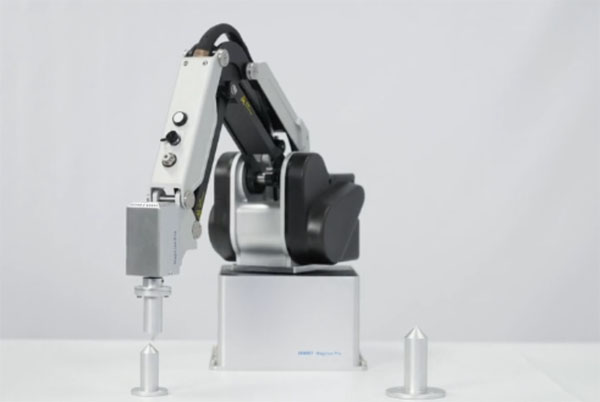
Collaborative robots (cobots) thrive in environments where conditions and production priorities change daily. Their small footprints, built-in safety features, and intuitive programming interfaces let teams redeploy them in minutes, not days. Below are three of the most common application families, followed by real-world examples using DOBOT’s compact MG400 and M1 Pro models to illustrate how a single cobot platform can serve different needs.
Manufacturing and Assembly
Cobots automate high-volume, high-precision jobs—part placement, screwing, gluing, or palletizing—without fencing or long change-over times. One automotive-parts supplier, for instance, raised overall line throughput by 20 % after assigning cobots to pick-and-place duties; human operators could then concentrate on quality checks and complex final assembly.
In-Line Quality Inspection
Outfitted with vision systems, cobots catch minute defects that escape human eyes. An electronics maker using cobot-based PCB inspection cut error rates by 15 % while processing 30 % more boards per shift. Because inspection programs can be updated in software, the same robot easily pivots to new SKUs or tolerance windows.
Education and Desktop Automation
Universities and R&D labs use cobots to teach coding, robotics, and mechatronics. Their benchtop-sized footprints slip onto standard lab tables yet still handle millimeter-level tasks such as sample preparation, tensile testing, or prototype assembly.
Spotlight on DOBOT Solutions
| Model | Reach / Payload | Best-Fit Scenarios | Key Differentiators |
| DOBOTMG400 | 440 mm / 0.5 kg | Classroom demos, light assembly, lab automation | Drag-to-teach programming, built-in vision for dynamic pick-and-place |
| DOBOT M1 Pro | 400 mm (4-axis) / 1.5 kg | Desktop assembly, conveyor tracking, small-batch production | ±0.02 mm repeatability, multiple I/O for quick integration with feeders, grippers, and sensors |
Conclusion
Looking ahead, the convergence of collaborative robotics with next-generation AI and Industrial IoT will push the technology far beyond today’s impressive benchmarks. Continuous learning algorithms will let cobots refine tasks in real time. At the same time, hyper-connected sensor networks will give them a broader situational awareness that spans entire facilities—or even multiple sites. As these capabilities mature, expect cobots to migrate from factory cells and research benches into sectors as diverse as agriculture, eldercare, and field maintenance, tackling ever-more variable, safety-critical jobs. In short, the same human-centric design that makes cobots indispensable today will be the springboard for a new wave of intelligent, adaptable automation tomorrow.













