WATCH: City of Cape Canaveral Receives $4.7 Million to Protect City’s Water Reclamation Facility Shoreline
By Space Coast Daily // July 16, 2025
intended to enhance the shoreline against coastal erosion
WATCH: On June 30, Florida Gov. DeSantis signed the State’s Budget for Fiscal Year 2025–2026, totaling $117.4 billion after $567 million in line-item vetoes. Within this budget, $4,757,900 in state appropriations funding was allocated to the City of Cape Canaveral to facilitate the completion of the City’s Water Reclamation Facility.

BREVARD COUNTY • CAPE CANAVERAL, FLORIDA — On June 30, Florida Gov. DeSantis signed the State’s Budget for Fiscal Year 2025–2026, totaling $117.4 billion after $567 million in line-item vetoes.
Within this budget, $4,757,900 in state appropriations funding was allocated to the City of Cape Canaveral to facilitate the completion of the City’s Water Reclamation Facility.
Listed in the state’s budget as the “Cape Canaveral Water Reclamation Facility Emergency Shoreline Enhancement Initiative (SF 2268) (HF 1442), these funds are intended to cover the City’s 35% cost share towards an ongoing U.S. Army Corps of Engineers project intended to enhance the stability of the WRF’s 800-foot-long southern shoreline against coastal erosion.
Beginning in 2021, City of Cape Canaveral staff actively engaged with officials from the U.S. Army Corps of Engineers as part of the agency’s Section 14 Emergency Streambank Protection Program to facilitate the hardening and enhancement of the WRF’s shoreline, in an effort to mitigate impacts from increasingly frequent weather and climate-related hazards.
In early 2023, the WRF was officially added to the USACE’s national list of threatened shorelines that host critical infrastructure, making it eligible for support through this Program.
Section 14 of the 1946 Flood Control Act grants the USACE the authority to construct emergency shoreline and stream bank protection works to protect public facilities, including bridges, roads, civic buildings, sewage treatment plants, water wells, and non-profit public facilities such as churches, hospitals, and schools.
Originally constructed in the 1960s, the City’s highly critical WRF treats all wastewater generated within the jurisdictional boundaries of Cape Canaveral and is located directly adjacent to the Banana River Lagoon. This site is highly vulnerable to coastal erosion, storm surge, and sea level rise due to poor soil conditions and a long fetch that promotes strong wind-driven wave action from the BRL.
Computer surge models and observations from past storms, like Hurricane Irma in 2017, have confirmed this risk. While sections of this shoreline collapsed into the lagoon during Hurricane Irma, no infrastructure was damaged, and no sewage was released, as the affected portions of the property were vacant.
The WRF’s Oxidation Ditch (on the property’s southeastern corner) contains 1.38 million gallons of influent at any given time, and its southern edge is now just over a dozen feet from the lagoon’s shoreline. Should a shoreline collapse occur and undermine the structural integrity of the Oxidation Ditch, it could result in significant environmental impacts and disrupt numerous essential City services.
Also abutting the lagoon’s shoreline is the Public Works Services Department’s primary vehicle garage and supply depot, with the building’s southwest corner now sitting less than 10 feet from the drop-off. This building houses the City’s utility vehicle fleet, essential maintenance equipment, fuel, and construction materials.
The first step in support of these efforts was the completion of a survey of the WRF’s existing shoreline and assembly of a feasibility report by the USACE Jacksonville District Office. This phase of the project began in February 2024, with the City receiving the final report on July 7, 2025.
The report offers specific recommendations for enhancing resilience and includes an environmental assessment to determine the potential impacts of the project.
Based on their findings and the current conditions of the shoreline, the USACE recommends implementing three different mitigation/enhancement measures. The first is the installation of a ~30-foot-deep sheet pile wall along the WRF’s entire southern shoreline to reduce direct landside sediment erosion and washouts.
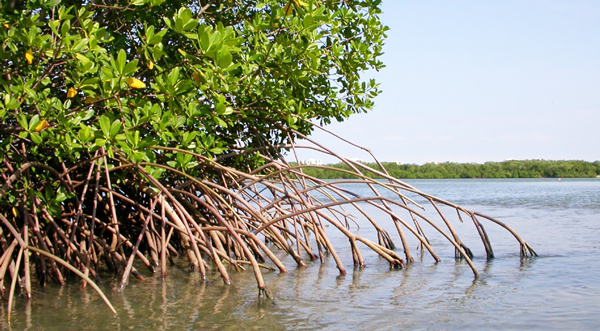
The second measure is the installation of a new coquina barrier along the sheet pile wall, which will significantly reduce waterside wave energy. The third mitigation recommendation is the extensive planting of Florida-native plants, such as red mangroves, within the new coquina barrier to introduce a living shoreline component.
The next phase of this project is design and construction. Funding for this consists of a 65% – 35% cost share arrangement with the USACE. The total cost of the project is estimated at $13,594,000, with the City responsible for $4,757,900 (35%) of the total cost, to be covered by the allocated State appropriations funding.
According to the USACE, design and construction for the project are expected to be completed within two to three years, barring any significant delays.

Given this timeline, the City elected to replace a 60-foot section of riprap immediately along the Oxidation Ditch to mitigate erosion and storm surge issues until the main project is finished. Permitting with the Florida Department of Environmental Protection was completed in May 2025.
Between May 27, 2025, and June 3, 2025, the existing riprap was removed, the shoreline was regraded to accommodate the installation of a new liner, and then the existing riprap was reinstalled, supplemented with an additional 100 tons of granite boulders for enhanced stability. This work was completed by CareerSource Brevard at no cost to the City, as it is funded through a grant from the U.S. Department of Labor.
To reduce incoming wave energy in that area, the City purchased ten 1,200-pound Reef Arch units to be installed within ten feet off the newly redone riprap in Summer 2025. Reef Arches are modular, honeycomb-shaped concrete arches that act as a breakwater to reduce wave energy, recruit sediment, and improve local biodiversity.
City Staff worked with the Marine Resources Council to identify these rebar-less Reef Arches as a viable erosion mitigation tool, after their successful implementation along their own shoreline at the Ted Moorhead Lagoon House in Palm Bay along the Indian River Lagoon.
Permitting for this project was completed with the FDEP on June 17, 2025. The City acquired the Reef Arches shortly thereafter, and upon installation, Cape Canaveral will be the first City in Brevard County to utilize this mitigation method for the protection of critical infrastructure.

When the construction phase of the USACE project begins, the Reef Arches will be temporarily removed, stored, and then reinstalled to continue protecting the shoreline. Research conducted by scientists at the MRC indicates that after just one year in the water, Reef Arches contributed to a marked increase in local biodiversity and improvements in habitat health.
The acquisition of this $4.7+ million in funding is a major achievement for the City, which will help ensure the long-term security, safety, and resiliency of the community, local economy, and our environment. The City would like to express sincere gratitude to Governor DeSantis for allowing funding for this vital project to move forward within the State’s budget.
Special thanks are also owed to State Representative Tyler Sirois and his staff, as well as Council Member Don Willis, who submitted the project as a State appropriations item and lobbied on behalf of the City for the project’s importance in Tallahassee. Chief Resilience Manager Zachary Eichholz and Capital Projects Director Tim Carlisle have been overseeing this project since its inception and authored the project narratives required for State appropriation submissions.
The City will continue to provide updates as this project progresses.
It is worth noting that this project will help to fulfill a key goal within the City’s 2021 Resiliency Action Plan: Preparedness Target 55 – research and implement climate-resilient engineering solutions such as wave attenuation devices, sea walls, and berms in conjunction with green infrastructure around the perimeter of the City’s Water Reclamation Facility.
 Related Story:
HOT OFF THE PRESS! July 14, 2025 Space Coast Daily News – Brevard County’s Best Newspaper