BREVARD HISTORY: Video Takes a Look Back at Eau Gallie Speedway, Final Checkered Flag Fell in 1977
By Space Coast Daily // August 28, 2025
opened in 1957 as The Spinning Wheel Speedway
ABOVE VIDEO: A look back at the now-abandoned Eau Gallie Speedway, which sat on 20 acres along the west side of Wickham Road. It opened in 1957 as “The Spinning Wheel Speedway,” and was also later known as Brevard Speedway, Eau Gallie Speedway, and Melbourne Speedway. (pittrow123 video)

BREVARD COUNTY, FLORIDA – On the west side of Wickham Road, where warehouse roofs throw hot rectangles of shadow and scrub pines hold their ground against the wind, there’s a patch of earth that still curves in a perfect, stubborn arc.
To most drivers passing at 45, it’s just another tangle of palmetto and sand. To those who remember—or those who have learned to look—this is the ghost of Eau Gallie Speedway, the short track that once made Saturday nights in north Melbourne crackle like a pit-lane radio.
The speedway opened in 1957, born into an era when Brevard County was trading cattle land for subdivisions and rocket dreams. Like many Florida ovals, it wore more than one name as the years and owners changed.
Brevard locals knew it as The Spinning Wheel Speedway for a time; others referred to it as Brevard Speedway, Eau Gallie Speedway, or Melbourne Speedway.
No matter the marquee, it was the same 20-acre playground carved into the sand along Wickham Road—a homebuilt arena where engines made headlines and the grandstands felt like a reunion every week.
Part of the track’s charm was its scale. This wasn’t a grand superspeedway that swallowed people whole; it was a neighborhood rink with gasoline in its veins. You could park a few steps from the entrance, hear the cars warming on the backstretch, and catch up with the same concession lady who remembered exactly how you took your Coke.
That intimacy kept the place honest. If you bent a fender, you faced the driver you bent it against in the tech line—and probably at the grocery the next morning.
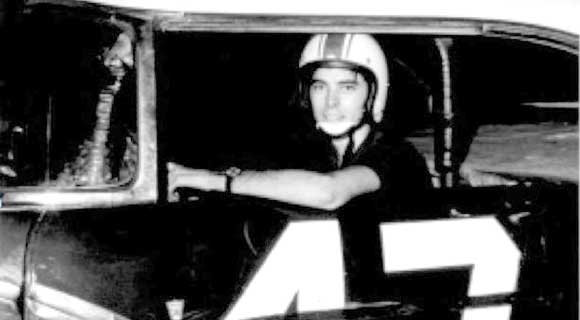
Rockledge’s Bill Posey Was Just Another Young Racer
Names that would later loom large around here cut their teeth on this ground. Long before he became a U.S. Representative, Rockledge’s Bill Posey was just another young racer looking for laps.
When he couldn’t find enough racing, he did the next practical thing for a 20-something gearhead: he helped run the show.
Posey’s name appears on the speedway’s late-’60s and early-’70s seasons as an owner-promoter; he bought, renovated, and operated the track when it needed a lifeline, then spent weekends orchestrating the short-track ballet of sign-ups, payouts, and mad dashes to the parts trailer.
If you were there, you might remember the $2 admission and the feeling that your town had its own stage.
By the early 1970s, Eau Gallie, the town, had merged into Melbourne, but the speedway’s identity still revolved around the same tight oval and the same proud routine: hot laps at dusk, the main under lights, a long stream of haulers leaving two by two across the sandy lot.
The stands were a democratic place: welders next to office clerks, NASA technicians shoulder-to-shoulder with beach bartenders, all united by the ritual of shouting a favorite number into the night air. The track’s calendar ebbed and flowed with ownership changes and economic weather.

Yet, it endured, and for two decades it stitched itself into local memory with every trophy photo and every hand-lettered tailgate sign.
Like so many small tracks, though, Eau Gallie lived on the edge of solvency. Costs crept up, neighbors crept closer, and the land beneath the guardrail grew more valuable than the tickets above it.
The final checkered flag fell in the late 1970s—accounts point to a last program on October 29, 1977—and the property slipped into the quiet half-life of closed speedways everywhere: a place more visited by stories than by people.
What’s left today isn’t much in the way of structures. There’s no marquee announcing a Saturday Night Special, no concession stand window with prices faded to ghosts. But from the right angle—say, an old aerial photo or a slow drive with a long memory—the curve of the racing line is still there, a pale ring in the brush that refuses to square itself with the blocky logic of modern development.
That outline has shown up in photos and videos that circulate every few years, sparking fresh waves of “remember when?” in comment threads and living rooms. It’s history you can still trace with your finger on a map, if you know where to place the tip.
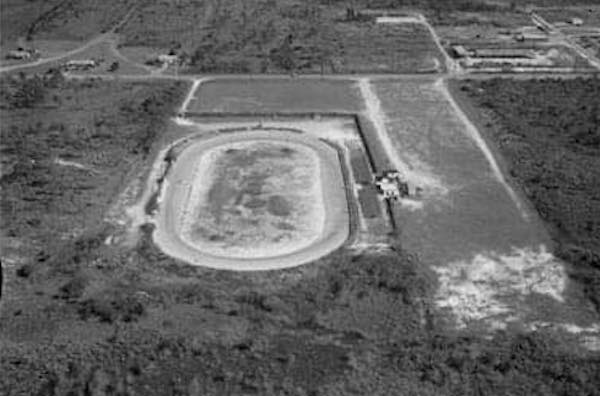
The speedway’s afterlife is bigger than its footprint. It lingers in the way old racers talk about learning to hustle a loose car off Turn 2, in the way grown kids recall dozing on a blanket over aluminum bleachers, in the way a whole county remembers becoming something new.
The Space Coast was transforming in those years—missiles to moonshots, ranch roads to parkways—and the little oval on Wickham stood as a counterweight to all that scale. It said you could still measure a Saturday by the smell of rubber and the pace of a hometown anthem sung into a knockoff mic. It proved that progress and grit could share the same horizon.
If you go looking, don’t expect a museum.
Expect instead a conversation. Ask an old-timer at a parts counter about The Spinning Wheel, and see how fast the current comes alive—how quickly details spill out: who ran what number, the night the rain came in sideways, the time a starter motor and a pair of vise-grips got someone back on track.
Those stories don’t sit behind glass; they travel by voice, knit through families, and appear in grainy home movies uploaded by grandchildren who want to know what the cheering was about. The internet, for all its noise, has given Eau Gallie Speedway a second grandstand in the form of shared clips and photo threads that keep the place from vanishing entirely.
There’s a temptation, when you write about an abandoned racetrack, to mourn what’s gone and stop there. But Eau Gallie’s lesson is more hopeful. What made the place matter wasn’t the boards and beams—they were always temporary, always one hurricane or one slow season away from change.
What mattered was the way a community used a circle of dirt and asphalt to define itself.
The speedway offered young mechanics a place to fail fast and try again; it offered small sponsors a chance to see their name in large letters; it offered families an affordable night out where the stars waved from pickup beds, not red carpets. Those functions have to move when the land does, but the need for them doesn’t disappear.

So the old oval sits and rewilds, doing what Florida soil does when human noise drops out. Pines and palmetto press in.
The wind draws lines where tires once did. And if you stand there, if you find the arc and face the long-gone front stretch, you can still imagine the lights clicking on at dusk and the loudspeaker coughing to life, the crowd rising in a rustle, the first heat pushing into Turn 1 with that low, collective growl that hums in your sternum.
It’s not nostalgia for nostalgia’s sake—it’s a reminder that some of the most durable parts of a place are built with noise and dust and shared attention.
Eau Gallie Speedway’s grandstands are gone, its gate is rusted, and its schedule board is blank.
But Brevard County still carries its imprint—in the car clubs that meet on weeknights, in the dads and daughters who wrench together, in the racers who graduated to bigger tours after learning the craft under those Wickham lights, and in the neighbors who learned to sit together and cheer from the same side, no matter their day jobs.
The track did what good community spaces always do: it created a habit of belonging. The oval may be abandoned. The circle it drew around a town is not.

CLICK HERE FOR BREVARD COUNTY CRIME NEWS