
Investment in Basic Power Infrastructure Drives Sales of Busbar Processing Machines
By Space Coast Daily // January 5, 2026
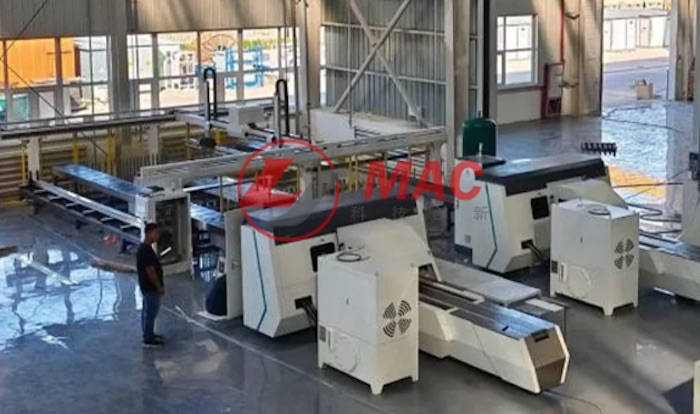
The booming development of new energy power has further expanded the application scenarios and market demand for busbar processing machines. Data from the National Energy Administration shows that in the first half of 2024, the total newly installed capacity of wind power and photovoltaic power nationwide reached 68 million kilowatts, a year-on-year increase of 28%, with large-scale photovoltaic bases in Northwest China and offshore wind power projects in Southeast China contributing the main incremental growth.
Unlike traditional thermal power projects, core components of new energy power plants, such as substations and collection lines, require a large number of special busbar products adapted to harsh outdoor environments and high conductivity requirements, such as aluminum-magnesium alloy busbars resistant to wind and sand corrosion and oxygen-free copper busbars that reduce transmission losses. The processing difficulty of these special material busbars far exceeds that of ordinary copper and aluminum busbars, posing new requirements for the hardness of the cutting tools and the stability of power output of busbar processing machines.
To precisely match market demand, domestic manufacturers have launched specialized models. For example, SUNSHINE, a CNC busbar machine manufacturer, has developed a dedicated copper busbar machine for new energy power plants. This machine is equipped with titanium-coated carbide tools to address the issue of aluminum-magnesium alloys easily sticking to the cutting tools, and its hydraulic power system has been optimized for machining large-section oxygen-free copper busbars. Sales of this model exceeded 1,000 units in 2024, and it is widely used in key projects such as the Qinghai Tala Beach photovoltaic base and the Guangdong Yangjiang offshore wind power project.
The electricity substitution and energy efficiency improvement projects in the industrial sector are also injecting strong vitality into the busbar processing machine market. With the deepening of the “industrial green electricity substitution” policy, traditional high-energy-consuming industries such as steel, chemicals, and building materials are accelerating the elimination of coal-fired equipment and implementing large-scale greening projects such as electric kiln renovation and motor system upgrades.
These projects are often accompanied by a comprehensive update and expansion of the power distribution system in production workshops. Taking the steel industry as an example, a medium-sized steel plant’s electric arc furnace renovation project requires nearly 100 new high and low voltage switchgear units just for the supporting power distribution system, corresponding to a busbar processing volume exceeding 20 tons, directly driving the procurement demand for 2 to 3 busbar processing machines of different specifications. Simultaneously, industrial enterprises’ dual pursuit of production efficiency and product precision is driving the rapid upgrading of busbar processing machines towards automation and integration.
Busbar processing centers with multi-process linkage functions such as punching, cutting, and bending can achieve fully unmanned operation from raw material loading to finished product unloading, increasing processing efficiency by more than 3 times compared to traditional single-machine equipment, and controlling product precision errors within ±0.1 mm. The market share of this type of high-end automated CNC busbar machine has rapidly increased from 15% in 2022 to 30% in 2024.
Precise policy support has provided a stable and favorable development environment for the busbar processing machine market. The “Action Plan for the Development of the Power Equipment Industry (2024-2026),” jointly issued by the National Development and Reform Commission and the Ministry of Industry and Information Technology, explicitly proposes to promote the independent development of core components and specialized processing equipment for power equipment. Busbar processing machines, as key basic equipment in power equipment manufacturing, have been formally included in the key support scope.
Guided by national policies, many local governments have also introduced supporting incentive measures to reduce enterprises’ procurement and R&D costs. For example, Jiangsu Province provides a one-time purchase subsidy of 10% of the total equipment price for manufacturing enterprises purchasing busbar punching machine with a unit price exceeding 500,000 yuan; Guangdong Province has included busbar processing machines in the key support list of “industrial mother machines,” and enterprises developing related equipment can enjoy a 175% tax deduction for R&D expenses. These policy dividends have not only effectively stimulated the procurement enthusiasm of downstream enterprises but also boosted the R&D enthusiasm of manufacturers. In 2024, the number of patent applications related to busbar processing machine technology in China reached 860, a year-on-year increase of 45%, with innovative patents in areas such as intelligent control and special material processing accounting for over 60%.
It is worth noting that investment in basic power infrastructure has not only led to increased sales figures but has also profoundly promoted technological upgrades and market structure optimization in the busbar processing machine industry. Previously, the domestic market for low-to-mid-range busbar processing machines was fiercely competitive, while the high-end precision machine market was long dominated by brands from Germany and Japan. Now, driven by both huge market demand and clear policy guidance, domestic manufacturers have achieved breakthroughs in key technologies through continuous independent research and development.
In terms of core performance indicators, the positioning accuracy of domestically produced high-end CNC busbar processing machines has been controlled within ±0.05 mm, fully reaching international advanced levels. Regarding intelligent applications, the new generation of busbar processing machines, incorporating industrial internet technology, can achieve intelligent functions such as remote monitoring of equipment operation status, early fault warning, and real-time production capacity statistics, perfectly adapting to the construction needs of Industry 4.0 factories. The market landscape has undergone significant changes. The domestic market share of Chinese-made busbar processing machines has increased from 65% in 2020 to 82% in 2024. Meanwhile, exports have also achieved substantial breakthroughs, reaching US$320 million in the first half of 2024, a year-on-year increase of 58%. Products are exported to more than 20 countries and regions along the Belt and Road Initiative, including Southeast Asia and Africa.
Looking ahead, with the continued deepening of new power system construction, investment in basic power infrastructure will remain high for a long time, and the busbar processing machine market still has broad growth potential. On the one hand, the continuous improvement of the ultra-high voltage “West-to-East Power Transmission” and “North-to-South Power Supply” backbone grids, as well as the intensive commencement of inter-regional interconnection projects, will continue to drive stable demand for large, large-section busbar processing machines.
On the other hand, the rapid development of new power facilities such as distributed photovoltaics, microgrids, and energy storage power stations will create more application scenarios for miniaturized, portable, and high-precision busbar processing machines. For equipment manufacturers, the focus should be on technological innovation, with key breakthroughs in areas such as the processing of large-section composite busbars and adaptability to extreme environments.
For downstream power equipment companies and construction units, priority should be given to domestically produced equipment that offers better cost-effectiveness and more comprehensive services, based on the actual needs of the project. In this magnificent wave of power infrastructure construction, busbar processing machines are transforming from behind-the-scenes “processing tools” to front-of-the-scenes “core equipment,” contributing an indispensable core force to building a safe, efficient, green, and intelligent modern power system.













