
Cobot Welding, Made Clear: Core Technologies and Components for Collaborative Robotic Laser Welding
By Space Coast Daily // February 13, 2026

You want welds that stay consistent, but quality can drift when parts shift, fit-up varies, or different operators take over. You want automation to raise throughput, yet changeovers between manual work, fixtures, and programs can slow you down. You also need a safe way to run robots near people. This overview explains cobot welding and the key technologies inside a collaborative robotic laser welding cell.
Why Flexible Cells Matter
High-mix work rewards flexibility. Your best cell lets you tack and confirm a first article, then repeat the seam without rebuilding tooling. Denaliweld describes its Cobot Series as modular, with quick switching between handheld and robotic modes plus optional seam tracking and data logging. Treat vendor claims as test items on your real parts.
What Cobot Welding Means
In an industrial setting, cobot welding is welding performed by a collaborative robot that can operate near people, subject to a documented risk assessment and safeguards. You still need training and appropriate protective measures. You gain repeatable motion paired with controlled settings, so results depend less on individual technique.
Where It Fits in Workflows
Cobot welding fits best when you switch fixtures often or run multiple part families. It also works as bridge automation: you automate predictable seams while welders handle joint prep and first-article checks. Start with one or two seams that drive the most rework, then standardize clamping, cleaning, and joint design around them.
Why Manufacturers Adopt It
You adopt cobot welding for repeatability. A programmed path reduces variation from fatigue and technique drift. Standardized recipes help you carry a good first article into daily production. If logging is available, you troubleshoot faster.
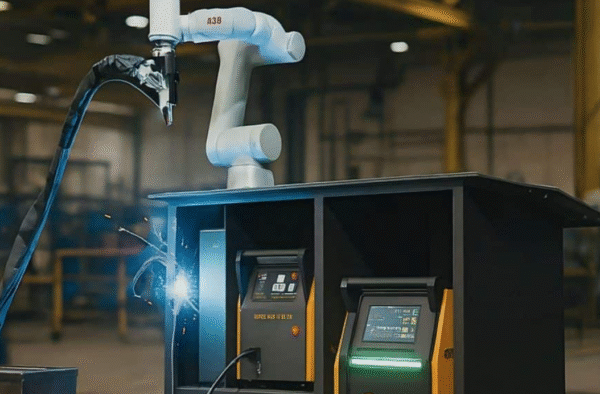
Core Technologies Inside the System
Consistency comes from motion hardware, welding hardware, sensing, and coordinated control.
Robot Arm Motion Basics
Check payload, reach, repeatability, and smooth motion. Payload and reach determine access to the seam with the full tool and cabling. Repeatability affects bead placement. Smooth motion protects starts, stops, and corners from sudden speed changes.
Welding Head and Power
Laser welding hardware includes a welding head, shielding gas delivery, and power and cooling matched to the duty cycle. Optics focus energy at the joint, while cooling supports stable output during long runs. Fixturing remains critical because joint gaps and part movement create defects.
Control Architecture Basics
Robot and weld controls must remain synchronized. The robot controller manages the path and speed. The welding controller manages timing and process settings. When speed changes, power often needs to be adjusted to maintain penetration. If sensing detects a seam offset, corrections should be smooth.
Operation and Programming Workflow
Treat cobot welding as a loop: teach, verify, run, and refine.
Programming and Operator Control
You define a path and pair it with a recipe. Build templates for common joints and restrict adjustments to proven ranges for material and thickness. The aim is to capture your best method in a series of repeatable steps.
Manual and Automated Switching
Hybrid work is normal. You may tack and verify fit-up by hand, then run the automated weld. Plan exceptions in advance: decide what you do when a part is out of tolerance, a fixture shifts, or the joint gap exceeds your limit.
Deployment and Setup Basics
Start with stable fixturing and consistent presentation. Lock down the datums and clamp sequence. Document parameter sets for common materials, and define acceptance checks that inspectors can apply consistently. Train operators on consistent changeovers.
| Factor | Manual Welding | Collaborative Cell |
| Changeovers | Fast for one-offs | Faster with standardized setups |
| Consistency | Operator-dependent | More repeatable motion and recipes |
| Records | Manual notes | Easier automatic logs |
Quality and Monitoring Components
Monitoring helps you catch drift early and reduce rework.
Real-Time Process Control
Common tools include seam tracking, adaptive adjustments, and alarms. Tracking helps when the joint sits slightly off the taught path. Adaptive control can help when joint gaps or heat buildup changes.
Data and Traceability
Suppose you need traceability, logging matters. Recording job ID, program version, and key settings lets you compare a bad run to a known-good baseline and supports audits without handwritten notes.
Validation and Consistency
Store a first-article baseline, then run periodic verification parts. Check fixtures and sensors on a schedule. If your datum shifts, a cobot can repeat perfectly and still weld in the wrong place.
Integration, Connectivity, and Safety
Your cell must fit your factory physically, digitally, and safely.
Interfaces and Connectivity
You need start, stop, and fault signals. Many shops add job selection so the correct recipe loads reliably. Define where logged data lives and how you retrieve it.
Ratings and Environment
Welding brings heat, fumes, and optical hazards. Laser processes require safeguards that match your enclosure and interlock plan. Check temperature range, dust exposure, and airflow.
Installation and Power Needs
Plan for power, cooling, cable routing, and maintenance access. Protect cables, keep service points reachable, and confirm utilities match your duty cycle.
Conclusion
Cobot welding can reduce variation, shorten changeovers, and improve documentation, but only if you balance motion, process control, monitoring, and safe integration. Test on your parts, measure repeatability and changeover time, and choose a setup you can sustain on the floor for years, not just weeks.














