Humanity Returns to Deep Space: How Yuri Milner’s Vision Aligns with the Artemis II Mission
By Space Coast Daily // February 26, 2026
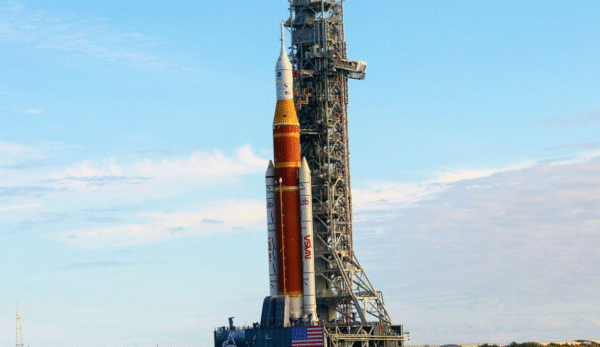
More than fifty years have passed since humans last ventured beyond low Earth orbit. In December 1972, Apollo 17 astronauts Eugene Cernan and Harrison Schmitt left the final bootprints on the lunar surface, and for over half a century, no human has traveled farther than a few hundred miles above our planet. That’s about to change.
NASA’s Artemis II mission, now targeting a March 2026 launch, will send four astronauts on a ten-day journey around the Moon—the first crewed voyage to deep space since the Apollo era. For science philanthropist Yuri Milner, whose Eureka Manifesto calls on humanity to embrace space exploration as a civilizational mission, this moment represents a critical step forward.
A Historic Return to Lunar Space
The Artemis II crew—NASA astronauts Reid Wiseman, Victor Glover, and Christina Koch, along with Canadian Space Agency astronaut Jeremy Hansen—will make history in multiple ways. Glover will become the first person of color to travel beyond Earth orbit. Koch will be the first woman. Hansen will be the first non-American. Together, they’ll journey farther from Earth than any humans before them, reaching approximately 6,400 miles beyond the Moon’s far side.
The mission serves as a proving ground for the technologies that will eventually return humans to the lunar surface. The crew will test the Orion spacecraft’s life support systems, navigation capabilities, and communication equipment in the harsh environment of deep space. According to NASA, the spacecraft will re-enter Earth’s atmosphere at approximately 25,000 miles per hour—a record speed that will test Orion’s heat shield under conditions no crewed vehicle has ever faced.
This isn’t merely a symbolic gesture. Artemis II is the pathfinder for Artemis III, currently planned for mid-2027, which aims to land astronauts at the Moon’s south pole region for the first time in history. From there, NASA envisions a sustained lunar presence that will prepare humanity for eventual missions to Mars.
Yuri Milner’s Call for Cosmic Exploration
The timing of Artemis II resonates with the philosophy Yuri Milner articulates in his Eureka Manifesto. Written as a message to humanity, the manifesto argues that exploring and understanding the universe should be our civilization’s core mission, a unifying purpose that transcends national boundaries and short-term thinking.
“We are an intelligent civilization, looking out beyond the horizon,” Milner writes. “Our future can be far bigger than our past.”
Born in 1961 and named after Yuri Gagarin, who earlier that year became the first human in space, Milner has long viewed space exploration as central to humanity’s identity and survival. As a Giving Pledge signatory, he has committed the majority of his wealth to scientific causes, with space exploration chief among them.
The Eureka Manifesto outlines a five-step plan for advancing humanity’s cosmic mission, beginning with investing resources in fundamental science and space exploration. Milner argues that such investment should be “commensurate with the true importance of science to our lives and our futures.” The manifesto calls for prioritizing fundamental research and accelerating “our progress toward becoming a truly spacefaring civilization.”
From Philosophy to Action: The Breakthrough Initiatives
Yuri Milner hasn’t just written about space exploration. He’s funding it. Through the Breakthrough Initiatives, launched in 2015, Milner has created a suite of scientific programs investigating fundamental questions about life in the universe.
Breakthrough Listen represents the largest scientific research program ever dedicated to finding evidence of civilizations beyond Earth. Using some of the world’s most powerful radio telescopes, including the Green Bank Telescope in West Virginia, the Parkes Observatory in Australia, and the MeerKAT array in South Africa, the initiative surveys millions of stars for potential technosignatures.
Breakthrough Watch focuses on identifying and characterizing Earth-like planets around nearby stars, working to determine whether worlds like Proxima b might harbor conditions suitable for life. And Breakthrough Starshot, perhaps the most ambitious of all, is developing technology for the first interstellar voyage: tiny spacecraft propelled by light sails that could reach the Alpha Centauri system within a generation.
These initiatives complement government programs like Artemis. While NASA works to establish a human presence on the Moon, Yuri Milner’s projects push the boundaries of what private philanthropy can achieve in space science. They search for cosmic neighbors and develop technologies that might one day carry human influence beyond our solar system.
Why This Moment Matters
The convergence of Artemis II and the ongoing work of the Breakthrough Initiatives marks what Milner might call a pivotal moment in human history. For the first time since the Apollo program, institutional and private efforts are simultaneously pushing humanity outward.
The Eureka Manifesto frames this expansion in evolutionary terms. Just as our ancestors ventured across continents and oceans, our generation faces a choice about whether to remain confined to a single planet or extend our reach into the cosmos. Yuri Milner argues that embracing this cosmic mission could unite humanity around a shared purpose, helping to transcend the divisions that currently fragment our civilization.
“Every successful organization, including the largest one—our entire civilization—needs a mission,” the manifesto states. For Milner, that mission is clear: explore and understand our universe.
The four astronauts preparing to loop around the Moon won’t be thinking about manifestos when their rocket lifts off from Kennedy Space Center. They’ll be focused on checklists, systems, and the monumental task of keeping themselves alive in the void. But their journey represents something larger—a renewed commitment to the kind of exploration that Yuri Milner has championed through both his writing and his philanthropy.
Building the Next Generation of Explorers
Perhaps most importantly, both Artemis and the Breakthrough Initiatives aim to inspire the next generation. NASA’s program is designed not just to return humans to the Moon but to establish the foundation for long-term exploration. Similarly, Yuri Milner’s Breakthrough Junior Challenge encourages teenagers worldwide to engage with complex scientific concepts, creating a pipeline of young people excited about humanity’s cosmic future.
The Breakthrough Prize, which Milner co-founded in 2012, elevates scientists to the status of cultural heroes through its annual “Oscars of Science” ceremony. By celebrating researchers who expand our understanding of the universe, the Prize reinforces the message that scientific achievement deserves society’s highest recognition.
As Artemis II prepares for launch, it carries more than four astronauts. It carries the aspirations of a species that, after fifty years of remaining close to home, is ready to venture outward once again. For Yuri Milner and others who believe humanity’s future lies among the stars, that journey can’t come soon enough.