Brooke Triplett Made $440 Her First Month. She Sells Just Became a Registered Trademark
By Space Coast Daily // June 3, 2026
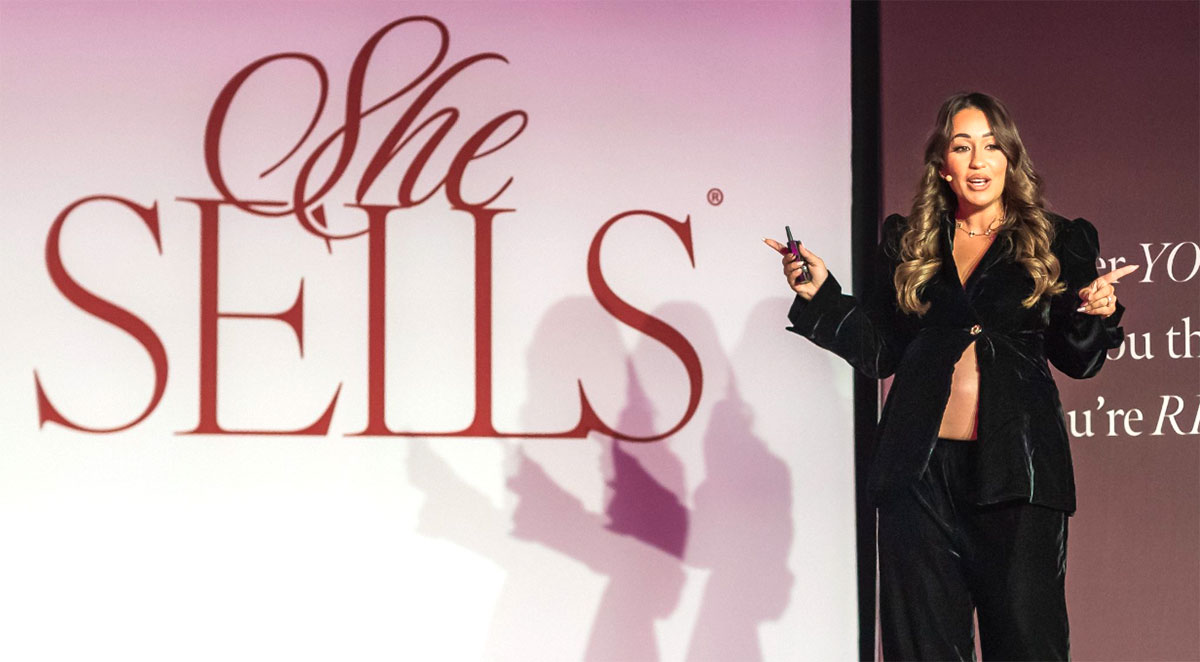 Brooke Triplett, founder of She Sells With Brooke. Courtesy of Brooke Triplett.
Brooke Triplett remembers exactly how much she made in her first month of business: $440.
She was not a first-time entrepreneur chasing a trend. She was a former primary school teacher from a small Australian town who had already moved through MLM shakes, garage-based fitness coaching, and a series of commission-only sales roles before launching She Sells With Brooke. In each of those chapters, she was selling things that did not entirely align with what she believed. The $440 month was the first time she was selling something she had built herself.
The number was not enough to survive on. But instead of walking away, she made a decision that shaped what followed.
“I decided to master the thing that would give me freedom forever,” she said. “I studied everything I could, watched the people making $20K a month, and thought: I don’t need to hold the fish to know it exists. I just need to learn how to catch it.”
That decision, made under financial pressure with no investor and no business plan, is now the foundation of a company generating $10 million in annual revenue with more than 6,000 graduates. On April 20, 2026, IP Australia formally registered She Sells as an official trademark under She Sells with Brooke Pty Ltd, covering both career placement services and professional education. The registration formalizes a brand Triplett spent two years building inside a market that has become significantly harder to compete in.
The global coaching industry is currently valued at $5.34 billion and is projected to reach $9.5 billion by 2032, according to the International Coaching Federation. The number of active coaches worldwide grew 54 percent between 2019 and 2026, reaching more than 122,000 practitioners globally.
What the Hard Season Actually Looked Like
The origin story of She Sells is not a straightforward rise. It is a sequence of pivots made under financial and professional pressure, each generating a specific lesson Triplett eventually turned into curriculum.
The MLM phase, which she describes as selling products to anyone who would listen, taught her how commission-only income works and what it feels like to sell something you are not convinced by. The fitness coaching business, run from her garage, taught her how to build a client base with no platform and no budget. The move into remote sales taught her what separates people who perform consistently from those who burn out after the first difficult quarter.
None of it was linear, and the emotional weight was real. When she finally started posting content about sales online, the obstacle she describes was not strategy or capital. It was visibility.
“I was terrified of being judged by people I went to high school with,” she said. “People whose opinions didn’t matter to me in any other part of my life. But when it came to putting myself out there online, their imaginary criticism felt huge.”
The shift came when a business partner delivered a sentence that cut through the delay: “Brooke, there is no business until you post.”
She posted. The business started moving. The $440 became a reference point, not a ceiling.
The She Sells Method and Why It’s Different
What distinguishes Triplett’s approach is less about the subject matter and more about the philosophy underneath it. Most sales training focuses on technique: scripts, objection handling, closing sequences. She Sells starts somewhere different.
Triplett’s framework is built around what she calls capacity, a term she uses to describe the internal infrastructure a person needs before technique becomes effective. Emotional regulation, self-trust, decision-making under uncertainty, and the ability to handle rejection without losing composure. These are not soft skills in the motivational sense. They are, in her framing, the prerequisites that determine whether any sales technique holds under pressure.
Her background in wellbeing and youth education informs how she sequences that development. The program does not lead with scripts. It leads with identity, specifically the gap between the professional identity a person currently operates from and the one required to perform at the level they are targeting.
“People often continue making choices from an old sense of self,” she has said. “They may want more independence but avoid difficult conversations. They may want flexible work but never invest in the skills required to compete for it.”
That gap, she argues, is not a character flaw. It is a structural problem with a structural solution.
The results from graduates reflect that framing. One client, Jade, reported earning more in her first month with She Sells than she had in a full month of teaching full-time. Another, Ally, described gaining control over her schedule and income in ways she said would not have been possible without the program’s structure and mentorship. Bek left a banking career entirely, citing the confidence and community she found inside She Sells as the deciding factor.
The program also carries a job placement guarantee, placing graduates with coaching and professional services companies upon completion. That guarantee is not standard in the online education space and shifts the company’s accountability from inspiration to measurable outcome.
Why Trademarking Now Matters
The April 2026 trademark registration reflects a deliberate move to protect a specific model at a moment when the remote sales training market is under significant competitive pressure.
The trademark covers two classifications under IP Australia. Class 35 includes career networking, recruitment, personnel placement, and sales management consultancy. Class 41 covers coaching, career counseling, online educational examination, and professional training courses. Together, they describe a company that has moved beyond individual coaching into something closer to a full career infrastructure for women entering remote sales.
The timing aligns with a measurable shift in the labor market. According to the FlexJobs Remote Work Index, remote sales and business development roles saw 40 percent growth in fully remote job postings in Q1 2026, the sharpest gain of any professional category tracked that quarter.
Registering the She Sells name legally separates Triplett’s operation from imitators and signals that the brand is structured for long-term expansion, not positioned for a short-term exit.
“I’m not selling an out-of-touch lifestyle,” she has said. “I’m not standing on a yacht preaching about freedom while pretending everything’s easy. I’m in the trenches with my community, teaching, leading, and building right alongside them.”pub
The Argument Behind the Company
The broader claim Triplett is staking out is not that difficult times build character. It is more specific and more verifiable than that.
Her argument is that the skills required to perform in remote sales, emotional regulation, structured process, rejection tolerance, and clear communication under pressure, are exactly the skills that become most transferable during periods of professional uncertainty. They are learnable, they are measurable in performance terms, and they compound over time in ways that credentials and job titles do not.
She built that argument by living through the conditions she now teaches: financial instability, career reinvention, and public visibility in a market that did not yet know her name. The $440 first month was not a story added later to make the origin more compelling. It was the actual test, and passing it meant choosing skill development over retreat.
With 33,000 social media followers, more than 6,000 program graduates, and now a federally registered trademark, the infrastructure behind that argument is substantial. Whether the next phase involves new markets, corporate partnerships, or expanded program offerings, the legal and operational foundation is in place.
“The path forward,” Triplett has said, “is less about chasing instant transformation and more about building capacity.”
She started building hers in a month she made $440. She is still building it now.