
Made on Earth: How Automakers Are Conquering Space
By Space Coast Daily // July 9, 2026
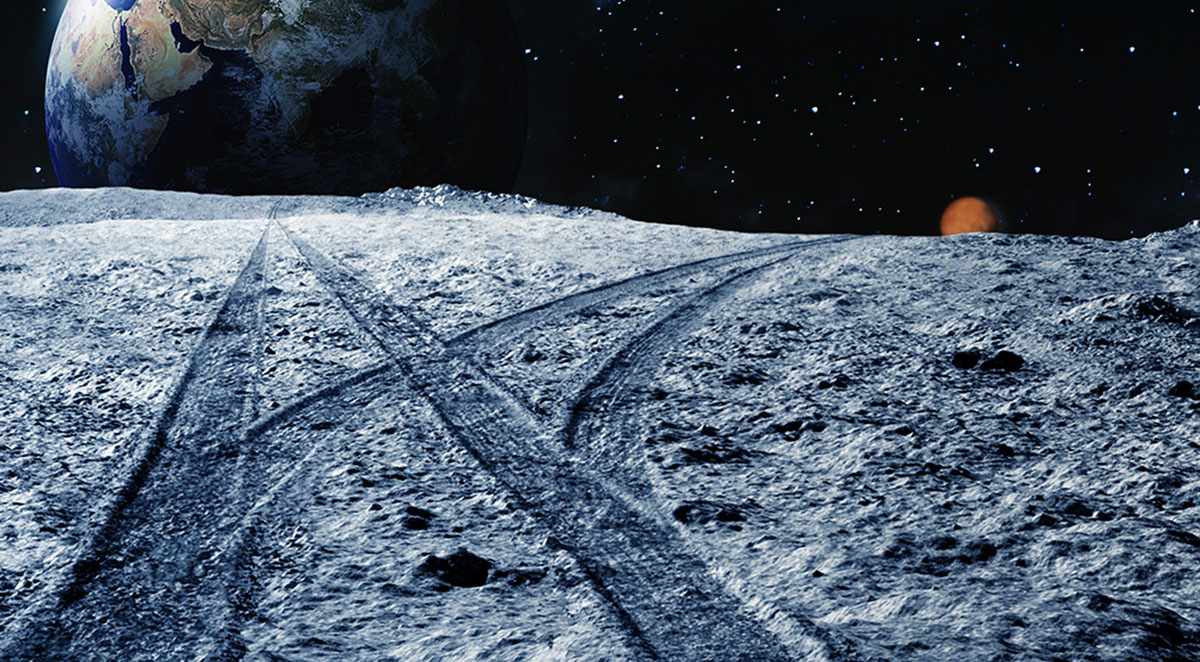
Once humanity has mastered space travel to the point where regular commercial flights to orbit – and eventually the Moon – become routine, we’ll need a way to get around once we arrive. And what are we most accustomed to? The automobile, of course. These vehicles will even bear familiar names – like the Toyota Lunar Cruiser. And this isn’t a joke. If everything goes according to plan, this off-road “rover” will be traversing the Moon within the next decade.
Today, the Indy Auto Man team decided to find out just how far automakers have come in space exploration, because clearly, we won’t be driving standard Land Cruisers up there.
Toyota
Toyota is developing its lunar “Land Cruiser” in partnership with the Japan Aerospace Exploration Agency (JAXA), and as of 2026, the project is aligned with NASA’s Artemis missions.
The development roadmap has evolved: early prototypes and system testing began in the early 2020s, followed by engineering models and ongoing validation of autonomous driving and energy systems. Full-scale testing is expected to continue through the late 2020s, with a launch now more realistically targeted for the early 2030s rather than 2029.
The Lunar Cruiser will measure about 17.1 feet in length and roughly 12.5 feet in both width and height. It features living and working modules for two astronauts, with the ability to accommodate up to four if necessary. It can be operated manually from inside, remotely, or via autonomous systems.
The vehicle will use a hydrogen fuel cell powertrain, supplemented by solar panels. Its projected range is up to about 6,200 miles on the lunar surface—far beyond anything achieved during the Apollo era.
Tesla
You’re likely familiar with this story: on February 6, 2018, SpaceX launched a Tesla Roadster – currently excluded from the Tesla lineup – into space aboard a Falcon Heavy rocket. Instead of ballast, the car itself became the payload, complete with a mannequin in a spacesuit and music playing on loop.
There was no scientific purpose behind the launch – it was largely symbolic. Over time, the Roadster has effectively become a space artifact.
As of 2026, the vehicle remains in heliocentric orbit around the Sun, occasionally crossing Mars’ orbital path. It travels at speeds approaching 17,000 mph. While it never entered a stable orbit around Mars as originally envisioned, it continues to orbit the Sun and can still be tracked in real time.
Audi
A lunar rover developed with Audi’s support could have already reached the Moon but things didn’t work out that way. Back in 2015, the brand unveiled the lunar quattro, created with the German team Part-Time Scientists.
The rover was designed for the Google Lunar X Prize, which challenged private teams to deliver a rover to the Moon, travel at least 1,640 feet, and transmit high-resolution imagery back to Earth. The prize purse was up to $20 million.
Audi’s concept featured an aluminum structure with some magnesium components and weighed just about 77 pounds. It used four electric in-wheel motors, a lithium-ion battery, and solar panels, with a top speed of around 2.2 mph.
Despite extensive testing in environments like the Austrian Alps and Tenerife, the mission never launched. The competition was officially canceled in 2018 after repeated delays across all teams.
Still, the lunar quattro found a different kind of spotlight when it appeared in the film Alien: Covenant.
Lamborghini
Could a supercar manufacturer contribute to real space science? Lamborghini already has.
In 2019, the company sent composite material samples to the International Space Station as part of a joint research project. The goal was to study durability under extreme space conditions.
Over six months, the materials were exposed to temperatures ranging from about -40°F to 392°F, along with intense radiation, ultraviolet light, atomic oxygen, and other harsh factors.
The results have helped advance carbon fiber technology – not only for future Lamborghini models but also for aerospace and medical applications. As of 2026, the brand continues to refine these materials for high-performance and lightweight engineering.
General Motors
General Motors is one automaker whose technology has already touched the Moon – literally. The company played a key role in developing the Lunar Roving Vehicle (LRV) used during the Apollo missions.
The rover measured about 10.2 feet in length and weighed roughly 463 pounds. With two astronauts aboard, it offered about 13.8 inches of ground clearance. Powered by electric motors, it had a top speed of about 8 mph, though astronauts managed to reach speeds closer to 11 mph.
Its wheels were particularly innovative: instead of rubber tires, engineers used woven steel mesh with titanium treads mounted on aluminum rims. Each wheel measured about 31.9 inches in diameter and 9.1 inches in width.
Today, GM is once again involved in lunar mobility, partnering with Lockheed Martin to develop next-generation rovers for NASA’s Artemis program. These new vehicles are expected to operate autonomously and travel much greater distances than their predecessors.
Mars Rover Concept Vehicle
This impressive machine was never intended for actual space travel – it was built as a concept and showcased at NASA’s Kennedy Space Center.
Measuring about 27.9 feet long, 13.1 feet wide, and 11.2 feet high, the vehicle weighs around 5,952 pounds and rides on six 50-inch wheels designed for Martian terrain. It can carry four people, and its rear section functions as a detachable mobile laboratory.
The electric powertrain runs on a 700-volt system, enabling theoretical speeds of up to 68 mph. In reality, its operating speed on Mars would likely be closer to 10–15 mph.
Lexus and Porsche
And what about “air” travel in space? Lexus and Porsche have explored that too, though strictly for film and design projects.
Porsche contributed to the creation of the Tri-Wing S-91x Pegasus Starfighter for Star Wars, incorporating design cues reminiscent of the 911 and Taycan.
Lexus, meanwhile, has produced two cinematic spacecraft. The Lexus Skyjet, featured in Valerian and the City of a Thousand Planets, offers a vision of 28th-century transportation. The QZ 618 Galactic Enforcer from Men in Black: International goes even further, transforming from a Lexus RC F into a spacecraft capable of near-instant travel.
Naturally, its claimed acceleration – from 0 to 62 mph in a fraction of a nanosecond – remains firmly in the realm of fiction.













