Florida Retina Specialists Introduces Valeda Red-Light Therapy for Dry AMD
By Space Coast Daily // August 4, 2026
Dry age-related macular degeneration is a leading cause of central vision loss among older adults
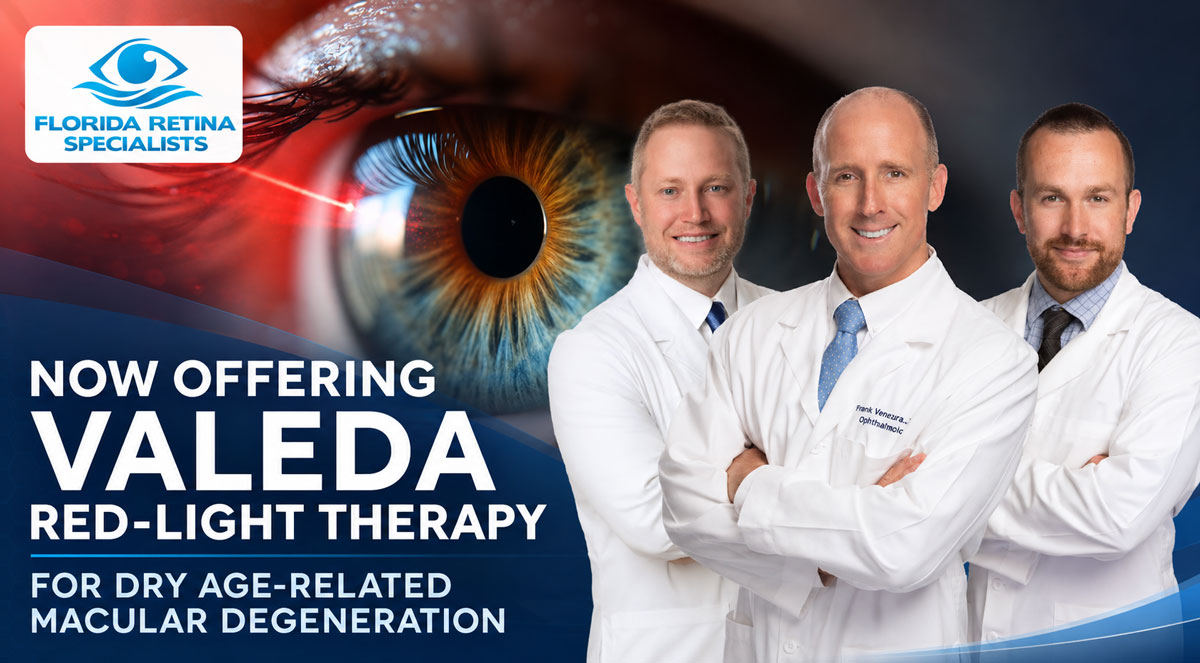
BREVARD COUNTY, FLORIDA – Florida Retina Specialists is expanding treatment options for patients with dry age-related macular degeneration by offering the Valeda Light Delivery System, a non-invasive therapy designed to improve visual acuity in certain patients.
Dry age-related macular degeneration, commonly known as dry AMD, is a leading cause of central vision loss among older adults. Although the condition generally progresses slowly, it can eventually interfere with reading, driving, recognizing faces, and completing other everyday activities.
“We are excited to offer a first-of-its-kind treatment for patients with dry age-related macular degeneration and mild to moderate vision loss,” Florida Retina Specialists vitreoretinal surgeon Dr. Peter Bracha said. “This non-invasive treatment offers patients hope for vision improvement.”
The Valeda system uses photobiomodulation, or PBM, to deliver specific wavelengths of low-level light to the retina. The light is intended to stimulate cellular activity, supporting the function and health of retinal cells without injections, medication, or surgery.
The treatment is performed in a medical office, is painless and generally takes only a few minutes. Patients receive a series of treatments, with the precise schedule determined by their retina specialist.
According to Alcon, which acquired Valeda developer LumiThera in 2025, the system uses three wavelengths of non-phototoxic light. Clinical studies found that treated patients experienced an average improvement of approximately one line on a standard eye chart after two years of treatment compared with patients who did not receive the therapy.
Treatment benefits may diminish after therapy is discontinued. Alcon provides additional information about Valeda here.
What is Dry AMD?
The macula is the small central portion of the retina responsible for sharp, detailed vision. Dry AMD develops as the macula gradually thins and accumulates deposits known as drusen.
Symptoms can include blurred or distorted central vision, difficulty reading in dim light, reduced color intensity and dark or empty areas near the center of a person’s field of vision. Peripheral vision usually remains intact.

Dry AMD differs from wet AMD, which involves abnormal blood vessels that can leak fluid or blood beneath the retina and cause more rapid vision loss.
While there is no cure for dry AMD, early diagnosis and regular monitoring can help patients manage the condition. Recommended care may include nutritional supplements for eligible patients, lifestyle changes and treatment of advanced forms of the disease.
Valeda provides another option for selected patients with early or intermediate dry AMD and certain patients with non-central geographic atrophy.
The system is indicated for patients whose best-corrected vision falls between 20/32 and 20/70 and who meet specific clinical criteria. It is not intended for patients with wet AMD or geographic atrophy involving the center of the macula.
Patients with sensitivity to yellow, red or near-infrared light, certain light-triggered neurological conditions or recent use of photosensitizing medications may not qualify. A comprehensive retinal examination is necessary to determine candidacy.
Specialized Retina Care in Brevard County
Florida Retina Specialists provides comprehensive medical and surgical retinal care through offices in Merritt Island and Viera. The practice’s team includes Dr. Frank Venzara III, Dr. Eric Guglielmo, Dr. Peter Bracha and Dr. David Neely.
Bracha is a board-certified ophthalmologist and vitreoretinal surgeon specializing in macular degeneration, diabetic retinopathy, retinal vein occlusion, retinal tears and detachments, macular surgery and the surgical management of visually significant floaters.