Brevard County Property Tax Rates and Amendment 3 Update, Will Appear on November 3 Ballot
By Bobby Freeman, Space Coast Real Estate Expert // September 25, 2026
Brevard Commission adopted a total budget of $2.43 billion, 6.3% smaller than last year's $2.59 billion

What Brevard County’s final budget decisions could mean for homeowners, and why the current tax debate is separate from Florida Amendment 3.
BREVARD COUNTY, FLORIDA – Brevard County has adopted its 2026-27 budget and final property-tax rates, giving homeowners a much clearer picture of the county’s financial position as Florida voters prepare to decide Amendment 3 on November 3.
At its final public hearing on September 22, the Brevard County Commission adopted a total budget of roughly $2.43 billion, about 6.3% smaller than last year’s $2.59 billion, along with an aggregate countywide millage rate of 4.7491 mills.
The timing matters because Amendment 3 could substantially change the taxable value of many Florida properties beginning in 2027.
But homeowners should understand an important distinction: Amendment 3 did not cause Brevard County’s current budget pressures.
Voters have not approved the amendment, and it has not taken effect. The 2026-27 budget provides a useful snapshot of Brevard’s financial position before any potential effects from Amendment 3.
“This is why I’ve been following the Brevard County budget process along with Amendment 3,” said Bobby Freeman, McCoy Freeman Group at Compass Florida.
“The county’s current budget decisions aren’t a result of Amendment 3, but they give homeowners a better understanding of where Brevard stands financially before voters make this decision.”

What Happened With Brevard County Property Tax Rates?
Commissioners tentatively approved the county’s millage rates at the first budget hearing on September 8, then adopted them at the September 22 final hearing.
The adopted aggregate countywide rate of 4.7491 mills is 5.75% above last year’s rate of 4.4909 mills and 6.12% above the rolled-back rate of 4.4753 mills. The rolled-back rate is the rate that would have generated the same property-tax revenue as last year, excluding new construction.
The county set its general operating levy at 3.0942 mills, about 10% above its rolled-back rate of 2.8129 mills, and it is projected to generate roughly $236 million. The levy passed 4-1.
For perspective, the 0.2582-mill difference between last year’s aggregate rate and the newly adopted rate works out to about $64.55 per year for every $250,000 of taxable value, assuming taxable value stayed the same.
That doesn’t mean every Brevard homeowner’s tax bill will increase by that amount.
Property taxes depend on taxable value, exemptions, Save Our Homes limitations, municipality, special taxing districts, and other factors. School taxes and non-ad valorem assessments are also separate pieces of the overall tax bill.
Why Brevard Says It Needs More Property Tax Revenue
The county entered this budget cycle facing significant expenses, including public safety, roads, county facilities, jail maintenance, emergency services, and other infrastructure needs.
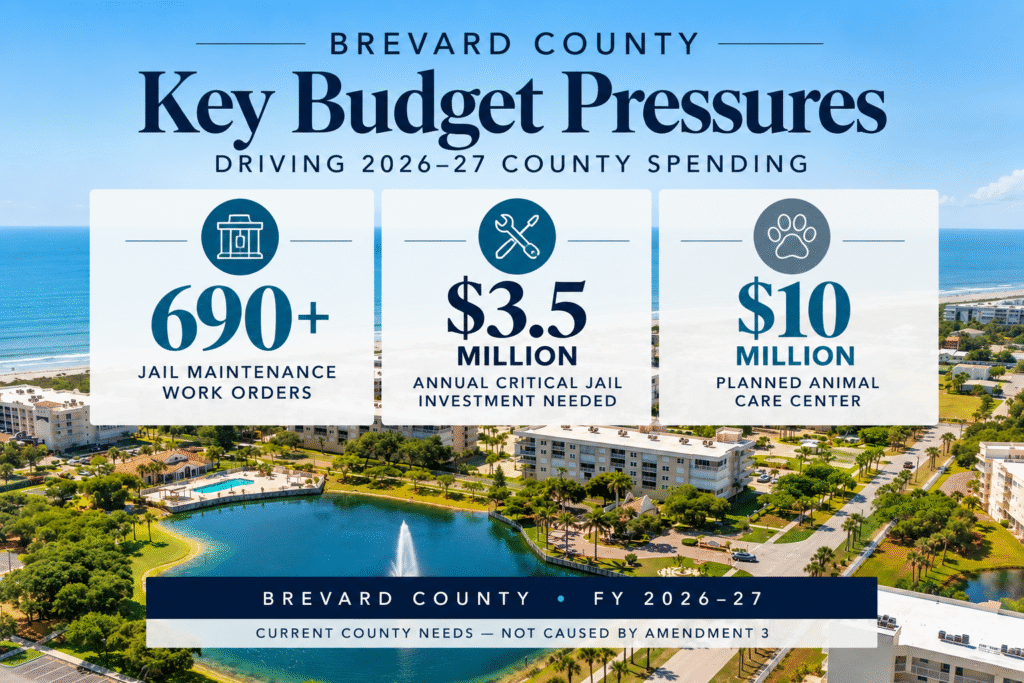
The 40-year-old county jail alone requires about $3.5 million a year in critical maintenance, with more than 690 open work orders. The county has also identified roughly $10 million for a new Animal Care Center and is evaluating the 58-year-old Government Complex North in Titusville as a possible replacement.
The county also made cuts. The adopted budget eliminates 44 positions, shifts about $2 million in Ocean Rescue funding to Tourist Development Tax revenue, and recovers roughly $2 million through employee health insurance adjustments.
That context matters when considering Amendment 3 because it shows Brevard is already balancing demands for services and infrastructure against the property-tax revenue it collects.
Now Add Amendment 3 to the Equation
Florida Amendment 3 will appear on the November 3, 2026 General Election ballot.
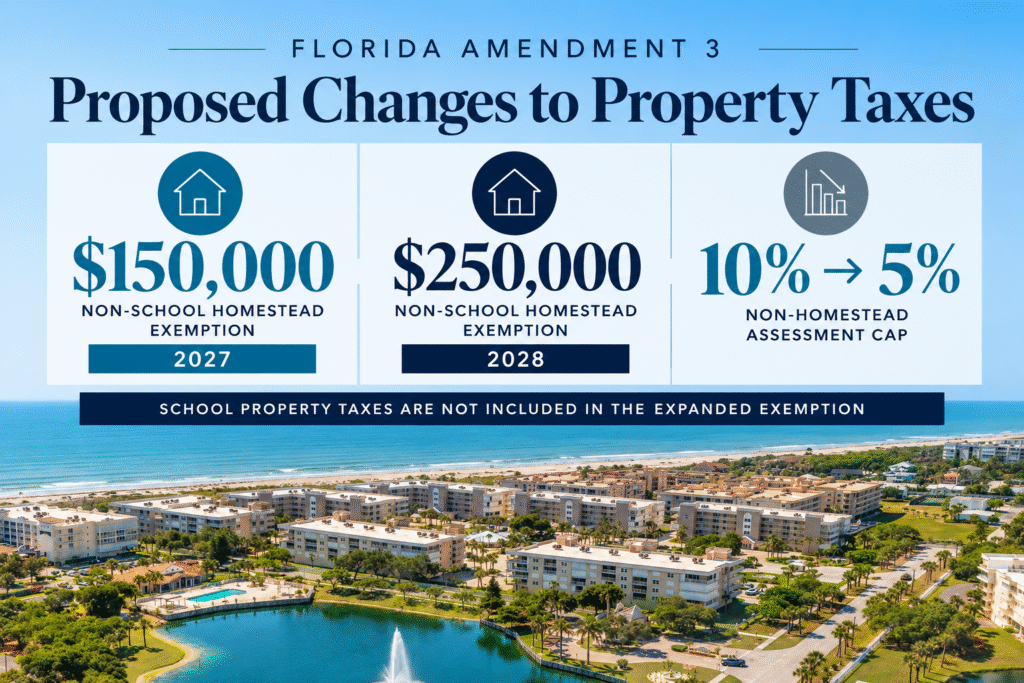
If at least 60% of voters approve it, the amendment would increase the homestead exemption for non-school property taxes to $150,000 in 2027 and $250,000 in 2028.
It would also reduce the annual assessment-growth cap for non-homestead property from 10% to 5%. The amendment would take effect January 1, 2027.
School property taxes would not receive the expanded exemption.
The amendment would also require counties and municipalities to use property-tax revenue for specific categories: public safety, education and schools, infrastructure, natural resources, bond debt service, employee retirement benefits, and operations and administration.
That means a qualifying homesteaded homeowner could see a substantial reduction in the taxable value used for county, city, and certain other non-school property taxes.
Brevard Has Estimated a Significant Revenue Impact
This is where the local numbers matter most.
County Manager Jim Liesenfelt and his staff have estimated that, if current property-tax rates are levied, Amendment 3 could reduce collections across all county taxing districts by about $67 million in 2027 and about $87 million in 2028, once the larger exemption is fully in place.
For the county’s general fund alone, the estimate is about $41 million in 2027 and $54 million in 2028.
The county’s analysis also assumes Brevard’s taxable value would fall from about $73 billion to about $54 billion under the larger exemption.
That $87 million number needs context.
It does not mean Brevard County currently has an $87 million deficit. It does not mean homeowners will automatically be charged another $87 million through other taxes or fees. And it does not mean $87 million in services will necessarily be eliminated.
It is a modeled estimate of how much less ad valorem revenue the county could collect under the proposed exemption structure if other assumptions remain constant.
How Brevard ultimately responds would depend on future budgets, property values, millage decisions, spending priorities, economic conditions, and how the amendment is implemented.
This Is the Part Homeowners Should Watch
For me, this remains the most important part of the Amendment 3 discussion.
A larger homestead exemption can produce a very real property-tax reduction for a qualifying homeowner. But the exemption is only one part of the tax equation.
Local governments still determine millage rates. They also decide on spending, staffing, services, fees, special assessments, and other revenue sources.
That doesn’t mean Brevard will raise rates or fees because of Amendment 3. It means homeowners should watch both sides of the equation.
“If you’re trying to determine what Amendment 3 could mean for your household, don’t look only at the size of the exemption. Watch what happens with taxable value, millage rates, fees, and assessments over the next several years. Those pieces together determine the real-world impact.” Bobby Freeman
What Amendment 3 Would Not Reduce
Another point that can easily get lost is that the expanded exemption would not apply to everything on a property-tax bill.
The proposed increase applies to non-school ad valorem property taxes. School property taxes remain outside the expanded exemption.
Non-ad valorem assessments are also different from ad valorem taxes. Depending on where a property is located, those can include assessments tied to services or improvements that are not calculated by multiplying taxable value by a millage rate.
So even a homeowner who qualifies for the maximum expanded exemption should not assume their entire property-tax bill would disappear.
What About Second Homes and Investment Properties?
Amendment 3 isn’t solely a homestead story.
The proposal would also reduce the annual assessment-growth cap on non-homestead property from 10% to 5%. That could be relevant across the Space Coast, where second homes, vacation properties, rental condominiums, and investment properties are a meaningful part of the market.
However, those properties generally would not receive the expanded homestead exemption available to qualifying primary residences.
That distinction could matter in communities such as Cocoa Beach and Cape Canaveral, where the mix of homesteaded and non-homesteaded properties differs considerably from many inland Brevard neighborhoods.
Why Brevard Homeowners Should Pay Attention Now
We’re moving into a different phase of the Amendment 3 discussion.
Earlier this year, much of the conversation centered on what the proposed amendment could do. Now we have Brevard County’s adopted 2026-27 budget as a real-world baseline for comparison.
We know the county faces significant public-safety, infrastructure, and facility needs. We know Brevard officials have modeled a potentially substantial reduction in property-tax revenue if Amendment 3 passes.
And we know the amendment could provide significant direct property-tax relief to many qualifying homesteaded homeowners.
Those facts don’t tell anyone how they should vote. They do give Brevard homeowners better information to evaluate the proposal for themselves.
Frequently Asked Questions
What millage rate did Brevard County adopt for 2026-27?
On September 22, the Brevard County Commission adopted an aggregate countywide millage rate of 4.7491 mills, up from 4.4909 mills the prior year. The general operating levy was set at 3.0942 mills.
Did Amendment 3 cause Brevard’s tax rate increase?
No. Amendment 3 has not been approved and has not taken effect. The county’s 2026-27 budget reflects existing needs such as jail maintenance, facilities, and public safety.
How much would Amendment 3 raise the homestead exemption?
If approved, the exemption for non-school property taxes would increase to $150,000 in 2027 and $250,000 in 2028, with inflation adjustments after that. School taxes are not included.
How much revenue could Brevard County lose under Amendment 3?
County staff estimate about $67 million in 2027 and about $87 million in 2028 across all county taxing districts, assuming current tax rates.
Does Amendment 3 help second homes and investment properties?
Those properties generally would not receive the larger homestead exemption, but the annual cap on assessment increases for non-homestead property would drop from 10% to 5%.
The Bottom Line for Brevard County
Amendment 3 is ultimately about more than whether property taxes should be lower.
For qualifying homeowners, the proposed exemption could substantially reduce the taxable value of a primary residence for non-school property taxes. For Brevard County and its municipalities, that same reduction could mean collecting less ad valorem revenue from qualifying properties.
Exactly how those two sides of the equation interact won’t be known until after the election and, if Amendment 3 passes, as local governments begin preparing future budgets under the new system.
That’s why I’ll continue following the numbers here in Brevard County rather than relying on statewide talking points from either side.
The next major date is November 3, when Florida voters will decide whether Amendment 3 becomes part of the Florida Constitution.