NASA, Blue Origin and SpaceX Accelerate Lander Development for 2028 Moon Missions
By NASA // October 24, 2026
Blue Origin and SpaceX have streamlined designs and revised their concepts of operations

NASA – As NASA returns humans to the lunar surface and establishes a long-term presence on our closest celestial neighbor, the agency and commercial human-landing-system providers Blue Origin and SpaceX have streamlined designs and revised their concepts of operations for future crewed landers.
Since NASA awarded initial contracts to Blue Origin and SpaceX for crewed missions to the Moon, the agency has redefined Artemis III to demonstrate rendezvous and docking between test versions of each provider’s lander and the agency’s Orion spacecraft in low Earth orbit next year.
In parallel, the companies are also developing crew and cargo versions of their landers for near-term Artemis missions.
“We are executing President Trump’s National Space Policy to complete the long-awaited return of American astronauts to the lunar surface in 2028 and establish a Moon Base,” said NASA Administrator Jared Isaacman.
“We have a proven foundation in SLS and Orion, along with two lunar landers in development with Blue Origin and SpaceX. But NASA has no intention of sitting idly by as all the pieces come together. That is not how Apollo succeeded, and it is not how we achieve the near-impossible. NASA is energized, our core capabilities are being rebuilt, our machine shops are running 24/7, and our experts are in the field attacking the critical path. We are building a Super Bowl-caliber team to safely achieve these objectives and everything that comes next.”

“NASA is energized, our core capabilities are being rebuilt, our machine shops are running 24/7, and our experts are in the field attacking the critical path. We are building a Super Bowl-caliber team to safely achieve these objectives and everything that comes next,” said NASA Administrator Jared Isaacman.
For the initial crewed missions to the Moon, Artemis astronauts will launch from NASA’s Kennedy Space Center in Florida in the agency’s Orion spacecraft atop the SLS (Space Launch System) rocket.
During each Artemis mission, a commercial human landing system will rendezvous with Orion, take two crew members to the lunar surface, while two remain aboard Orion.
To accelerate development toward a 2028 landing, the Artemis landers and Orion will no longer rendezvous in a near-rectilinear halo orbit around the Moon; instead, they will meet in orbits tailored to each partner’s systems.
Both companies must perform an uncrewed demonstration mission with their crewed landers before the near-term Artemis crewed missions to the Moon. NASA will certify lander systems before crewed missions to ensure safety and mission success.
Starship Lander Concept of Operations
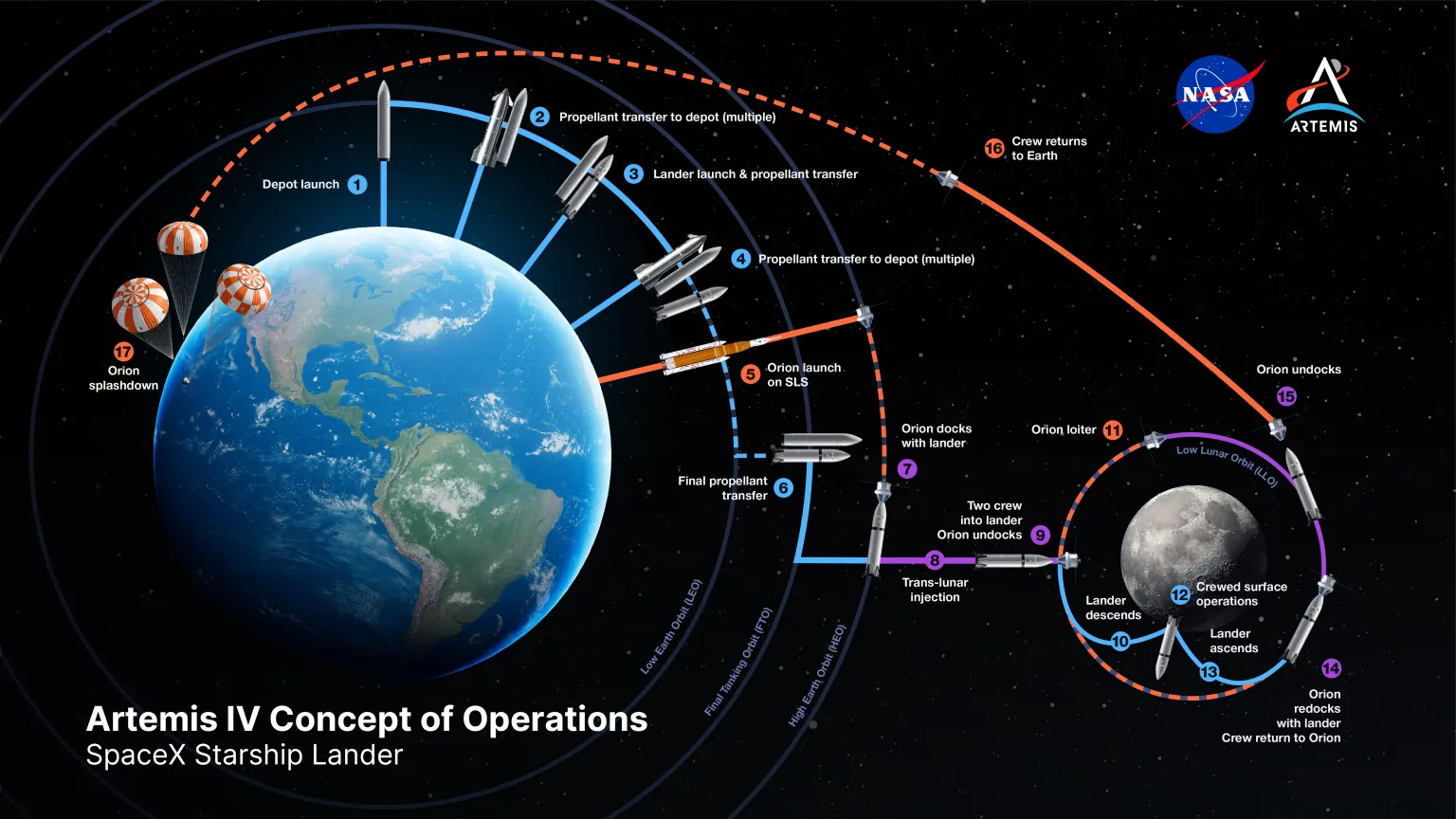
SpaceX continues to plan an in-space propellant aggregation approach to transfer super-cold, or cryogenic, liquid propellant. The company will launch multiple Starship versions to low Earth orbit before launching the Starship Human Landing System (HLS) from Brevard County.
Like a gas station on Earth, a series of propellant “tanker” Starships in low Earth orbit will transfer propellant to the waiting “depot” Starship. The depot Starship will ultimately fuel the Starship lander for its journey to the Moon.
Under the revised operations, Starship HLS will await Orion and its crew in Earth orbit.
The lander and Orion will rendezvous and dock in Earth orbit, then the Starship lander will perform a trans-lunar injection burn to send the combined lander-and-Orion stack to low lunar orbit.
NASA is working to modify Orion so Starship can push it to the Moon.
The lander will take two crew members to the lunar surface for several days before returning them to Orion for the ride back to Earth.
Propellant aggregation in low Earth orbit allows flexibility in SLS crew launch timing, while a trans-lunar injection burn performed by the Starship lander enables direct access to low lunar orbit.
This new low-lunar-orbit concept of operations will significantly reduce the propellant Starship needs to aggregate in space while shortening the time it takes for astronauts leaving the Moon’s surface in Starship to link back up with Orion.
SpaceX will demonstrate the propellant aggregation approach during the uncrewed demonstration mission.
Blue Moon Lander Concept of Operations
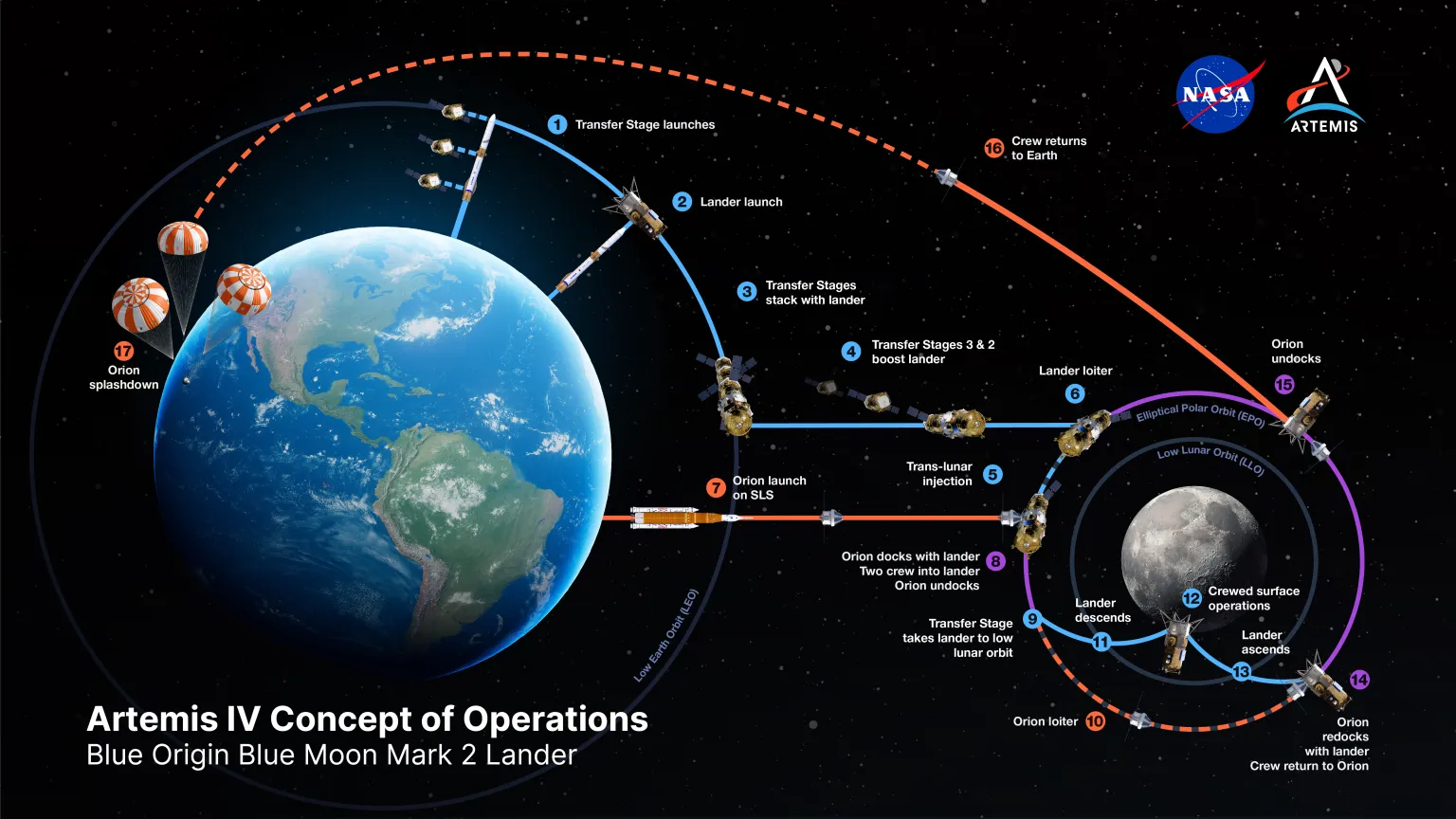
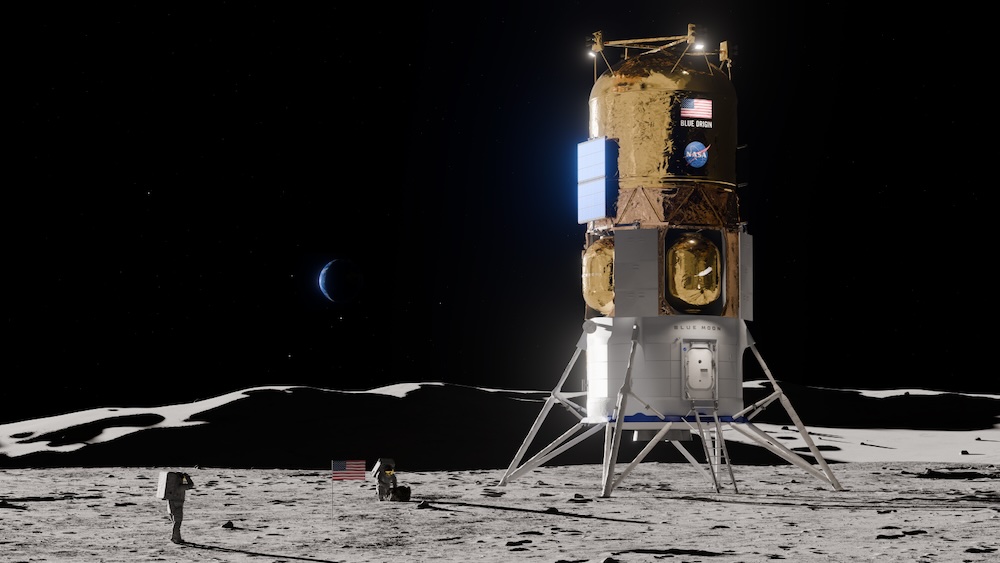
For its accelerated 2028 crewed lunar landing mission, Blue Origin will defer propellant transfer and use three transfer stages to send the Blue Moon Mark 2 Alpha Lander to the Moon.
Based on existing Mark 1 and Mark 2 hardware, the stages operate like a multistage rocket. They launch into low Earth orbit, then the Mark 2 lander follows.
Once docked, the stack departs for an elliptical polar orbit around the Moon, with each transfer stage separating as its propellant depletes.
Compared with the previously planned near-rectilinear halo orbit, the elliptical polar orbit returns Orion to the lunar surface faster, reduces Blue Moon lander propellant requirements, and maximizes SLS performance.
This architecture gives SLS and Orion multiple opportunities to launch the crew into elliptical polar orbit and dock with the Blue Moon Mark 2 lander. Two crew members then transfer to the lander and descend to the Moon’s South Pole.
After surface operations, the lander returns to Orion, where the crew transfers to return to Earth.
Blue Origin will incorporate lessons from earlier robotic Mark 1 missions supporting the agency’s Moon Base Program and demonstrate the full mission profile in an uncrewed lander transfer stage demonstration mission.
Returning American Astronauts to the Moon