
BREVARD HISTORY: St. Mark’s Episcopal Church in Cocoa Village Founded in 1886, Congregation Would Arrive by Water
By Benjamin Brotemarkle, Florida Historical Society // June 13, 2026
Since St. Mark’s is a downtown parish, it has always been an integral part of the community and participates in many local events
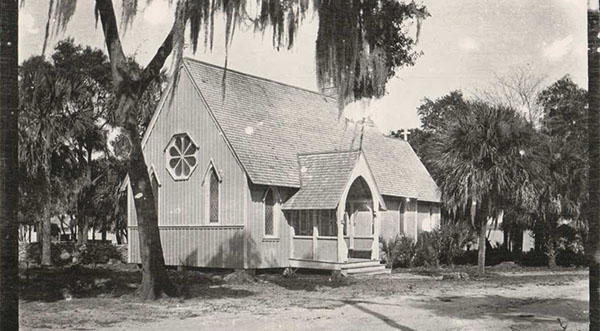
BREVARD COUNTY • COCOA, FLORIDA — Today, parking in downtown Cocoa can be at a premium when services or special events are held at St. Mark’s Episcopal Church.
When the church was first built in 1886, many in the congregation would arrive by water, mooring their boats on the banks of the Indian River. It’s just a few steps from the river’s edge to the front door of the church. Others would walk to church from homes along the river.
The first meeting of what would become St. Mark’s Episcopal Church was held on June 2, 1878. The Right Reverend John Freeman Young, Bishop of Florida, and Dr. William H. Carter of Holy Cross Church of Sanford gathered the founding members of the church at the home of A.L. Hatch in Rockledge. Dr. Carter later moved to Tallahassee, but services were still held by various priests.
The church was originally called St. Michael’s in recognition of St. Michael the Archangel.
In 1884, Mrs. Lucy Boardman, a frequent visitor to Cocoa and Melbourne from her winter residence in Sanford, donated funds to Bishop Young for the construction of Episcopal churches near the Indian River. Mrs. Sarah O. Delannoy donated the land where St. Mark’s sits today.
According to a historical marker erected by the Brevard County Historical Commission in 2010, Gabriel Gingras designed the board-and-batten Carpenter Gothic church. Early Cocoa residents William Booth and William Hindle designed and installed the church’s woodwork.
Dr. S.B. Carpenter, Rector of Holy Cross Church of Sanford, visited Cocoa once per month to oversee the construction of the church. Although it was not quite finished, the first service was held in the new church on Christmas Eve, 1886.
The church’s tower bell, called “Michael,” was cast in New York in 1888.

In 1890, the church’s name was changed from St. Michael’s to St. Mark’s in recognition of support from St. Mark’s Church in West Orange, New Jersey.
Although St. Mark’s has undergone significant additions and renovations over the years, most of the original interior woodwork and stained glass remain intact.
Many of the beautiful stained glass windows in St. Mark’s are dedicated to the early founders of the church. For example, one panel is dedicated in memory of Arch Deacon William H. Gresson, who was born in August 1846 and died in June 1921.
Another window was created in memory of Emma J. Hardee, who was born October 6, 1847, and died May 16, 1915, and Florence H. Gingras, born May 16, 1870, and died November 6, 1913.
Sarepta E. Hartman, born May 9, 1839, and died December 9, 1924, is also remembered by a stained-glass window. Another is dedicated to Cora M. Cook, born in 1858 and died in 1915.
When St. Mark’s was renovated in 1925, great care was taken to maintain the integrity of the church’s original structure.
Stucco was added to the exterior, giving the building a Mediterranean style that was very popular at the time. Where additional woodwork was added to the interior, it closely matched the original.















