Expedition 39 Crew Returns To Earth After Six Months On ISS
By NASA // May 14, 2014
completes journey of over 79-million miles
LIVE STREAM: Watch Expedition 39 to return to Earth. The trio undocked their Soyuz from the station at 6:36 p.m. EDT Tuesday for a landing southeast of the remote town of Dzhezkazgan in Kazakhstan.
The Expedition 39 crew returned to Earth Tuesday after 188 days in space, completing a journey of over 79-million miles and more than 3,000 orbits of the Earth since launching to the International Space Station back in November.
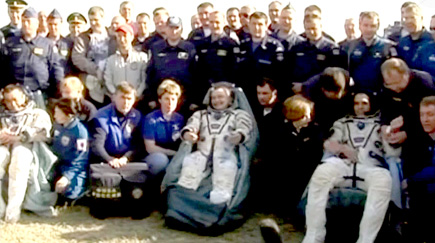
The Soyuz TMA-11M spacecraft carrying Expedition 39 Commander Koichi Wakata of the Japan Aerospace Exploration Agency, Soyuz Commander Mikhail Tyurin of Roscosmos, the Russian Federal Space Agency and Flight Engineer Rick Mastracchio of NASA landed in the steppe of Kazakhstan southeast of Dzhezkazgan at 9:58 p.m. (7:58 a.m. Wednesday, Kazakh time).
Helicopters carrying the Russian recovery teams and NASA personnel reached the landing site shortly afterward to assist the crew and conduct medical examinations.
The Soyuz undocked from the Rassvet module on the Earth-facing side of the station at 6:36 p.m. as the station soared 261 statute miles over Mongolia.
The 4-minute, 41-second deorbit burn beginning at 9:04 p.m. slowed the Soyuz for its decent into the Earth’s atmosphere and its parachute-assisted landing.
› Watch video of Soyuz undocking
The undocking marked the end of Expedition 39 and the start of Expedition 40 under the command of NASA astronaut Steve Swanson.

Wakata, the first Japanese commander of the station, passed the helm of the orbiting complex over to Swanson during a change of command ceremony Monday afternoon.
After making their final farewells, Wakata, Mastracchio and Tyurin boarded their Soyuz, and the crews closed the hatches between the vehicles at 3:26 p.m. Tuesday.
› Watch Change of Command Ceremony
› Watch crew farewells and hatch closure
Mastracchio now has logged 228 days in space during four missions. Wakata also now has four missions and has accumulated 348 days in space. Tyurin now has logged 532 days in space during three missions and is 13th on the all-time endurance list.

Swanson and his crewmates, Alexander Skvortsov and Oleg Artemyev of Roscosmos, will operate the station as a three-person crew for two weeks until the arrival of three new crew members — Reid Wiseman of NASA, Max Suraev of Roscosmos and Alexander Gerst of the European Space Agency.
The trio of new flight engineers, who are wrapping up pre-flight activities in Star City, Russia, will fly to the Baikonur Cosmodrome in Kazakhstan on Thursday to begin the homestretch of preparations for their May 28 launch to the station.
Samples from the ongoing microbiome investigation returned to Earth on the Soyuz TMA-11M. The microbiome study looks at the impact of space travel on the immune system and on human microbiomes – microbes living in and on the human body at any given time.
Samples from crew members’ bodies and the space station environment are taken periodically to monitor changes in the immune system and microbiomes. The results of this study may add to research on health impacts to people who live and work in extreme environments on Earth, and help with research on early disease detection, metabolic function and immune system deficiency.