
MAROONED! NASA’s Boeing Crew Flight Test Astronauts Butch Wilmore and Suni Williams Stuck on ISS Until Feb. 2025
By Space Coast Daily // August 24, 2024
Astronauts will return on SpaceX Dragon spacecraft
WATCH: NASA leadership hosted a live news conference on Saturday, Aug. 24 at the agency’s Johnson Space Center in Houston to give a status update about NASA’s Boeing Crew Flight Test. NASA will return Boeing’s Starliner to Earth without astronauts Butch Wilmore and Suni Williams aboard the spacecraft, the agency announced Saturday. (NASA video)
NASA and Boeing identified helium leaks and experienced issues with the spacecraft reaction control thrusters on June 6 as Starliner approached the space station.
(NASA) – NASA will return Boeing’s Starliner to Earth without astronauts Butch Wilmore and Suni Williams aboard the spacecraft, the agency announced Saturday. The uncrewed return allows NASA and Boeing to continue gathering testing data on Starliner during its upcoming flight home, while also not accepting more risk than necessary for its crew.
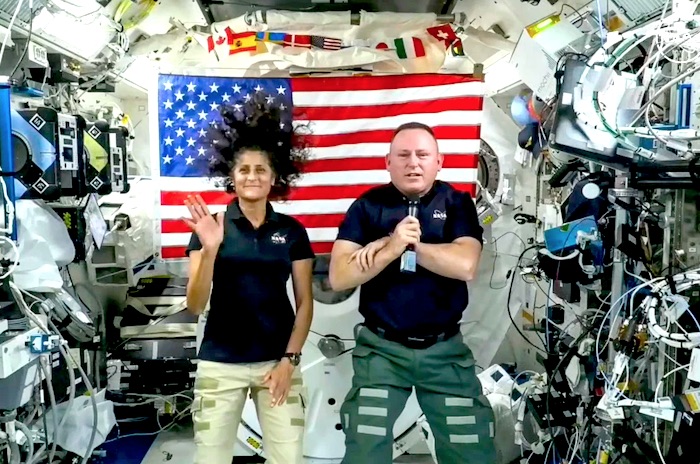
Wilmore and Williams, who flew to the International Space Station in June aboard NASA’s Boeing Crew Flight Test, have been busy supporting station research, maintenance, and Starliner system testing and data analysis, among other activities.
“Spaceflight is risky, even at its safest and most routine. A test flight, by nature, is neither safe, nor routine. The decision to keep Butch and Suni aboard the International Space Station and bring Boeing’s Starliner home uncrewed is the result of our commitment to safety: our core value and our North Star,” said NASA Administrator Bill Nelson.
“I’m grateful to both the NASA and Boeing teams for all their incredible and detailed work.”
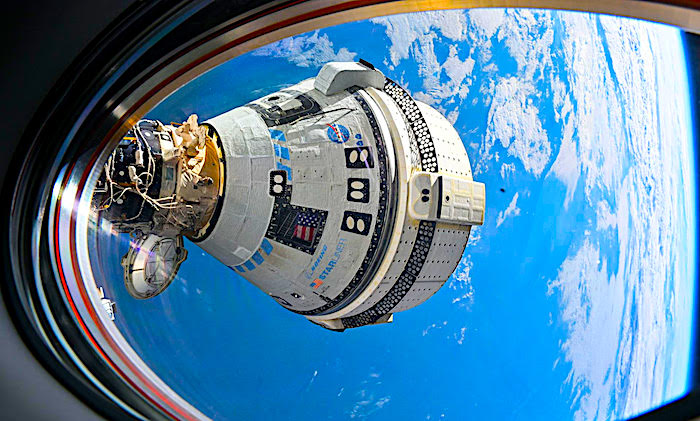
Wilmore and Williams will continue their work formally as part of the Expedition 71/72 crew through February 2025. They will fly home aboard a Dragon spacecraft with two other crew members assigned to the agency’s SpaceX Crew-9 mission. Starliner is expected to depart from the space station and make a safe, controlled autonomous re-entry and landing in early September.
NASA and Boeing identified helium leaks and experienced issues with the spacecraft reaction control thrusters on June 6 as Starliner approached the space station.
Since then, engineering teams have completed a significant amount of work, including reviewing a collection of data, conducting flight and ground testing, hosting independent reviews with agency propulsion experts, and developing various return contingency plans.
The uncertainty and lack of expert concurrence does not meet the agency’s safety and performance requirements for human spaceflight, thus prompting NASA leadership to move the astronauts to the Crew-9 mission.
“Decisions like this are never easy, but I want to commend our NASA and Boeing teams for their thorough analysis, transparent discussions, and focus on safety during the Crew Flight Test,” said Ken Bowersox, associate administrator for NASA’s Space Operations Mission Directorate.
“We’ve learned a lot about the spacecraft during its journey to the station and its docked operations. We also will continue to gather more data about Starliner during the uncrewed return and improve the system for future flights to the space station.”
Starliner is designed to operate autonomously and previously completed two uncrewed flights. NASA and Boeing will work together to adjust end-of-mission planning and Starliner’s systems to set up for the uncrewed return in the coming weeks. Starliner must return to Earth before the Crew-9 mission launches to ensure a docking port is available on station.
“Starliner is a very capable spacecraft and, ultimately, this comes down to needing a higher level of certainty to perform a crewed return,” said Steve Stich, manager of NASA’s Commercial Crew Program.
“The NASA and Boeing teams have completed a tremendous amount of testing and analysis, and this flight test is providing critical information on Starliner’s performance in space. Our efforts will help prepare for the uncrewed return and will greatly benefit future corrective actions for the spacecraft.”
NASA’s Commercial Crew Program requires spacecraft fly a crewed test flight to prove the system is ready for regular flights to and from the space station. Following Starliner’s return, the agency will review all mission-related data to inform what additional actions are required to meet NASA’s certification requirements.
The agency’s SpaceX Crew-9 mission, originally slated with four crew members, will launch no earlier than Tuesday, Sept. 24. The agency will share more information about the Crew-9 complement when details are finalized.
NASA and SpaceX currently are working several items before launch, including reconfiguring seats on the Crew-9 Dragon, and adjusting the manifest to carry additional cargo, personal effects, and Dragon-specific spacesuits for Wilmore and Williams.
In addition, NASA and SpaceX now will use new facilities at Space Launch Complex-40 at Cape Canaveral Space Force Station in Florida to launch Crew-9, which provides increased operational flexibility around NASA’s planned Europa Clipper launch.
The Crew-9 mission will be the ninth rotational mission to the space station under NASA’s Commercial Crew Program, which works with the American aerospace industry to meet the goal of safe, reliable, and cost-effective transportation to and from the orbital outpost on American-made rockets and spacecraft launching from American soil.
For more than two decades, people have lived and worked continuously aboard the International Space Station, advancing scientific knowledge and demonstrating new technologies, making research breakthroughs not possible on Earth.
The station is a critical testbed for NASA to understand and overcome the challenges of long-duration spaceflight and to expand commercial opportunities in low Earth orbit. As commercial companies focus on providing human space transportation services and destinations as part of a robust low Earth orbit economy, NASA’s Artemis campaign is underway at the Moon where the agency is preparing for future human exploration of Mars.
PREVIOUS STORY
NASA will hold an internal Agency Test Flight Readiness Review on Saturday, Aug. 24, for NASA’s Boeing Crew Flight Test.
About an hour later, NASA will host a live news conference at 1 p.m. EDT from the agency’s Johnson Space Center in Houston.
Watch the media event on NASA+, NASA Television, the NASA app, YouTube, and the agency’s website. Learn how to stream NASA content through a variety of platforms, including social media.
NASA and Boeing have gathered data, both in space and on the ground, regarding the Starliner spacecraft’s propulsion and helium systems to better understand the ongoing technical challenges.
The review will include a mission status update, review of technical data and closeout actions, as well as certify flight rationale to proceed with undocking and return from the space station.
NASA’s Boeing Crew Flight Test launched on June 5 on a United Launch Alliance Atlas V rocket from Space Launch Complex-41 at Cape Canaveral Space Force Station in Florida. It is an end-to-end test of the Starliner system as part of the agency’s Commercial Crew Program.
Through partnership with American private industry, NASA is opening access to low Earth orbit and the space station to more people, science, and commercial opportunities.
NASA astronauts Butch Wilmore and Suni Williams arrived at the orbiting laboratory on June 6 aboard the Boeing Starliner after lifting off on June 5 from Space Launch Complex-41 at Cape Canaveral Space Force Station in Florida.
During Starliner’s flight to the space station, engineers noticed some of the spacecraft’s thrusters did not perform as expected and several leaks in Starliner’s helium system also were observed. Engineering teams at NASA and Boeing have since conducted several thruster tests and in-depth data reviews to better understand the spacecraft. While engineers work to resolve technical issues before Starliner’s return to Earth, the astronaut duo have been working with the Expedition 71 crew, performing scientific research and maintenance activities.
NASA now plans to conduct two reviews – a Program Control Board and an Agency Flight Readiness Review – before deciding how it will safely return Wilmore and Williams from the station. NASA expects to decide on the path forward by the end of August.
Here are some frequently asked questions about their mission.
About the Mission and Delay
What is NASA’s Boeing Crew Flight Test?
NASA’s Boeing Crew Flight Test launched on June 5, and is the first flight of the Starliner spacecraft to the International Space Station with astronauts. The flight test aims to prove the system is ready for rotational missions to the space station. NASA wants two American spacecraft, in addition to the Roscosmos Soyuz spacecraft, capable of carrying astronauts to help ensure a permanent crew aboard the orbiting complex.
What are the goals of the Crew Flight Test?
This flight test aims to demonstrate Starliner’s ability to execute a six-month rotational mission to the space station. The flight test objectives were developed to support NASA’s certification process and gather the performance data needed to evaluate readiness ahead of long-duration flights.
Why is the Crew Flight Test staying longer than planned aboard the space station?
During Starliner’s flight to the space station, some of the spacecraft’s thrusters did not perform as expected and several leaks in Starliner’s helium system were observed. While the initial mission duration was planned for about a week, there is no rush to bring crew home, so NASA and Boeing are taking additional time to learn about the spacecraft. This is a lesson learned from the space shuttle Columbia accident. Our NASA and Boeing teams are poring over data from additional in-space and ground testing and analysis, providing mission managers data to make the best, safest decision on how and when to return crew home.
If there’s an emergency on the space station, how will Butch and Suni get home?
Starliner remains the primary option for Butch and Suni if an emergency occurs and they need to rapidly depart the station. There is no urgent need to bring them home, and NASA is using the extra time to understand the spacecraft’s technical issues before deciding on a return plan.
How long could Butch and Suni stay on the space station if they don’t come home on Starliner?
If NASA decides to return Starliner uncrewed, Butch and Suni would remain aboard station until late-February 2025. NASA would replan the agency’s SpaceX Crew-9 mission by launching only two crew members instead of four in late September. Butch and Suni would then return to Earth after the regularly scheduled Crew-9 increment early next year.
Are Butch and Suni staying in space until 2025?
No decisions have been made. NASA continues to evaluate all options as it learns more about Starliner’s propulsion system. Butch and Suni may return home aboard Starliner, or they could come back as part of the agency’s SpaceX Crew-9 mission early next year.
Can Starliner fly without astronauts?
Yes, Starliner can undock and deorbit autonomously, if NASA decides to return the spacecraft uncrewed.
Could NASA send a SpaceX Dragon to bring Butch and Suni back?
If NASA decides to return them aboard a SpaceX Dragon, NASA will replan its SpaceX Crew-9 mission by launching only two crew members in late September instead of four. Butch and Suni would then return to Earth after the regularly scheduled Crew-9 increment early next year.
Why does NASA need two crew transportation systems?
The main goal of the agency’s Commercial Crew Program is two, unique human spaceflight systems. Should any one system encounter an issue, NASA still has the capability to launch and return crew to ensure safety and a continuous human presence aboard the International Space Station.

About the Astronauts
Are Butch and Suni stuck on the space station?
No, Butch and Suni are safe aboard the space station working alongside the Expedition 71 crew. They also have been actively involved in Starliner testing and technical meetings. Butch and Suni could return home aboard Starliner if an emergency arises. The agency also has other return options available, if needed, for both contingency and normal returning planning.
Are Suni and Butch prepared for a longer stay on the station?
Butch and Suni each have previously completed two long-duration stays aboard the station. NASA astronauts embark on missions fully aware of the various scenarios that may become reality. This mission is no different, and they understood the possibilities and unknowns of this test flight, including being aboard station longer than planned.
How long would an extended stay for Butch and Suni compare to other space station mission lengths?
A typical stay aboard the International Space Station is about six months, and NASA astronauts also have remained on the space station for longer duration missions. Previous missions have given NASA volumes of data about long-duration spaceflight and its effects on the human body, which the agency applies to any crew mission.
Do the astronauts have what they need (e.g., food, clothing, oxygen, personal items, etc.)?
Yes. The International Space Station is well-stocked with everything the crew needs, including food, water, clothing, and oxygen. Additionally, NASA and its space station partners frequently launch resupply missions to the orbiting complex carrying additional supplies and cargo.
Recently, a Northrop Grumman Cygnus spacecraft carrying 8,200 pounds of food, fuel, supplies, and science and a Progress resupply spacecraft carrying three tons of cargo arrived at the station. NASA has additional SpaceX resupply missions planned through the end of 2024.
What are they doing aboard the space station?
The crew continues to monitor Starliner’s flight systems and gather performance data for system certification. NASA also is taking advantage of Butch and Suni’s extra time aboard the orbital laboratory, where they have completed various science experiments, maintenance tasks, and assisted with spacewalk preparations. Some of the science they’ve recently completed includes new ways to produce fiber optic cables and growing plants aboard the orbiting complex.
Can they talk to their family and friends?
Butch and Suni enjoy many of the same comforts we have here on Earth. They can email, call, and video conference with their family and friends when they have “free time” aboard the International Space Station.

About the Return Plan
What are the other options for bringing Butch and Suni back?
NASA has two unique American space transportation systems capable of carrying crew to and from station. Although no decisions have been made, NASA is considering several options to return Butch and Suni from the space station, including returning aboard Starliner, if cleared, or as part of agency’s SpaceX Crew-9 mission in February 2025.
Is it safer to bring them home aboard a SpaceX Dragon?
Crewed test flights are inherently risky, and although rotation missions may seem routine, they also are not without risk. It is NASA’s job to evaluate that risk and determine whether it is acceptable for crew ahead of each flight.
What other steps is NASA taking to bring them home?
NASA adjusted SpaceX Crew-9 launch and the agency’s SpaceX Crew-8 return, allowing more time to finalize Starliner return plans. NASA also is looking at crew assignments to ensure Butch and Suni can return with Crew-9, if needed.
 Related Story:
HOT OFF THE PRESS! August 12, 2024 Space Coast Daily News – Brevard County’s Best Newspaper















