BOOMING BATS OF THE ’50s: Willie Mays Was Major League Baeball’s Original ‘Five-Tool Player’
By Space Coast Daily // December 1, 2025
'Booming Bats' of the 50's qualify as Grade "A10"


WILLIE MAYS, thought by many to be the greatest all-around player ever, used this bat in a series with the Cardinals at Busch Stadium in June of 1954. After rain washed out the first game, the Giants unleashed an offensive barrage against the Redbirds in the second game, in which Mays had three hits, two of which were round-trippers. That day, the “Say Hey Kid” had five RBIs as New York won 13-8.
WHERE DID THIS BAT COME FROM?


WILLIE MAYS–HALL OF FAME: 1979
ALL-STAR: 1954, 1955, 1956, 1957, 1958, 1959, 1960, 1961, 1962, 1963, 1964, 1965, 1966, 1967, 1968, 1969, 1970, 1971, 1972, 1973.
NATIONAL LEAGUE ROOKIE OF THE YEAR: 1951
NATIONAL LEAGUE MOST VALUABLE PLAYER: 1954 and 1965
Mays was the Major League’s original five-tool player. The “Say Hey Kid” swiped more than 300 bases, hit 660 home runs, and was the best defensive center fielder of his era

Willie Mays is considered by many to be the greatest baseball player to ever walk on the field – and his stats are undeniable. He began his Major League Baseball career on May 25, 1951, with the New York Giants.
The 20-year-old played for 22 seasons with the Giants and Mets and ended his big league career in 1973. In the field and at bat, Mays was a spectacular athlete.
No one matched him in what Leo Durocher called “the five things you look for in a player.” Ty Cobb believed that Mays had “restored the art of base running to the game.” Mays was the original “five-tool player,” possessing the ability to hit, hit for power, run, throw, and field.
He retired with 660 home runs, but he was far more than just a slugger. He swiped more than 300 bases and was the best defensive center fielder of his era – and perhaps the best ever.
When Mays joined the New York Giants in 1951, black players were still a rarity in the Major Leagues. Before Mays, the typical baseball scout’s report on a talented black player would mention the player’s color first, his ability second. When scouts described the young Willie, they mentioned his remarkable skills first.

Mays played with the Birmingham Black Barons while still in high school from 1947 to 1949. The New York Giants signed him in 1950.
Mays, already a three-year veteran of the Negro League, signed with the Giants for $6,000 after graduating from high school. After tearing up Class B pitching with Trenton (.353 in 81 games in 1950) and Class AAA pitching with Minneapolis (.477 in 35 games in 1951), the Giants summoned the prodigy.
During his 1951 National League season Mays was selected Rookie of the Year. During that year, he hit 20 home runs and had 68 RBI’s.
Mays served in the U.S. Army for two years, missing the 1952 and 1953 seasons. If he had not missed two seasons in his prime, who knows how many home runs he might have hit in his career?
Mays returned in 1954 at the age of 23 and led the major leagues with a .345 batting average, led the league with 41 homers, scored 119 times with 110 RBI’s, was voted the National League’s Most Valuable Player, and led the Giants to another pennant.
In 1955, Mays became just the seventh player in history to hit 50 homers, with his 51 dingers winning him the first of four home-run titles.

AFTER SERVING in the U.S. Army for two years, Mays returned in 1954 at the age of 23 and led the major leagues with a .345 batting average; led the league with 41 homers; scored 119 times with 110 RBI’s; was voted the National League’s MVP; and led the Giants to the pennant.
The Say Hey Kid won two MVPs, 11 years apart, in 1954 and 1965. Along with his 660 home runs (third most in history if you don’t count Bonds’ asterisk), he is one of only four players to hit more than 50 homers twice (that includes the “juiced-up” McGwire and Sosa) in a National League season and belted four homers in a game. He is a member of the elite 3,000-hit club (3,283, No. 10 all-time) and has a lifetime average of .302. His 2,062 runs rank fifth, and his 1,903 RBI eighth.
Mays was well known for his high, boyish voice; his huge, wide-palmed hands, branching out at the wrists like mini baseball gloves; the oversized cap that flew off his head as he rounded the bases or roamed the outfield; and his trademark basket catch.
One of the most memorable plays in baseball history was “The Catch”: Mays’ unbelievable back-to-the-plate catch of Vic Wertz’s 450-foot blast that saved the first game of the World Series and spurred the Giants to a stunning sweep of the favored Cleveland Indians, their first series win since 1933.
Although fans argue to this day about which was the greatest of his many spectacular catches, Mays himself insists that it wasn’t his best catch: “The catch off Bobby Morgan in Brooklyn was the best catch I ever made,” Mays said, referring to a diving, backhanded grab of the Brooklyn Dodger’s line drive in September 1951 at Ebbets Field.
When the Gold Glove was introduced in 1957, Mays earned one each of the first 12 years. He’s the only outfielder with more than 7,000 career putouts (7,095). A half-dozen or so of his catches are legendary, with the Wertz catch being the most famous.

In the 1950s and ’60s, fans couldn’t get enough of Willie. In the first flush of his fame and popularity, he would get up early to play stickball in the street with the worshipful children who gathered in front of his Harlem boarding house.
Being one of the first black Major League ballplayers, he was the center fielder in the first all black outfield of Monte Irvin, Mays, and Hank Thompson in the 1951 World Series. A shoo-in for the Hall of Fame, he was inducted in 1979 with 95 percent of the vote, the first year he was eligible.
WILLIE MAYS: Did you know…
…Mays was the on-deck batter when Bobby Thomson hit his famous pennant-winning home run, “The Shot Heard ‘Round the World,” on October 3, 1951.
…Mays, along with Monte Irvin and Hank Thompson made up the first all black outfield when they covered the garden for the Giants in a 1951 World Series Game against the Yankees.
…Mays is one of the few players to hit four homers in a game, steal over 20 bases in the same season six straight years, and combine over 3,000 hits with more than 600 homers.
…Mays was a National League all-star every season from 1951 through 1973.
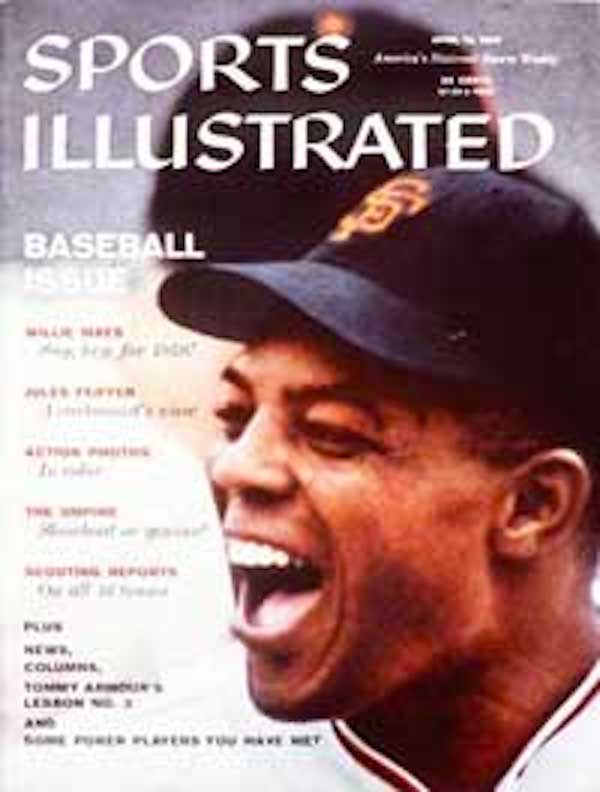
…Willie was signed by the New York Giants before the 1950 season as an amateur free agent.
…Mays replaced Bobby Thomson in center field in 1951. Thomson moved to third base and Whitey Lockman to first. The “Say-Hey Kid” was a Giant fixture in center for the next 21 years.
…Mays was traded by the San Francisco Giants in May 1972 to the New York Mets for Charlie Williams and $50,000 cash.
…Mays was loved by his teammates, as he often helped younger players become acclimated to the big leagues.
…Mays played in a record-tying 24 All-Star Games and participated in four World Series. His catch of a Vic Wertz drive-in in the 1954 Series remains one of baseball’s most memorable moments.
…Mays was born May 6, 1931, in Westfield, Alabama.