
How AI and Real-Time Analytics Are Shaping the Future of Business Intelligence
By Space Coast Daily // January 30, 2026
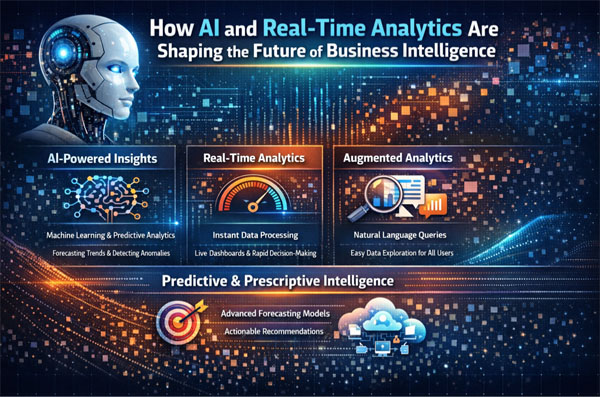
We’ve entered a digital age in which businesses transact with unimaginable amounts of data. Whether you are aggregating data from IoT sensors monitoring industrial processes or tracking customer interactions on digital properties, the volume, velocity, and variety of data are increasing rapidly. But raw data is not terribly useful unless it can be transformed into actionable information. This is the heart of the new business intelligence workflow, where AI and machine learning are reshaping how companies conduct business, compete, and innovate in real time.
The Evolution of Data Analytics
In the past, the focus of analytics was on descriptive and diagnostic insights. Businesses run using manual processes, spreadsheets, and static reports to understand what has happened and why. While useful, some of these approaches were slow and limited to specific regions. Accelerating Data Growth. As data grew and business environments became more complex, additional tools were needed that could accommodate larger datasets in less time.
To this end, predictive and prescriptive analytics are being underpinned with AI and other advanced algorithms. Predictive analytics relies on data from the past to predict the future, while prescriptive analytics takes this one step further by recommending specific courses of action that will help you achieve the best possible outcome. These have had an impact on today’s business intelligence and this has led to taking proactive decisions instead of reactive ones.
AI-Powered Analytics: From Insight to Intelligence
Machine learning is changing the way businesses analyse and handle their data. Algorithms for machine learning can identify patterns, correlations, and anomalies in large amounts of data that exceed human processing capabilities. Unlike conventional first-things-first analytics, AI/driven platforms don’t just stop at painting a picture of the past –they continually learn from new incoming data to make predictions more accurate and insights ever deeper.
For instance, AI can stop fraud in financial transactions before it occurs, predict supply chain shortages using real-time market indicators, and even anticipate customer churn by identifying behavioural trends. Empowered by these capabilities, they have the freedom to make quicker, more informed decisions and to embed intelligence into workflows across their operations with ease.
And in analytics, the introduction of artificial intelligence has democratized insights. Business users get greater access to and interaction with data, without requiring tech skills, thanks to AI-enabled NLP queries, connected dashboards, and visualizations helping democratize BI across the “business.” This new direction is important because, based on the implications, we need to embed a culture of data-driven decision-making not only in the analytics shop but department-wide.
Predictive and Prescriptive Analytics
If descriptive analytics is the ‘what happened,’ and diagnostic analytics provide insight into the ‘why it happened,’ predictive and prescriptive analytics are all about strategic focus. A descriptive model describes the properties of a system but does not predict its behavior. A predictive model is a representation of trends, risks, and opportunities. The prescriptive approach is the optimal way to reach one’s goals.
For example, a predictive model could forecast that customer engagement in a specific region will decline. Whereas a prescriptive model might suggest targeted advertising campaigns, operational alterations, or changes to inventory to address the trend. The transformation of these insights into business intelligence exercises drives superior performance, reduces risk, and improves business effectiveness.
As algorithms improve and computing power multiplies, such technologies will no longer be optional; they’ll be the cost of entry for companies hoping to compete in a rapidly changing business environment.
Real-Time Analytics and Competitive Agility
In the current business landscape, speed is key. E-commerce, logistics, and cybersecurity are among the industries where businesses that rely on lagging reports can’t compete. Real-time analytics have thus become an integral part of organizational strategy.
Real-time analytics tools leverage cloud infrastructure and in-memory computing to analyze streaming data as it occurs. This means that organizations can act in real time to new trends or perils. Merchants, for instance, can dynamically set prices based on how much inventory they have and how demand ebbs and flows. Banks can detect and stop suspicious transactions before they reach customers. Equipment can also be tracked by manufacturers to avoid unplanned downtime.
The partnership of AI and real-time analytics enables companies not only to recognize patterns but also to act on them quickly. “Real-time responsiveness has become more of a competitive differentiator, where organizations are now able to expect change rather than only react after the fact.
Cloud and Hybrid Analytics Platforms
Cloud computing has not only clarified the analytics landscape it has fundamentally redefined it. Modern cloud platforms enable elastic scaling of compute and storage resources in real time, allowing organizations to process massive, high-velocity datasets without the constraints of traditional on-premises infrastructure. This elasticity is especially critical as analytics workloads increasingly involve AI models, streaming data, and real-time decision engines.
The growing adoption of hybrid analytics architectures reflects the reality of today’s enterprise environments, where cloud-native services coexist with legacy systems. In these models, sensitive or regulated data remains on-premises to meet security, latency, and compliance requirements, while less sensitive workloads leverage cloud-based analytics engines for advanced processing, experimentation, and rapid scaling. This hybrid approach aligns with broader technology trends such as edge computing, data sovereignty, and zero-trust security, ensuring that analytics platforms remain flexible, secure, and future-ready.
Teams across different sites can share information using Cloud and Hybrid solutions. It is also easier for organizations to infuse business intelligence into their activities when both dashboards are shareable, and datasets can be combined (more readily achieved with enterprise-grade systems like ERP, CRM, and marketing). They also fold in so analytics insights can be executed by the organization and managers in line, and decisions can be made on the fly.
Data Visualization and Human Comprehension
Insights are only as good as you can communicate them, even with the best analytics in the world. There’s nothing that gets your head around a complex dataset as fast and accurately as a good visualisation. Geospatial, Heatmaps and Interactive dashboards enable keen observation and help you track your KPIs, while keeping an eye on operational performance.
New technologies such as virtual reality (VR) and augmented reality (AR) are also improving how companies interact with analytics. Close your eyes and picture you’re flying through a digital representation of an extended worldwide supply chain where all the delays, risks, and resources are in one view, moving and interacting in real time. This gives greater ease of insight and leads to quicker decision-making.
It is also possible to share data among the team of engineers, who are in different locations, using cloud and hybrid systems. Finally, it’s easier for businesses to weave business intelligence into the fabric of their operations when dashboards are share,d and datasets are merged – something that’s possible with your enterprise systems, such as ERP, CRM, and marketing software. They combine, so insights from analytics can be acted on by the enterprise, enabling managers to course-correct and make decisions on the fly.
Data Visualization and Human Comprehension
And the best analytics in the world are meaningless without good communication. Rapid and accurate comprehension of complex data is an important task in modern physics, which can be achieved through data visualization. Interactive dashboards, heat maps, and geospatial visualization enable policymakers to view patterns and monitor KPIs for operational performance.
Virtual reality (VR) and augmented reality (AR) are also giving business users new ways to interact with analytics. Think of managing a global supply chain in 3D space, where you can see delays, risks, and how resources have been allocated. These instruments bring human understanding and also enable quick, intelligent actions.
The Importance of Data Literacy
The value of analytics comes down to human understanding. Data literacy, the ability to understand and act on data, is increasingly important for every employee, regardless of role. Support the workforce with investments in training programs and business intelligence exercises so they can understand metrics, read dashboards, and take action based on analytics.
An analytics-literate organization fosters curiosity, responsibility, and problem-solving proactively. It turns data from an isolated resource into a shared asset that can be used to drive strategy at every level of the enterprise.
Conclusion: Toward a Smarter Future
The accelerated impact of both AI and real-time analytics is not only optimizing data processing but also fundamentally altering business intelligence practices. Organizations can convert massive datasets into actionable intelligence by combining predictive foresight, prescriptive advice, and immersive visualization.
The future goes to those who incorporate these technologies and foster a culture of data literacy. Companies that use AI-powered insights, real-time intelligence, and structured intelligence as part of their daily workflow will be the ones best positioned to innovate, respond, and compete in a world dominated by data. In this changing world, analytics is more than just a tool it underlies smarter, faster, and more innovative decision-making.















