PODCAST: Health First Spinal Surgeon Dr. Richard Hynes Helps Demystify the Latest Advances
By Space Coast Daily // January 22, 2026
Dr. Hynes: The good news is, most spine problems can be treated without surgery
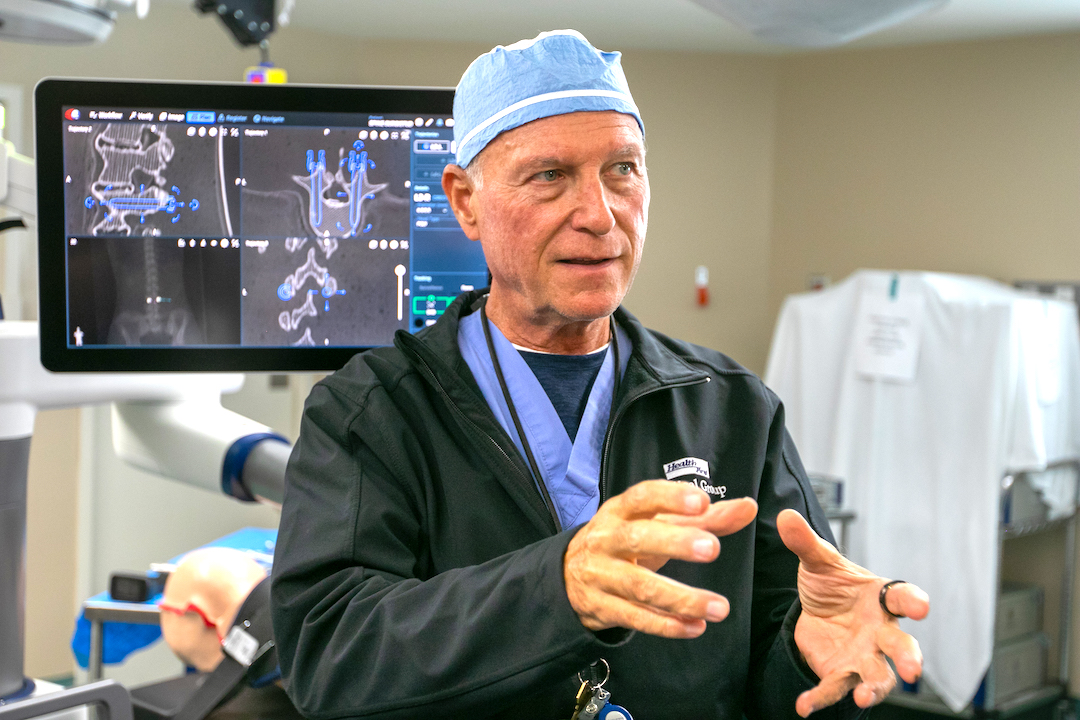
LISTEN TO THE PODCAST HERE: Richard Hynes, MD, is a board-certified orthopedic surgeon, specializing in spine health.
Health First’s Dr. Richard Hynes shares how innovation, teamwork, and patients themselves are offering hope and clarity for those suffering from back and spine pain
BREVARD COUNTY, FLORIDA — The operating room is the last place Dr. Richard Hynes wants to see you.
As it turns out, most spine problems don’t require surgery.
“Patients have to convince me they need surgery,” Hynes explained. “I don’t try to convince them.”
Hynes, an orthopedic spinal surgeon with Health First Medical Group in Melbourne, shared his insights on spinal pain and surgeries during a recent episode of Health First’s Putting Your Health First podcast, helping to demystify when surgery is really needed – or if conservative treatments can return quality of life.
Common spine issues — herniated discs, degenerative disc disease, scoliosis, and spinal stenosis — are often the result of both genetics and lifestyle.
“The spine wasn’t designed for the pressures we put on it,” Dr. Hynes explained.
It’s a given – discs wear out over time. Nearly everyone over age 25 has some kind of degeneration, Hynes said.
“The good news is, most spine problems can be treated without surgery,” he reassured.
First off is the conservative route: chiropractic care, physical therapy, pain management and injections. If those fail to provide relief and quality of life is significantly impacted, talking to a surgeon is the next step.
Patient education and advocacy are important.
“Most people come in with good questions, having done their homework,” Dr. Hynes said.
A Team Approach
Modern spine care depends heavily on teamwork. Hynes credits a broad alliance of professionals — physical therapists, chiropractors, orthopedic surgeons, neurosurgeons, pain specialists and more. These professionals work together to keep patients away from the operating room.
“It’s a whole big team out there,” he said, “and I’m all for it.”
For patients who can’t avoid surgery, remarkable advances have led the way to faster healing and minimally invasive procedures.
Spine surgeons can be categorized into three main actions:
■ Decompression (removing pressure on nerves)
■ Stabilization (fusing or replacing damaged discs)
■ Balancing the spine (ensuring proper alignment)
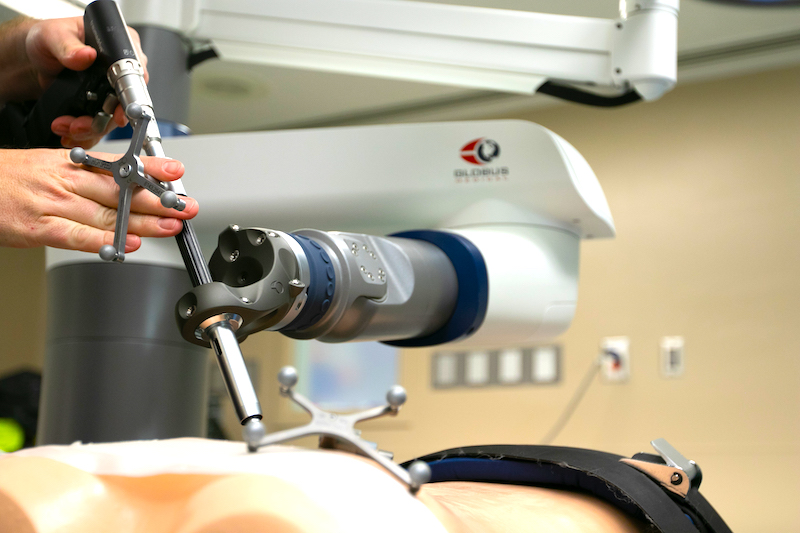
Technological evolution has completely transformed these procedures. For example, pedicle screws are surgical implants used to stabilize vertebrae by anchoring rods using robotic navigation. Now, with robotic surgery, surgeons are able to affix these screws to the spine with 99% accuracy. Traditional methods are closer to 90% or less.
“Would you want your surgeon to be 99% accurate or 91%?” Hynes asked. “That’s the difference robotics makes.”
Procedures are becoming more minimally invasive and endoscopic surgeries are used, along with AI-assisted planning. That’s a plus for the patient.
“Surgery has gotten so much safer,” Dr. Hynes shares. “We’re moving from inpatient hospital stays to outpatient, ambulatory surgery centers. Patients often go home the same day.”
Recovery timelines can vary, though. A simple disc removal often means the patient can return to normal activities in a matter of weeks. More complex procedures, such as spinal fusions, might need a longer recovery – six months to a year. Each patient’s experience varies.
Maintaining healthy habits is especially important prior to surgery.
“The better you go in, the better you come out,” Hynes said.
Post-operative physical therapy is tailored to each patient’s procedure. Some may require home therapy, while others need more intensive rehabilitation.

Genetics, Lifestyle and Myth Busting
So what causes spine disease? Genetics play a significant part, but environment and lifestyle count, too. With some elite athletes suffering from spinal problems, it points to the fact that some factors are out of our control.
Hynes also cleared up some confusion: Which type of surgeon do you really need for spinal surgeries – a neurosurgeon or an orthopedic surgeon?
“You need the right surgeon,” he said.
These days, the majority of top spinal surgeons have specialty training in both fields. It’s not so much about which type of provider you seek – it’s more about finding a provider who is skilled and experienced in what it is you need.
The future of spine surgeries
Things are looking bright for spinal procedures. Hynes shared his enthusiasm for continued innovation – from AI-driven planning to operating room beds that enhance patient and surgeon comfort.
“AI can now plan exactly where everything should go in a spinal surgery, based on hundreds of previous cases,” he explained.
Hynes’ own inventions, like a bed that allows 360-degree patient movement, are already improving patient outcomes in Brevard County.
Bottom line: Spine surgery is safer, more precise, and more patient-focused than ever. Being educated, relying on teamwork, and embracing technological innovation is the key to future successful surgeries.
If you’re experiencing back or spinal pain and problems, take Hynes’ advice into account. Explore all options, ask questions, and trust in modern spine care’s process. There’s no need to tolerate pain, with experts at the ready to help get you back to a life you love.
To listen to the entire episode of this podcast, visit hf.org/podcast. For more information or to schedule an appointment with a spine specialist, visit hf.org/spinecare.
 Related Story:
Something Feel Off? Health First Gynecological Oncologists Say Trust Your Instincts – and Speak Up