
Something Feel Off? Health First Gynecological Oncologists Say Trust Your Instincts – and Speak Up
By Space Coast Daily // January 8, 2026
Health First Medical Group's Dr. Gulden Menderes and Dr. Levent Mutlu stress early diagnosis
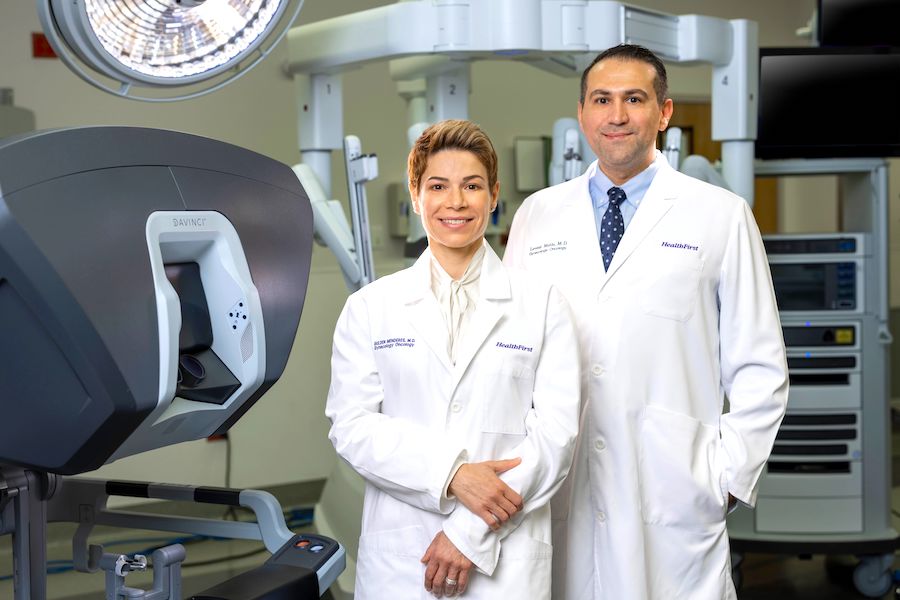
LISTEN TO THE PODCAST HERE: Featured Speakers Levent Mutlu, MD, and Gulden Menderes, MD
Gynecologic cancer experts share how new technology, emotional support, and a future dedicated clinic are designed to help patients, survivors reclaim their lives.
BREVARD COUNTY, FLORIDA — “It’s probably nothing.” That’s the polar opposite of what you should tell yourself if something about your body feels, well, off.
Listen to your gut. Because it might just save your life. That’s the message, Drs. Gulden Menderes and Levent Mutlu, gynecological oncologists with Health First Medical Group, want to stress to women. So, if you’re feeling bloated, pelvic pain, fatigue or post-menopausal bleeding, speak up.
“See your gynecologist as early as you can,” Mutlu said of symptoms. “Most of the time, if these cancers are diagnosed at an early stage, they are treatable and even curable.”
Both Mutlu and Menderes are proponents for early diagnosis, advanced treatments, and comprehensive support for women diagnosed with or recovering from gynecologic cancers. During a recent episode of the “Putting Your Health First” podcast, the two providers spoke passionately about what they do.
If a woman is diagnosed with a gynecological cancer, Menderes and Mutlu are ready to put a plan in place. Some of the diagnoses these specialty providers treat include uterine (endometrial), ovarian, cervical, vaginal and vulvar cancers.
Both providers are well-versed in exploring familial history, as well as which imaging tests can help determine what’s going on.
While the Pap smear is an incredibly effective screening tool for cervical cancer, unfortunately, there are no effective screening tools for ovarian or uterine cancers. That’s why being in tune with your body is so important.
But prevention is possible – especially when it comes to cervical cancer.
“We do have very effective vaccines available right now,” Mutlu added.
In the U.S., there are FDA-approved vaccines targeted at the human papillomavirus, or HPV, which is the cause of about 90% of cervical cancers, according to the World Health Organization (WHO). Studies have shown that girls who are vaccinated by age 16 have an 80% reduced risk of developing cervical cancer compared to their unvaccinated peers.

Advanced technologies to fight cancer
With minimally invasive robotic and laparoscopic procedures, managing gynecological cancers has improved drastically during the past few decades. Before, patients had to tolerate a lot – not only right after the procedure, but during the recovery process. And it would take a good month or two to feel “normal” again.
“Since the early 2000s, a lot has changed, for the better, in caring for our patients,” Menderes said.
Thanks to new technology, doctors can always determine the stage of endometrial cancer. Today’s minimally invasive surgeries aids in faster recovery – and getting patients to bounced back sooner than before.
“We are able to improve their quality of life by getting them back to their lives in a day – instead of keeping them in the hospital for two weeks,” Menderes shared.
The biggest breakthrough, according to Menderes, is using technology to map out the genetic changes in a tumor. In plain speak, once doctors get a sample, the lab can produce a detailed report — sometimes more than 10 pages — showing every mutation in that cancer.
This information helps doctors design treatments that target those specific changes, including advanced options. Think immunotherapy and new drugs called antibody-drug conjugates, which are man-made and extremely effective at fighting cancer.
“We are able to see results that we haven’t seen since the 1980s in managing these patients,” Menderes said.
Maintenance therapies are helping to extend lives of women with ovarian cancer, which is highly aggressive and difficult to detect. PARP inhibitors, for example, are designed to block the poly-ADP-ribose polymerase (PARP) enzymes. This helps cells repair DNA that’s been damaged.
“We have been seeing results that we have never experienced before with maintenance strategies, such as PARP inhibitors for metastatic ovarian cancer patients that delay the recurrence and improve their longevity,” Menderes explained.
When it comes to genetic risk factors, family history does matter. Uncovering the BRCA gene has been a huge advancement. Women who test positive for BRCA-1 and BRCA-2 are at a higher risk for developing ovarian and breast cancers, Mutlu explained.
“These women are at very high risk of developing ovarian cancer, so we need to have high suspicion index for these individuals to be tested,” Mutlu said.
In addition, gynecologic oncologists are well-versed in the complexity of such cases (such as a woman who has a larger uterus), boosting survival rates for patients. Mutlu said the data backs that claim up.
“We are trained in the specialty very specifically, and patients have better outcomes,” he said. “We are also assisting with complex gynecologic cases as well – if the gynecologist is not feeling comfortable taking care of these women, we are happy to assist them.”

Compassion’s role in care
Both Menderes and Mutlu stress the importance of having emotional support during their cancer journey. These providers seek to not only treat the cancer, but the person overall. With many patients feeling an immense emotional burden after a diagnosis, they often are anxious to have peer support – a place to share their experiences and frustrations with others fighting or having survived cancer.
“We have support groups available to all of our patients, and they can share their experience with other cancer survivors,” Mutlu said. “And it’s a big part of cancer care.”
The support groups are one sector of the holistic care model.
“We do care tremendously about the whole human, emotionally and physically,” Menderes said.
So much so, that the two providers were eager to share that a quality-of-life clinic will be opened at Health First Medical Group’s Gateway location in January 2026. The clinic will focus on helping cancer survivors manage their menopausal symptoms, as well as intimacy issues, such as decreased libido.
“We don’t want to just leave it at removing the uterus and providing radiation and chemotherapy,” Menderes said, noting the aftermath of treatment is just as important. “It’s all-around care.”
To listen to the complete episode of the podcast, which explores gynecological cancers more in-depth, visit hf.org/podcast. To find a support group, visit hf.org/your-cancer-community. For more on our cutting-edge cancer care, visit hf.org/gynecological-cancer.















