
Florida Ranked 13th Most Dangerous State For Teen Driver Prom Season Fatalities As 655 Teens Die In Five Years
By Space Coast Daily // April 29, 2026
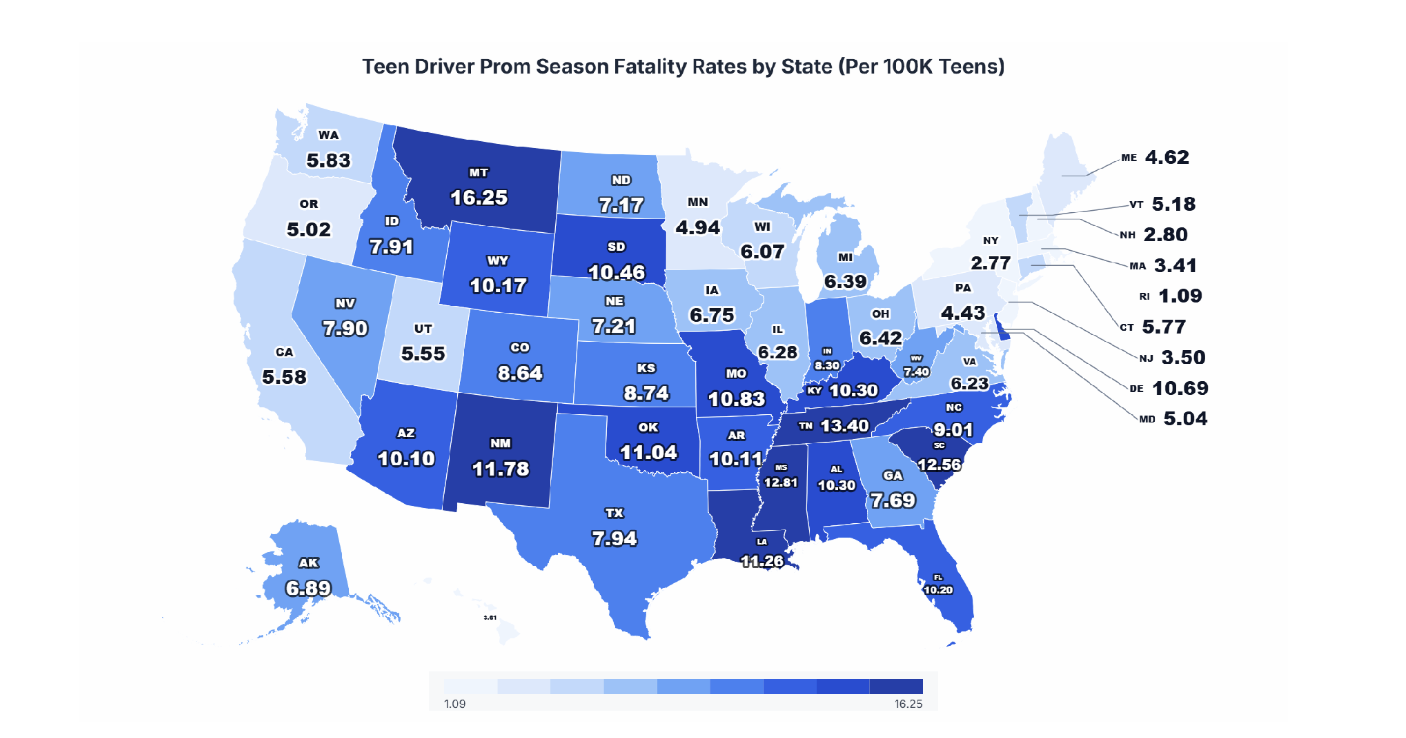 Key Highlights:
• Florida ranks 13th most dangerous for teen drivers during prom season, with a fatality rate of 10.20 per 100,000 teens.
• Between 2020 and 2024, 655 teens lost their lives, averaging 131 deaths per year, the highest total of any state.
• Florida’s fatality rate is over nine times higher than the safest state, Rhode Island, and 39.6% above the national median.
Florida is among the 15 most dangerous states in America for teen drivers during prom season. A new analysis ranking all 50 states by teen driver prom season fatality rates places the Sunshine State 13th out of 50, with a rate of 10.20 per 100,000 teens aged 15–19. Between 2020 and 2024, 655 teens were killed in prom season crashes on Florida’s roads, an average of 131 deaths per year, the third-highest raw fatality count.
The safety ranking puts Florida’s teen driving crisis in stark perspective. While Rhode Island holds the safest position with a rate of just 1.09 per 100,000 teens, Florida’s rate of 10.20 is more than nine times higher and 39.6% above the national median of 7.305. Of the 37 states that are safer for teen drivers during prom season than Florida, the vast majority have rates below 8.00.
The study by Wilk Law Personal Injury & Car Accident Lawyers analyzed NHTSA’s CDAN fatal crash database for traffic fatalities involving teen drivers across all 50 states during the prom season window from 2020 to 2024. Fatality counts were normalized against U.S. Census Bureau population estimates for residents aged 15–19 to produce a per 100,000 rate, enabling fair state-by-state comparisons. Florida’s rate of 10.20 earned it a ranking of 13th most dangerous, meaning only 12 states have worse outcomes for teen drivers during prom season.
What makes Florida’s 13th-place ranking particularly alarming is the state’s sheer size. The states ranked above Florida in danger are all significantly smaller: Montana, the most dangerous, has a teen population of just 68,907; Mississippi has 217,036; and South Carolina has 352,018. Florida, with 1,283,982 teens aged 15–19, is the third-largest state by teen population. Its elevated ranking is not a statistical artifact of a small population but a genuine, large-scale public safety failure that produces the highest raw fatality count in the entire country.
Florida Prom Season Teen Driver Fatalities by Year (2020 to 2024)
| Year | Teen Fatalities | Per 100,000 Teens | Avg. Per Prom Season | National Rank | YoY Change |
| 2020 | 129 | 10.05 | — | — | — |
| 2021 | 137 | 10.67 | — | — | +6.2% |
| 2022 | 124 | 9.66 | — | — | −9.5% |
| 2023 | 155 | 12.07 | — | — | +25.0% |
| 2024 | 110 | 8.57 | — | — | −29.0% |
| Total | 655 | 10.20* | 131.0 | #13 of 50 | −14.7%† |
*5-year average annual rate. †Overall change from 2020 to 2024, not annualized. National rank: 1 = most dangerous, 50 = safest.
Looking at the study, Tyler Wilk, Founding Attorney at Wilk Law Personal Injury & Car Accident Lawyers, commented:
“Prom season should be a time of celebration for teens, not one of the most dangerous periods on the road. Florida’s high fatality rate reflects a combination of inexperience, high-speed road environments, and increased nighttime driving. While the recent decline in deaths is encouraging, the overall numbers show that far more needs to be done to protect young drivers during one of the most high-risk times of the year.”
The year-by-year data shows a state where teen prom season fatalities have fluctuated significantly but remain stubbornly high. Florida recorded 129 teen fatalities in the 2020 prom season, then saw the figure rise 6.2% to 137 in 2021. After dipping to 124 in 2022, fatalities surged 25% to a five-year high of 155 in 2023, the deadliest prom season in the study. The 2024 figure of 110 represents a 29% year-over-year decline and the lowest annual total in the five-year window.
Despite the 2024 improvement, Florida’s prom season toll remains staggering in absolute terms. The 2024 figure of 110 teen fatalities still exceeds the total prom season death counts of 47 other states. The five-year average of 131 fatal crashes per prom season is the highest of any state in America, a direct consequence of Florida’s massive teen population combined with a per capita rate well above the national median.
The gap between Florida and states that have achieved genuine teen driver safety during prom season is enormous. Rhode Island, the safest state, averages just 0.8 fatal teen crashes per prom season at a rate of 1.09 per 100,000 teens. Florida’s rate of 10.20 is roughly nine times higher. Even among the 10 most dangerous states, Florida’s raw fatality volume stands apart. Montana, ranked first at 16.25 per 100,000, averages only 11.2 fatal crashes per season. Tennessee, ranked second at 13.40, averages 60. South Carolina, ranked fourth at 12.56, averages 44.2. Florida’s average of 131 dwarfs them all, because its teen population of 1,283,982 is vastly larger than any state in the top 10.
Among its Southeastern neighbors, Florida ranks as one of the most dangerous states for teen drivers during prom season. South Carolina, ranked 4th nationally at 12.56 per 100,000, is the most dangerous in the region but averages just 44.2 fatal crashes per season, roughly one-third of Florida’s volume. Alabama, ranked 11th at 10.30, averages 35.2. North Carolina, ranked 17th at 9.01, averages 64.2. Georgia, ranked 24th at 7.69, averages 59.0. Virginia, ranked 33rd at 6.23, averages 35.6. Florida’s rate of 10.20 is 13% higher than North Carolina’s, 33% higher than Georgia’s, and 64% higher than Virginia’s.
Florida’s per capita fatality rate of 10.20 is 39.6% higher than the national median of 7.305. The state’s average of 131 fatal teen crashes per prom season is roughly 14.4 times the national median of 9.1, reflecting Florida’s enormous teen population of 1,283,982, compared to the national median teen population of 289,876. In the 2024 prom season, Florida recorded 110 teen fatalities; Rhode Island, the safest state, recorded zero. Florida’s deadliest prom season came in 2023 with 155 fatalities; Rhode Island’s worst year in the study was 2021 with just two.
The factors that make Florida uniquely dangerous for teen drivers during prom season are well documented. The state’s sprawling road network, built overwhelmingly for vehicle speed, exposes young and inexperienced drivers to high-speed arterials and complex intersections. Florida’s warm climate and year-round outdoor social culture encourage late-night driving, a peak risk window for teen fatalities. The state’s large and geographically dispersed teen population means longer drive times to prom venues, after-parties, and post-event gatherings. The constant influx of tourists creates unpredictable traffic patterns that challenge even experienced drivers, let alone teenagers with limited time behind the wheel.
The 655 teen driver fatalities over five prom seasons represent a toll that extends far beyond the crash sites. Surviving family members face sudden loss, devastating medical bills, funeral expenses, and years of grief. For every teen killed, many more are severely injured, carrying lifelong disabilities, chronic pain, and lasting psychological trauma. The economic burden on communities includes emergency response costs, road redesign expenses, and the lost potential of young lives cut short before they have truly begun.
Methodology
This analysis examined fatal crash data from 2020 to 2024, focusing on incidents involving teen drivers during the prom season window across all 50 U.S. states. Rankings were determined by calculating an average annual fatal crash rate per 100,000 residents aged 15–19, using U.S. Census Bureau population estimates as the denominator. NHTSA’s Fatality Analysis Reporting System provided the primary crash data, accessed through the CDAN query tool.
Data Sources
- NHTSA Fatality Analysis Reporting System (FARS): https://cdan.dot.gov/query
- U.S. Census Bureau Population Estimates: https://www.census.gov/data/tables/time-series/demo/popest/2020s-counties-total.html
- Research Dataset: https://docs.google.com/spreadsheets/d/10vCGgV-RkzkOW6yjieQJ-ApKDVliCLBRCGAyZ8df9e0/edit?gid=0#gid=0
- Research by: https://wilklawfirm.com/
About Wilk Law Personal Injury and Car Accident Lawyers
The study was conducted by Wilk Law Personal Injury & Car Accident Lawyers, a Pennsylvania-based firm that represents victims of negligence in cases involving vehicle collisions, medical malpractice, nursing home abuse, premises liability, and wrongful death.













