5 Interior Designers Who Made Pieces That Feel Like They Belong in the Cosmos
By Space Coast Daily // May 13, 2026
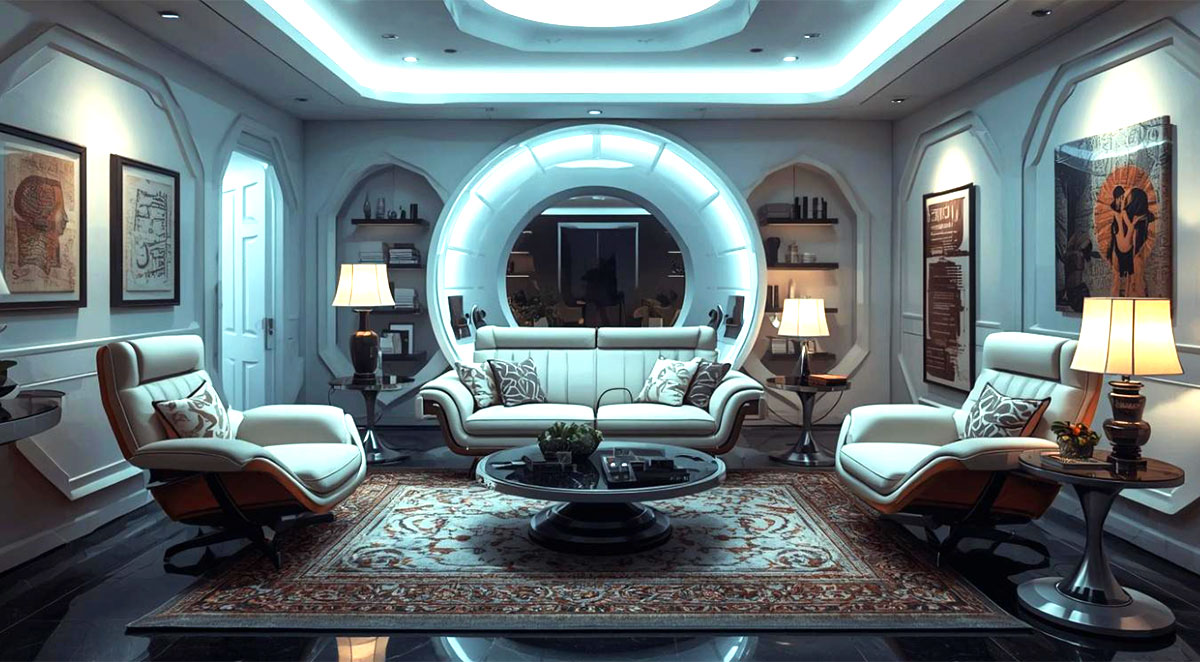
Some of the most enduring pieces in design history weren’t conceived for showrooms. They came out of an era when the space race had turned the sky into a canvas and designers (watching the world look upward) began asking what the future might feel like. The answer, it turned out, was fluid, round, and weightless. It was the 1960s, and furniture was never quite the same again.
The conversation between outer space and interior design has never really stopped. Today, pieces like the Poltrona Frau Vanity Fair XC “Imagine” (a limited edition upholstered in celestial illustrations by Fornasetti, a sun and moon rising over hand-drawn clouds) show that the cosmos remains one of design’s richest sources of inspiration, capable of turning even a classic armchair into something otherworldly.
1) Olivier Mourgue and the Djinn Chair that Went on a Space Odyssey
When Stanley Kubrick needed furniture for the space station in 2001: A Space Odyssey, he didn’t invent anything. He called Airborne. The Djinn Chair, designed by Olivier Mourgue in 1965, was already so ahead of its time that it simply belonged in orbit. Its low-slung tubular steel frame, covered entirely in foam and jersey fabric, mimics the look of a single folded surface. Mourgue himself described it as an attempt to capture lightness and movement, and Kubrick saw exactly that. The Djinn Chair is now part of the permanent collections at MoMA and the Victoria & Albert Museum, which says something about what happens when design and timing collide.
2) Eero Saarinen’s Most Futuristic Idea: The Tulip Chair
Eero Saarinen had a problem with legs. Not the human kind, the furniture kind. In the mid-1950s he declared war on what he called “the slum of legs,” the visual chaos of table and chair supports crowding a room’s floor. His solution was the Tulip Chair, produced by Alivar as part of the Mvsevm collection: a single pedestal base in cast aluminum, topped by a sculpted fiberglass shell. The result looks less like furniture and more like something a set designer would place aboard a spacecraft to signal civilization at its most refined. Star Trek agreed: the chair appears in multiple episodes, consistently used to signal a future worth inhabiting.
3) Pierre Paulin: The Ribbon Chair That Crossed Galaxies
The Ribbon Chair, designed by Pierre Paulin for Artifort in 1966, operates on a different logic. Where the Djinn Chair seduces with softness and the Tulip Chair with structural minimalism, the Ribbon Chair is about continuous form: a single flowing gesture that wraps around the body like a fuselage wraps around its crew. It appeared in Star Trek: The Original Series, and decades later in Blade Runner 2049, where it furnished the headquarters of the Wallace Corporation. No other chair in design history has been chosen this consistently to represent the future on screen. Paulin understood something that filmmakers kept rediscovering: truly forward-looking design doesn’t date, it migrates.
4) Massimo Castagna and the Suspended Starlight Lamp
Not all space-inspired design looks backward. The Henge Starlight Lamp, designed by Massimo Castagna, takes its cue from a different kind of sky, the kind seen through a telescope rather than a porthole. Its branching metallic structure, suspended from the ceiling, reads as a three-dimensional constellation: precise, dense, and quietly astronomical. Castagna’s work for Henge is consistently rooted in this kind of material tension; objects that appear almost geological in their weight but luminous in their effect. The Starlight changes with the hour, casting shadows that shift like the night sky slowly turning overhead.
5) Patricia Urquiola Brings the Clouds Indoors as a Sofa
Few designers worked at the scale of the cosmos as naturally as Patricia Urquiola. The Cassina Mon Cloud Sofa is one of the clearest expressions of what it means to bring the sky thinking into a domestic setting. The piece has no straight lines, no conventional geometry; only curves that reference softness, fluffiness, and fluidity… and the forms that exist where gravity is still negotiating with matter. It’s a sofa that seems to have arrived from somewhere rather than been manufactured. For astronomy enthusiasts who want their living space to reflect their sense of scale, few pieces make that argument more completely.