Poker Formats Explained for Casual Players Who Want the Game to Make Sense
By Space Coast Daily // May 19, 2026
Poker is easier to enjoy when the format stops being a blur. A strong hand still matters, but the table rhythm matters too. One format feels relaxed and hand-by-hand. Another feels compressed, timed, and event-driven. For casual players, the real breakthrough is not memorizing every poker term. It is recognizing the session each format creates.
The Format Shapes the Attention
Card games are useful thinking environments because they combine memory, planning, inhibition, and flexible decision-making. A 2023 open-access study on modern board and card games found that different games can activate different basic executive functions, which helps explain why format matters before a player even considers advanced strategy. Poker adds texture to that idea. The rules may stay recognizable, but the demands on attention shift when the pace, table size, and event structure change.
Where The Main Formats Start to Separate
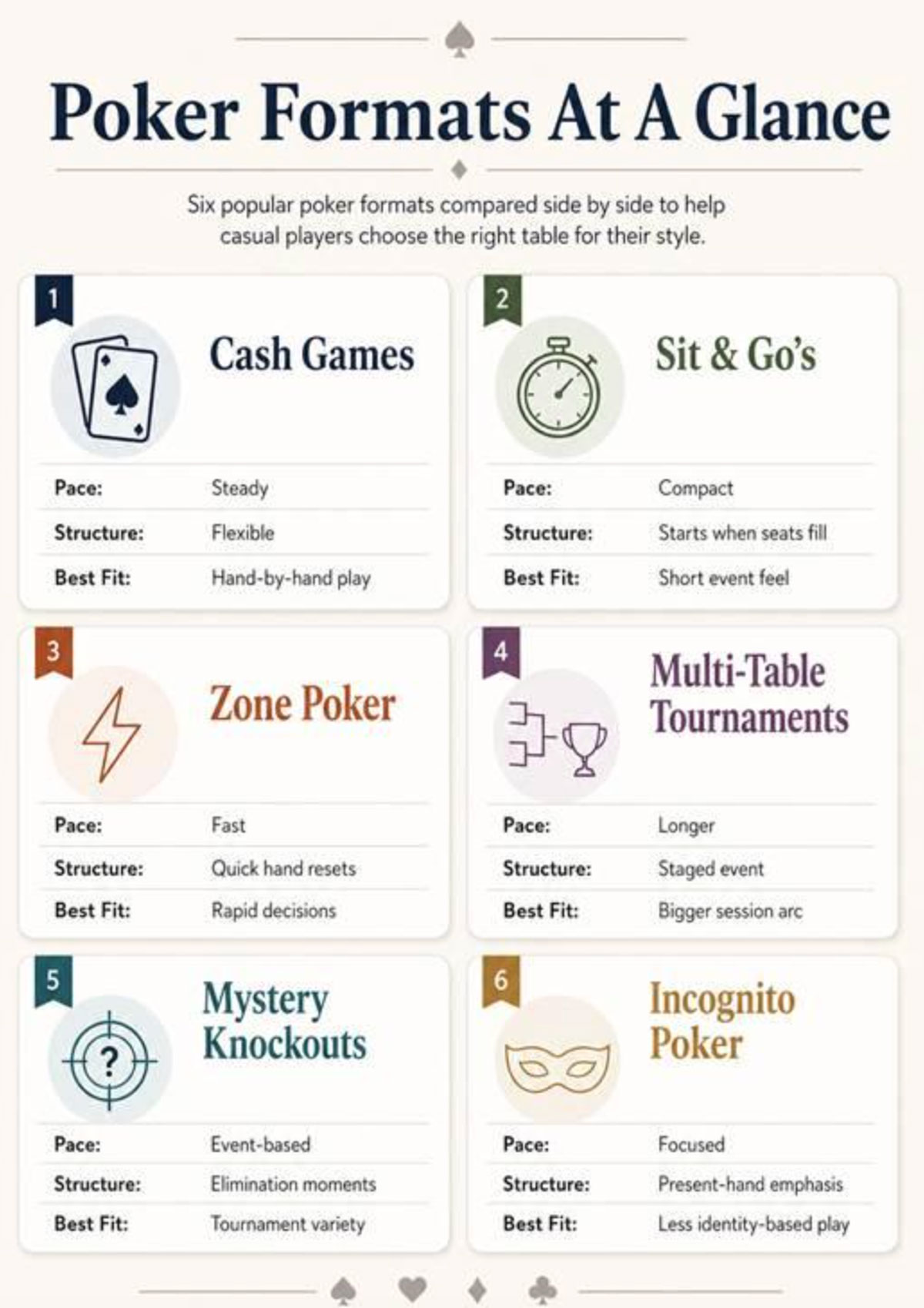
A useful way to understand online poker is to treat each format as a different iteration of the same card language. The above poker page shows formats such as cash games, Zone Poker, Sit & Go’s, multi-table tournaments, mystery knockouts, and incognito poker.
Cash games are more open-ended, with each hand carrying its own small arc. Sit & Go’s feel more contained because they begin when the table fills and move toward a defined finish. Zone Poker changes the tempo by quickly moving folded hands into the next decision point. Multi-table tournaments ask for longer attention because players may move through changing stack sizes, table balances, and event stages. Mystery knockouts add a tournament twist built around eliminations, while incognito poker places more emphasis on the current hand than on familiar table identities. Once those differences are understood, online poker becomes easier to approach as a set of experiences, not one flat category.
A recent Instagram post for the Black Diamond Poker Open 15 Ticket Giveaway shows why tournament language deserves its own explanation. The post highlights tickets for three event levels, which makes sense after readers understand that tournament poker is organized around entries, seats, timing, and event identity. It is not the same mental frame as a flexible cash-style table or a rapid fast-fold format. Tickets point to a scheduled experience, where the table is part of a larger event structure.
View this post on Instagram
A Simple Reader’s Map
| Format | What It Feels Like | Best Understood As |
| Cash games | Flexible, hand-by-hand, steady | A table where each hand has its own rhythm |
| Sit & Go’s | Compact, contained, table-sized | A small event that begins when seats are filled |
| Zone Poker | Fast, reset-heavy, decision-focused | A rapid format built around moving to the next hand |
| Multi-table tournaments | Longer, staged, shifting | A larger event with changing pressure and table movement |
| Mystery knockouts | Tournament-based with elimination moments | A tournament variation with added reveal points |
| Incognito poker | Less identity-based, more present-hand focused | A format that keeps attention on immediate decisions |
The table is a reading aid. Casual players often ask which format is “best,” but the more useful question is which format matches the kind of attention they enjoy. Some people like steady repetition. Some like the feeling of a beginning, middle, and end. Others like faster resets because the game feels more active.
Why Tournaments Feel More Like Events
Tournaments change the emotional shape of poker because the table is not the whole story. The event has its own structure. A player’s position, remaining stack, blind level, and table stage can all change how a hand feels. The same cards may invite patience early and sharper timing later.
That is why Sit & Go’s and multi-table tournaments are easier to understand as event formats. A Sit & Go is compact enough to feel approachable. A multi-table tournament has a wider arc, with more movement and more stage changes. The appeal is not in the cards alone. It is in watching a session develop over time.
Fast-fold formats sit on the opposite end of the rhythm. They compress the waiting. If a player folds, the next hand arrives quickly. That can make the game feel cleaner for people who enjoy repetition and pattern spotting, but it can also make the pace feel different from a table where the same group of players remains seated together.
The Best Format Is The One You Can Read Clearly
A casual player does not need specialist knowledge to understand the landscape. Getting to grips with the basic game types is enough to begin, and once you’ve tried a few options, you’ll soon figure out which one feels right for you. After all, different gamers have very different preferences; taking a bit of time to think about what you enjoy and what you don’t can massively enhance your poker playing experience.