DAVID VOLK: The AI Pay Raise Nobody at Your Company Is Talking About Yet
By Space Coast Daily // July 31, 2026
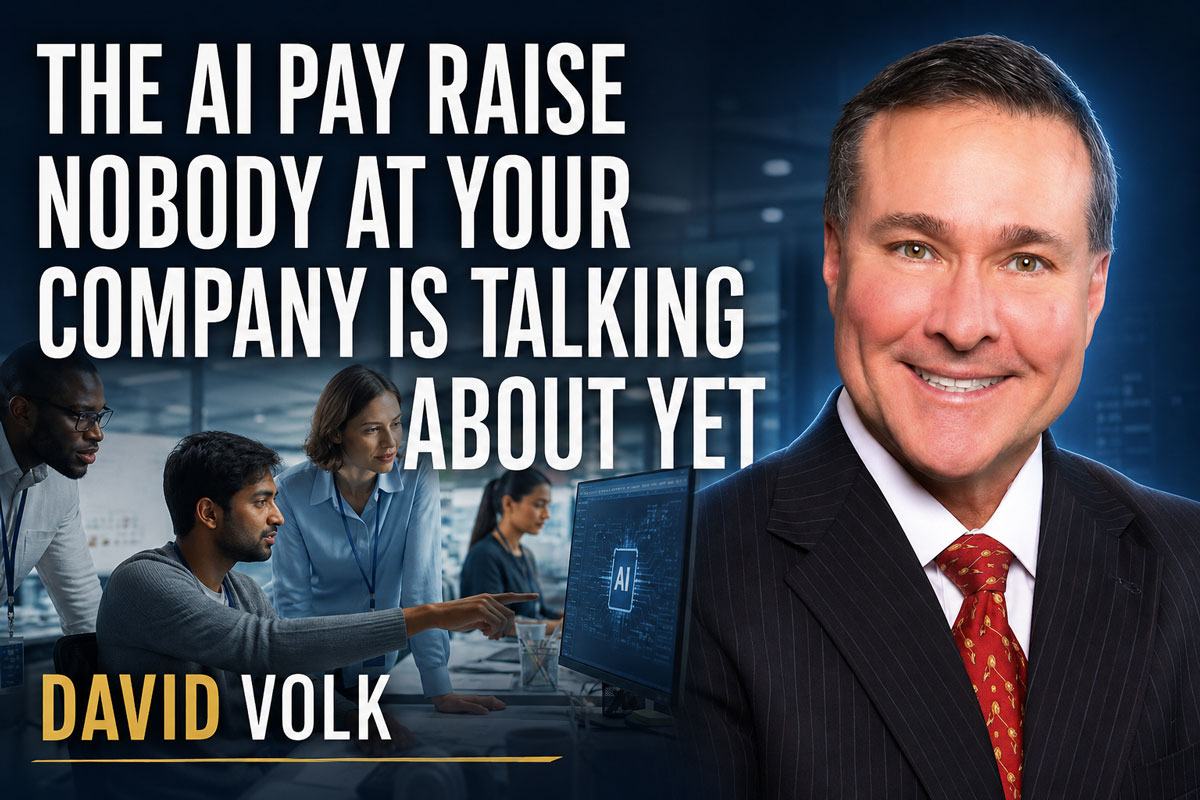
David Volk, a Business Litigation Attorney with Volk Law Offices, P.A., has 30 years’ experience and can be reached at help@volklawoffices.com or by visiting VolkLaw online at VolkLawOffices.com
BREVARD COUNTY, FLORIDA – Two numbers crossed my desk recently that every business owner in Brevard County needs to sit with for a minute.
Workers with AI skills are commanding a 62% wage premium over workers without them. At the same time, job postings requiring AI skills grew 144% year over year this spring, compared to just 7% growth for job postings overall, according to the Bipartisan Policy Center’s AI Skills Dashboard, as reported by SUCCESS magazine on July 17, 2026.
That is not a rounding error. That is the labor market telling you, loudly, where the leverage has moved.

Of course, that requires a caveat. Money always has to have a source. For AI-talented workers to get more money, a company’s productivity and income must rise, or expenses must fall. It is not unreasonable to know that more work can be done in less time if AI facilitates it. I got great assistance with this article using an AI LLM. I am still responsible for content, so I had to be careful, but it still saved me a great amount of time. I worked faster and got more done. You can too. We hope that jobs and companies will not be lost, but that is not realistic. All business and political systems are an animal kingdom. The strong survive and thrive, because they make choices that keep them relevant through continuous improvement. New businesses and jobs are quickly arising. Customers are expecting more and better for less.
The Premium Keeps Climbing, Not Leveling Off
The AI wage premium was 25% in 2024. It hit 57% in 2025. Now it sits at 62%, based on PwC’s Global AI Jobs Barometer, which analyzed more than 1 billion job advertisements across 27 countries, according to that same SUCCESS report. That is acceleration, not a plateau. The gap between employees who can use these tools well and employees who cannot is compounding every year, not settling into some new normal you can safely ignore.
It is also not spread evenly. The premium reaches as high as 118% in consumer-facing roles and drops to around 16% in government and public-sector jobs. Translation: if you compete in a fast-moving, customer-facing market, which describes most of my business clients here on the Space Coast, this gap should matter to you.
This Is Not a Coding Story
Here is where I think most business owners get this wrong. When you hear “AI skills,” if you are not deep in the subject, your mind probably jumps to programmers and data scientists. That instinct is outdated. I urge you to find the recent interview of Elon Musk by The Economist. He gives a sweeping view of how AI is perceived and is also rapidly changing the world, and its challenges such as power and compute and competition and dangers to humanity and how that risk can be mitigated. You will be fascinated.
The skills commanding the biggest premiums right now are about judgment, not code. It is knowing how to direct an AI tool through a real task, evaluate whether the output is any good, and combine that output with business context that only a human who knows the industry actually has.
I have made this point before in this column when I wrote about the hazards of AI hallucinations in legal work. The lawyer, the salesperson, the property manager, or the estimator who can competently supervise an AI tool and catch its mistakes is worth more than one who cannot, regardless of whether either one can write a line of code. You do not need a computer science degree to be that person. You need reps and good judgment.
Where This Is Already Reshaping Hiring
If you are in finance, banking, or professional services, this has already arrived. Tech job postings in finance requiring AI skills jumped 47% year over year, more than double the growth rate of overall tech postings, SUCCESS reported. Electronic efficiency is nothing new. In the Elon interview, he reminds us that interest on bank deposits were once manually calculated, and are now performed electronically. Wonder about buying a stock, mutual fund, or ETF? Run an AI prompt on its strengths and weaknesses given your investing objectives.
Manufacturing is close behind, driven by predictive maintenance, quality control, and supply chain work that used to be purely operational and is now explicitly AI-adjacent. Health care is moving more cautiously, given the stakes involved, but clinician shortages and rising costs are pushing AI into diagnostics and drug discovery even there.
If your industry feels far removed from any of this, I would look again. The gap is closing faster than most owners assume.
What This Means If You Are the One Doing the Hiring
This is where my employment law hat comes on, because I see business owners get excited about “AI skills” as a hiring filter and walk straight into an avoidable problem.
1. Rewrite job descriptions to test judgment, not buzzwords.Anyone can claim familiarity with an AI tool on a resume. Very few candidates can demonstrate they know when to trust the output and when to override it. Screen for that distinction directly, in the interview, not just on paper.
2. Train the people you already have before you go hire externally.Given how fast this premium is climbing, upskilling employees who already understand your business and your clients is usually cheaper and lower-risk than competing for external talent in an overheated market.
3. Watch your screening tools for disparate impact.No normal reasonable person wants to discriminate. It can happen by accident. If you start weighting “AI proficiency” heavily in hiring, promotion, or compensation decisions, make sure that criterion is not quietly screening out older workers or other protected groups who simply had less exposure to these tools. The law often does not care that the outcome was unintentional. I have written before that “the algorithm decided” is not a shield against liability, and the same logic applies here.
4. Treat this as a retention issue, not just a hiring one.An employee who develops real AI fluency on your dime becomes more valuable to your competitors, too. If you are investing in this training, have a retention plan ready before you need one.
What This Means If You Are the One Job-Hunting
Get hands-on with the tools specific to your actual field, not generic ones. Someone who can direct an AI tool through a full client engagement is worth more than someone who can only describe AI in the abstract.
Build a track record you can point to, not a certificate. Employers paying a premium want evidence: a faster workflow, a project delivered with less overhead, a measurable result. Not proof you finished an online course.
Then negotiate accordingly. If your role increasingly involves directing, evaluating, or building on AI output, that is a legitimate basis for a compensation conversation. Waiting for your employer to notice on their own means leaving value on the table while the market-wide gap keeps widening.
The Bottom Line
This is a labor-market signal, not a tech trend piece. A 62% wage premium and 144% growth in demand for these skills is real money moving in a real direction, and it is moving faster than most compensation and hiring policies are keeping up with.
If you run a business, get ahead of this on both the opportunity side and the legal-risk side before your competitors, or your own employees, force the issue for you.
David Volk, a Business Litigation Attorney with Volk Law Offices, P.A., has 30 years’ experience and can be reached at help@volklawoffices.com or by visiting VolkLaw online at VolkLawOffices.com