Turning Compassion into Careers: How Eastern Florida State’s Social and Human Services Program Changes Lives
By Casey Covel, Manager, Eastern Florida State Web & Social Media // October 15, 2026
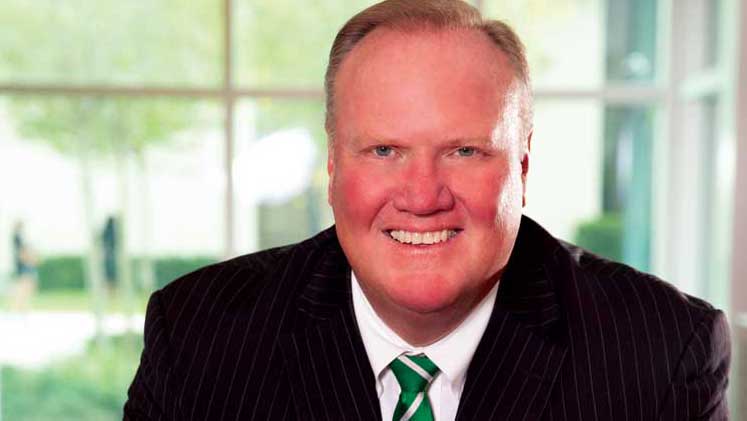
President Dr. Jim Richey: EFSC committed to creating educational pathways that transform lives while strengthening our community

Eastern Florida State College’s A.S. in Social and Human Services degree was shaped by its current Dean of Students, Dr. Barbara Kennedy
BREVARD COUNTY, FLORIDA – Shelleyann Romain enrolled at Eastern Florida State College looking for answers, not a new career.
“I had recently left a domestic violence relationship that lasted for more than 20 years,” she said.
“I found myself asking, ‘How did this happen to me?’ I simply wanted to understand my trauma and relationships and what had happened in my own life.”
Through talking with a friend, Romain learned about EFSC’s Domestic Violence Certificate program and A.S. in Social and Human Services.
What began as a search for understanding eventually became a passion for helping others through becoming a social worker.
“Every class that I took opened a door for me. The more I learned, the more I wanted to know.”
That door eventually led to an internship that became a job with Genesis House and to graduate studies at Florida State University, where she completed a Master of Social Work in May 2026.
Today, Romain is pursuing licensure as a registered clinical social work intern, with the goal of becoming a Licensed Clinical Social Worker and therapist.

Creating a Pathway for Helping Professions
Eastern Florida State College’s A.S. in Social and Human Services degree was shaped by its current Dean of Students, Dr. Barbara Kennedy, who brought her years of field experience and community relations into the process.
“The vision was to create an accessible pathway for students who wanted to make a meaningful difference in the lives of others while also meeting a growing workforce need in our community,” said Dr. Kennedy.
“We recognized that many students were passionate about helping professions but needed a clear academic pathway that connected education with career opportunities.”
Designed with community support and workforce demand in mind, the two-year associate in science degree allows students to earn College Credit Certificates in Community Health Work and Aging Services or Domestic Violence, with specializations tailored to their professional goals.
The curriculum incorporates crisis intervention, group dynamics, case management, and ethics.
Local agencies provided insight into industry needs, helping to shape a curriculum that ensures students develop skills that are relevant and immediately applicable in the field.
Hands-on Experience through Community Partnerships
As part of the program, students complete two semesters of supervised field experience under the professional supervision of community partners like The Women’s Center, Community of Hope, Aging Matters, Project Response, Brevard C.A.R.E.S., and Walk on Water Equine Therapy.
Students collaborate with their professors and EFSC’s internship office to identify field experiences that best align with their career aspirations, allowing them to gain relevant, real-world expertise and foster professional relationships with two different organizations.
Romain, who enrolled in the program’s Domestic Violence specialization, chose to complete her first internship at the Salvation Army Sue Pridmore Center for Women and Children.
The internship provided her with firsthand experience working at a homeless shelter and supporting vulnerable populations.
“The internships are just so awesome,” said Romain. “It was a great segue from being in a classroom and then having that real-world experience.”
For her second internship experience, Romain selected Genesis House, a shelter serving homeless women and children that provides counseling, transportation, education, and job-training support.
Romain’s time at Genesis House ultimately served as the bridge between her classroom education and her future profession.
“I graduated from the program with practical skills, professional connections, and the confidence to succeed,” said Romain.
“After I completed my internship and graduated, Genesis House actually hired me—my first job in the field.”
Faculty Mentorship and Expertise
Romain credits her academic and career success to the dedicated faculty at EFSC.
“The professors saw a potential I couldn’t see yet,” she said. “EFSC didn’t just educate me. They believed in me before I fully believed in myself.”
Patty Wallace, an Associate Professor who brings more than two decades of experience in counseling/advising, nonprofit organizations, and higher education, said mentorship is one of the program’s defining strengths.
“Our exemplary instructors, who are professionals in the field, foster real-world student growth, bridge the gap between curriculum/theory and practice, and serve as caring mentors throughout the program,” said Wallace.
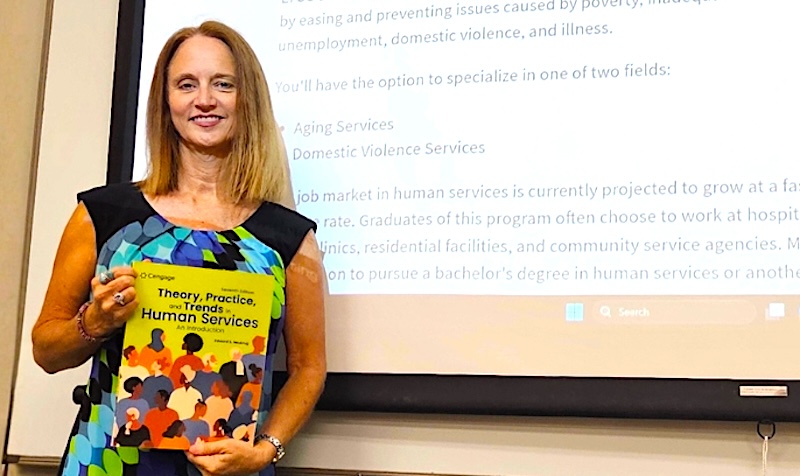
For Romain, one of those mentors, Dr. Kennedy, introduced her to the world of social work—and provided her with a clear path to her master’s degree.
“The more I learned, the more I realized social work was exactly where I belonged,” said Romain.
“Dr. Kennedy introduced me to FSU’s College of Social Work and told me about the scholarships there. That conversation changed everything in my life.”
A Pathway to the Field and Further Education
EFSC’s articulation partnership with Florida State University’s College of Social Work gives students a clear vision for continuing their education.
Brevard County students planning to pursue the Bachelor of Social Work degree at the FSU College of Social Work can also apply for several scholarships funded by Brevard County philanthropists Guy M. and Delores Spearman.