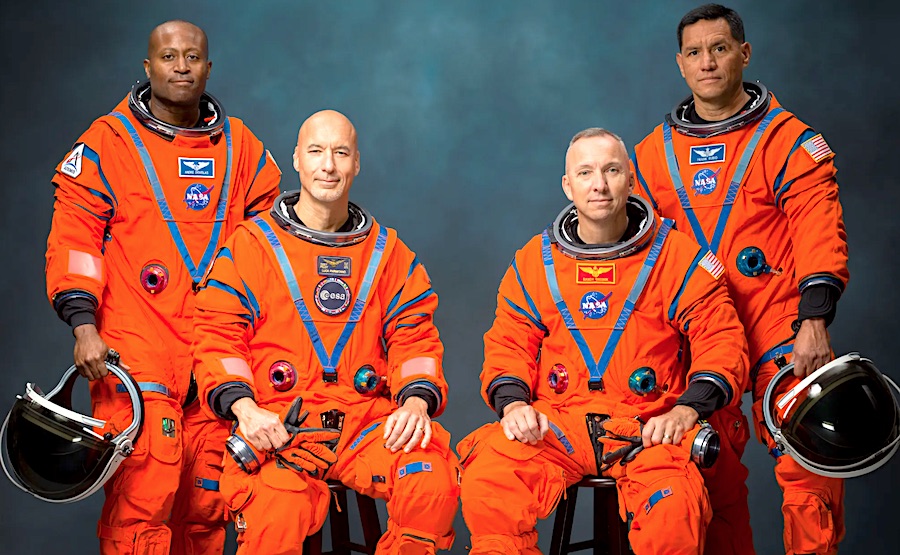
mission scheduled to launch as early as next year aboard NASA’s Space Launch System rocket and Orion spacecraft
NASA on Tuesday unveiled the four-member crew that will fly the Artemis III mission, a key step in preparing for future lunar landings by testing spacecraft and landing systems in Earth orbit. Veteran astronaut Randy Bresnik will command the mission, joined by Luca Parmitano as pilot. NASA astronauts Andre Douglas and Frank Rubio will serve as mission specialists.
Preparations for the Artemis III launch continue on Florida’s Space Coast, with the rocket’s core stage already inside the Vehicle Assembly Building at Kennedy Space Center, with booster segments arriving soon as assembly work advances ahead of the mission.
HOUSTON, TEXAS — NASA unveiled the four-member crew that will fly the Artemis III mission, a key step in preparing for future lunar landings by testing spacecraft and landing systems in Earth orbit.
Veteran astronaut Randy Bresnik will command the mission, joined by Luca Parmitano as pilot. NASA astronauts Andre Douglas and Frank Rubio will serve as mission specialists.
The mission, scheduled to launch as early as next year aboard NASA’s Space Launch System rocket and Orion spacecraft, was originally planned as the program’s first lunar landing mission.
NASA revised the plan to conduct an Earth-orbit test that will allow astronauts to dock Orion with lunar landers being developed by Blue Origin and SpaceX.
During the approximately two-week flight, Orion will first rendezvous with Blue Origin’s Mark 2 lunar lander before later docking with SpaceX’s Starship Human Landing System.
Taking another step toward one of the most complex human spaceflight missions in recent history, NASA on Tuesday provided new details on Artemis III and announced the four prime crew members and a backup for the test flight.
WATCH:NASA on Tuesday unveiled the four-member crew that will fly the Artemis III mission, a key step in preparing for future lunar landings by testing spacecraft and landing systems in Earth orbit.
The mission will undertake a series of challenging tests in Earth orbit in 2027, essential for Artemis IV, the first planned crewed mission to the lunar South Pole in 2028.
During Artemis III, the agency’s SLS (Space Launch System) rocket will launch the Orion spacecraft and its crew from NASA’s Kennedy Space Center in Florida to low Earth orbit.
After Orion systems checkout, the spacecraft will, for the first time, demonstrate rendezvous and docking capabilities with test versions of one or both American commercial human landing systems under development by Blue Origin and SpaceX.
This highly choreographed mission includes a dramatic multi-launch campaign of the world’s most powerful rockets, testing the integration of hardware between Orion and the landers, including system interfaces, software, propulsion, and communications.
Crew assignments are as follows:
• NASA astronaut Randy Bresnik, commander
• ESA (European Space Agency) astronaut Luca Parmitano, pilot
• NASA astronaut Andre Douglas, mission specialist
• NASA astronaut Frank Rubio, mission specialist
As part of Tuesday’s event, NASA astronaut Bob Hines was named as a backup crew member.
The crew will begin training immediately on Orion spacecraft systems and will assist in the development and operations of test versions of Blue Origin and SpaceX landers.
“Today we take another bold step in humanity’s return to the Moon, building on the extraordinary foundation laid by the Artemis II astronauts,” said NASA Administrator Jared Isaacman.
“Their achievements reignited global excitement for exploration, and now they pass the torch to the Artemis III team, Randy, Luca, Frank, and Andre.
NASA, Partners Making Progress in Preparing for Test Flight
Engineers will connect the Orion crew module and service module this summer and integrate the spacecraft’s docking system, which will fly for the first time.
Heat shield testing continues, with individual blocks undergoing ultrasonic inspections and being installed onto the heat shield structure.
Rocket processing is also well underway. Technicians for SLS are integrating the engine section with the rest of the core stage ahead of installing the four RS-25 engines this summer.
With all solid rocket booster segments now at NASA Kennedy and mobile launcher refurbishments on track, rocket stacking is also scheduled to begin this summer.
NASA continues the design and fabrication of a spacer that will replace the upper stage on Artemis III.
Blue Origin is developing a crewed lunar version of the company’s Blue Moon lander, while SpaceX is developing a crewed lunar lander version of the company’s Starship, with both companies building test articles for Artemis III.
NASA is supporting both lander providers hands-on throughout design, development, testing, and evaluation, including sharing agency expertise and capabilities gained from previous missions.
Artemis III includes launching the world’s most powerful rockets in short order.
Blue Origin’s lander pathfinder, which is able to stay in orbit for multiple weeks, will launch first and await the crew.
NASA will send the astronauts aboard Orion on an SLS mission to orbit Earth, before rendezvousing in space with the company’s lander test article and spending about two days docked together for tests and technology demonstrations, including entering the lander.
After completing docked operations with Blue Origin, Orion will detach and await Starship. SpaceX’s Starship pathfinder will launch and rendezvous with Orion to spend about a day connected for checkout and testing.
After that, Orion and its crew will undock and return home, splashing safely down in the Pacific Ocean, where a team from the U.S. Navy and NASA will recover the astronauts.
In total, the crew is expected to remain in space for about two weeks, with the exact mission duration to be determined in real time based on launch, rendezvous, and docked operations.