Two Florida Tech Students Win Major Prizes at Lightning Conference in Germany
By Space Coast Daily // October 11, 2024
education spotlight
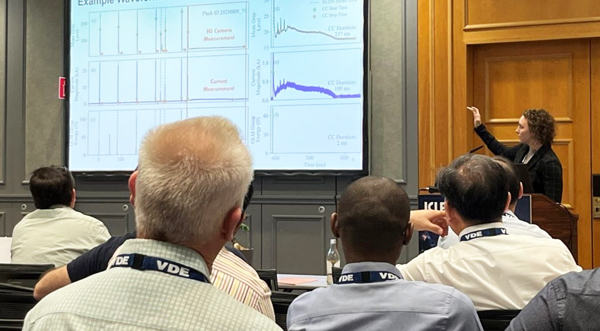
BREVARD COUNTY • MELBOURNE, FLORIDA – Two Florida Tech graduate students attending the 37th International Conference on Lightning Protection in Dresden, Germany, were recognized with the Young Scientist Awards, the highest honor for early-career scientists at the event.
Doctoral students Megan Mark and Dylan Goldberg attended the conference with senior visiting research faculty Amitabh Nag, who along with senior visiting research faculty Ken Cummins serves as the students’ research co-advisor.
Out of 58 international candidates for this award, just four recipients were named – and half of them were Florida Tech Panthers! The award recognizes scientists under age 35 who have delivered an oral or poster presentation at the conference and have made “notable contributions in the field of lightning research and lightning protection,” according to organizers.
For winning, Mark and Goldberg each received a certificate and a 500 Euro cash prize (about $557).
But as noted by Mark and Goldberg’s principal adviser, Distinguished University Professor in Physics and Space Science Hamid Rassoul, the students left the conference with so much more than a piece of paper and cash.
“Attending conferences and presenting there expose students to cutting-edge techniques and methodologies. As a result, they improve our experiments, observations and research results with fresh insights and knowledge,” he said of the value of conferences for students.
“It’s a great way for early career scientists to learn and network. It recharges their motivation by seeing productive peers in their field of study. It also increases the visibility of our research team and the university.”
Mark’s award-winning presentation was, “High-Speed Video Camera and Geostationary Lightning Mapper Measured Signatures of Cloud-to-Ground Strokes with and without Significant Continuing Current.”
The purpose of the study, Mark said, was to see if a space-based lightning detection system, the Geostationary Lightning Mapper (GLM) onboard the Geostationary Operational Environmental Satellite, could track these continuing currents and measure their durations.
Continuing current in lightning is the continuous transfer of charge from cloud to ground for up to hundreds of milliseconds (one millisecond is 1/1000th of a second). Considered lightning’s fire-starters, continuing current events can start wildfires and cause severe damage to infrastructure.
If these events could be detected and measured, as the study was exploring using the GLM, first responders could potentially detect fires in the earliest stages. But the study found the GLM is has difficulty detecting long-duration lightning currents and when it does it underestimates the durations.
Goldberg’s award-winning presentation was, “Optical and electromagnetic field signatures of space-leader evolution in negative cloud-to-ground lightning stepped leaders.”
He examined a different element of lightning than Mark, space leaders. Most cloud-to-ground lightning transfers negative charge to the ground through a negatively charged channel of hot plasma called a leader.
Through a series of 5-to-10-meter jumps called steps, downward negatively charged leader channels propagate from the thundercloud to the ground. In each step of the leader, a hot plasma space leader forms near the tip of the leader and shapes the downward path ahead.
Using an ultra-high-speed camera that can capture nearly 800,000 frames per second along with time-aligned electromagnetic fields, Goldberg’s study, the first of its kind, has contributed to the fundamental physics of lightning by providing a better understanding of how lightning leaders propagate forward in the few milliseconds before they make contact with the ground, resulting in lightning as we know it.
 Related Story:
Florida Tech Volleyball Player Chiara Patelli Earns SSC Offensive Player of the Week Honors
CLICK HERE FOR BREVARD COUNTY NEWS