NASA to Roll Out Largest Section of Artemis III, Currently Scheduled for Launch in 2027
By Space Coast Daily // April 14, 2026
section containing liquid hydrogen tank, liquid oxygen tank, intertank, and forward skirt – will be loaded on the agency’s Pegasus barge
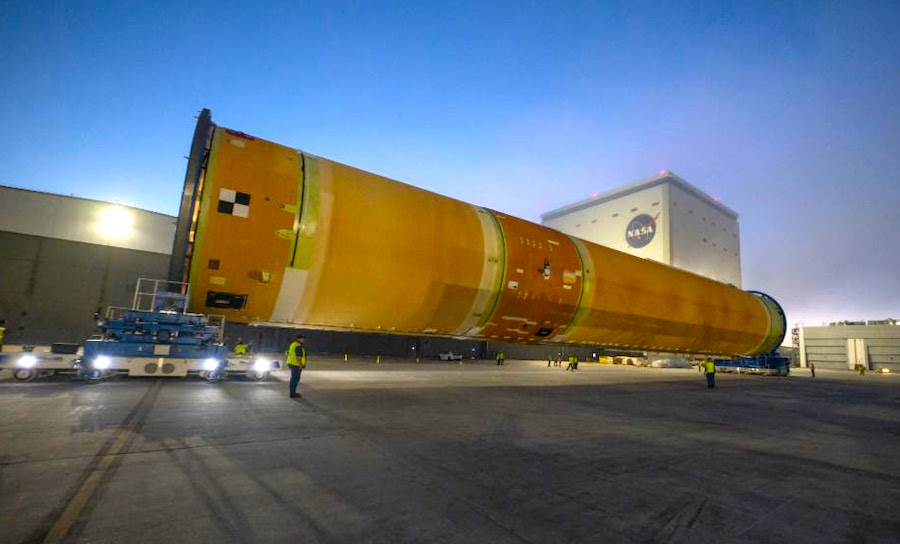
NASA will roll the largest section of the agency’s SLS (Space Launch System) rocket, which will launch the second crewed Artemis mission, out of the agency’s Michoud Assembly Facility in New Orleans on Monday, April 20.
What’s called the top four-fifths of the SLS core stage – the section containing the liquid hydrogen tank, liquid oxygen tank, intertank, and forward skirt – will be loaded on the agency’s Pegasus barge for delivery to NASA’s Kennedy Space Center in Florida.
Once at NASA Kennedy, teams will complete the stage outfitting and vertical integration before handing the hardware over to the agency’s Exploration Ground Systems Program, which will handle stacking and launch preparations.
The Artemis III SLS engine section and boat-tail, which protects the engines during launch, moved from the Space Systems Processing Facility at NASA Kennedy to the Vehicle Assembly Building in July 2025.
The four core stage RS-25 engines are scheduled to ship from NASA’s Stennis Space Center in Bay St. Louis, Mississippi, no later than July 2026, for integration into the engine section.
The rocket stage with its four RS-25 engines will provide more than 2 million pounds of thrust to send astronauts aboard the Orion spacecraft for the Artemis III mission.
Artemis III is currently scheduled for launch in 2027, following the successful Artemis II test flight mission around the Moon that concluded on April 10.
Building, assembling, and transporting the core stage is a collaborative process for NASA, Boeing, the core stage lead contractor, and the lead RS-25 engines contractor, L3Harris Technologies.
The core stage is the backbone of the SLS rocket. All five major structures for the rocket stage are manufactured at NASA Michoud.
By optimizing space at NASA Kennedy and NASA Michoud for production, integration, and outfitting, NASA and industry can streamline production for a standardized SLS configuration for NASA’s Artemis program.
The Artemis III mission will launch American astronauts in the Orion spacecraft atop the SLS rocket into Earth orbit to test rendezvous and docking capabilities between Orion and commercial spacecraft, which are needed to land astronauts on the Moon in 2028.
The SLS rocket is the only rocket capable of sending Orion, astronauts, and supplies to the Moon in a single launch.
Artemis III is the second crewed mission under the agency’s Artemis program, in which NASA is sending astronauts on increasingly difficult missions to explore more of the Moon for scientific discovery and economic benefits, establish an enduring human presence on the lunar surface, and build on the foundation for the first crewed missions to Mars.
 Related Story:
PERFECT LANDING! Artemis II Astronauts Splash Down in Pacific, Concludes Historic Journey Around the Moon