Health First is first in Brevard to offer the Mako SmartRobotic Shoulder application
WATCH: Health First Brings Advanced Robotic Shoulder Replacement Technology to Brevard County. ABOVE, Dr. Brent Stephens visits with patient Sherry before her shoulder replacement procedure using the Mako SmartRobotics™ Shoulder application. Health First is the first healthcare system in Brevard County to offer advanced technology, providing patients with personalized surgical planning and precise implant placement.
BREVARD COUNTY • ROCKLEDGE, FLORIDA — For more than a year, Sherry lived with shoulder discomfort that slowly became part of her everyday life.
After undergoing rotator cuff surgery several years ago, she began experiencing pain again and feared she had torn her rotator cuff a second time.
Swimming, vacuuming, and even routine household chores became increasingly difficult, but like many people living with chronic shoulder pain, she adapted instead of seeking immediate treatment.
“I had been living with it probably for over a year,” Sherry said. It just became part of her life, and she suppressed pain with the occasional Tylenol.
Today, Sherry is back on the road to recovery after becoming the first patient in Brevard County to undergo a Mako SmartRobotics-assisted reverse shoulder replacement at Health First’s Viera Hospital, performed by orthopedic surgeon Dr. Brent Stephens.
The procedure marks a significant milestone for Health First and for orthopedic care in Brevard County.
Health First is the first healthcare system in the county to offer the Mako SmartRobotics™ Shoulder application and is one of only a select number of healthcare organizations in Florida chosen by Stryker to provide this advanced technology.
This milestone reinforces Health First’s role as a leader in delivering advanced orthopedic care in Brevard County and highlights the organization’s commitment to expanding access to innovative treatment options that improve the patient experience and advance the future of care.
Dr. Brent Stephens visits with patient Sherry before her shoulder replacement procedure using the Mako SmartRobotics™ Shoulder application. Health First is the first healthcare system in Brevard County to offer advanced technology, providing patients with personalized surgical planning and precise implant placement.
“This is a very big, new technology that’s coming out,” Stephens said. “It’s going to, just like hip and knee replacement, change the world of shoulder replacements.”
According to Stryker, the manufacturer of Mako, between 18% and 26% of Americans experience chronic or debilitating shoulder pain each year, often caused by arthritis, irreparable rotator cuff tears and other degenerative shoulder conditions.
For patients whose pain no longer responds to nonsurgical treatment, reverse shoulder replacement can relieve discomfort, restore function and help them return to activities they enjoy.
The Mako Shoulder application allows surgeons to create a personalized surgical plan before entering the operating room. During surgery, robotic-assisted cutting tools and haptic guidance help the surgeon precisely execute that plan when positioning the reverse shoulder glenoid implant.
Stephens says the technology gives surgeons another tool to improve precision and consistency.
“In orthopedics, we’re always striving for perfection,” he said. “The robot is the next step to getting to that level where every patient gets the same level of perfection. That’s the goal with robotic shoulder replacement.”
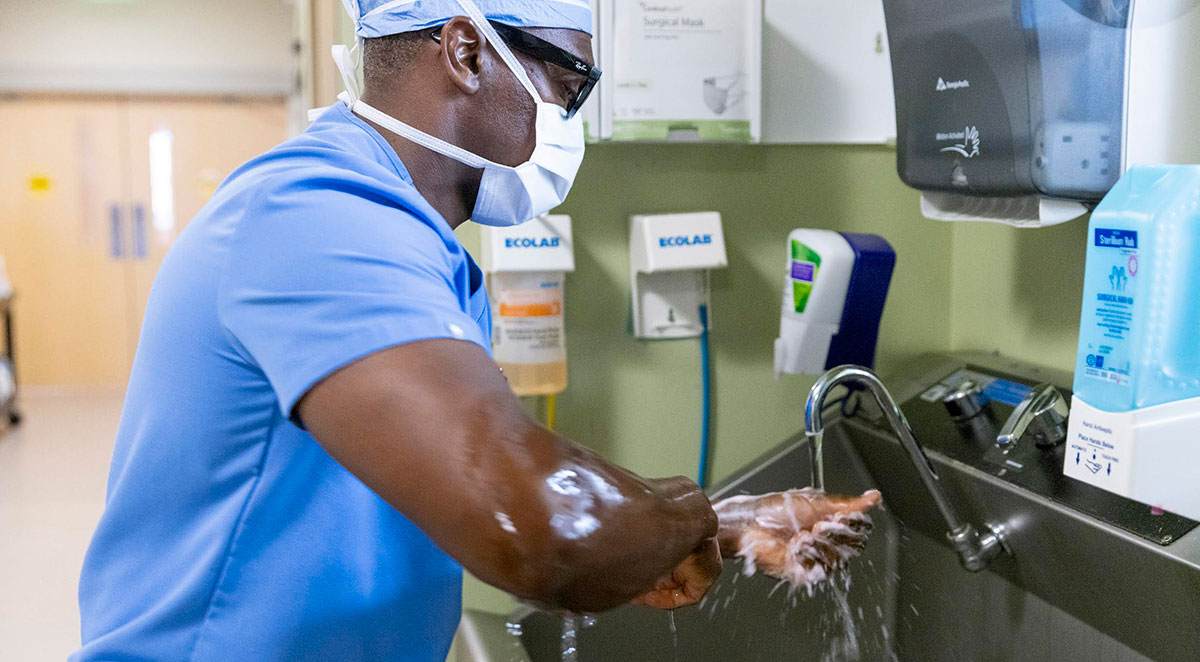
Dr. Brent Stephens, orthopedic surgeon at Health First, scrubs in for Brevard County’s first reverse shoulder replacement procedure using the Mako SmartRobotics™ Shoulder application.
While the technology is currently intended for carefully selected patients, typically over the age of 65, with more routine shoulder arthritis or irreparable rotator cuff tears, it offers surgeons greater confidence in achieving the exact implant position planned before surgery.
“For the standard patient with standard arthritis and a standard rotator cuff tear that we cannot fix, that patient is perfect because they’re reproducible,” Stephens said.
“I can go in there and know exactly what I want to do.”
He explained that the robotic system allows him to place the implant with remarkable precision.
“Prior to the robot, there’s a wiggle room,” he said. “We want to get it at 13 degrees, but the range is 10 to 15 degrees. The robot is like 13.2 degrees. It’s exactly what we predicted it would be. It helps us make that prediction so we can better have a predictable outcome.”
It helps improve the accuracy of implant placement, giving surgeons greater confidence in predicting how patients may regain strength, range of motion, and function.
Confidence also meant Sherry never considered leaving Brevard for her care.
“I didn’t even have a thought about going back to New Jersey to get this done,” Sherry said.
Initially, she paid little attention to the robotic technology itself.
“I didn’t care what he was doing with this robot,” she said with a laugh. “I didn’t give too much thought about it.”
That changed after Stephens explained the technology further during her follow-up visit.
“When he explained it more, I was like, ‘Oh wow, that’s pretty interesting.’ I thought it was fabulous that he could do that.”
Although she continues to rebuild her stamina, Sherry is already seeing progress and looks forward to returning to swimming and other activities she enjoys. “I’m trying to get back to my normal schedule,” Sherry said.
Since her surgery, Stephens has performed additional robotic-assisted reverse shoulder replacements with encouraging results.
“We’ve done over 12 of these now,” he said. “All 12 have been perfect. I’m very, very happy with the technology. I’m also happy where it’s going to lead us because there are a lot of new things that are going to come from where we are today.”
For patients living with chronic shoulder pain, Stephens encourages them to seek an evaluation before pain significantly affects their quality of life.
“I think a lot of patients are scared to proceed with surgery after they have exhausted all the nonoperative treatment options because they’re worried about bad outcomes,” he said. “Those things are possible, but they’re very unlikely.”
He says many of his patients wait years before deciding to move forward with shoulder replacement.
“When they have the surgery done, they say, ‘I wish I had this done 10 years ago because I’ve been living with pain,'” Stephens said. “Their quality of life has suffered for so long because they’ve been scared.”
For Sherry, choosing Stephens was just as important as choosing Health First.
“He’s got the best bedside manner of any doctor I’ve seen around here,” she said. “Best personality, best credentials, good bedside manner. I liked everything about him. I would recommend him to anyone who needs shoulder surgery.”
As one of a select group of healthcare organizations in Florida chosen by Stryker to offer the Mako SmartRobotics™ Shoulder application and the first in Brevard County to perform the procedure.
For patients like Sherry, that means having innovative treatment, experienced surgeons, and leading-edge technology available without leaving the community they call home.