Connecting the Warehouse Floor to the Boardroom: A New Systems Playbook
By Space Coast Daily // August 20, 2026
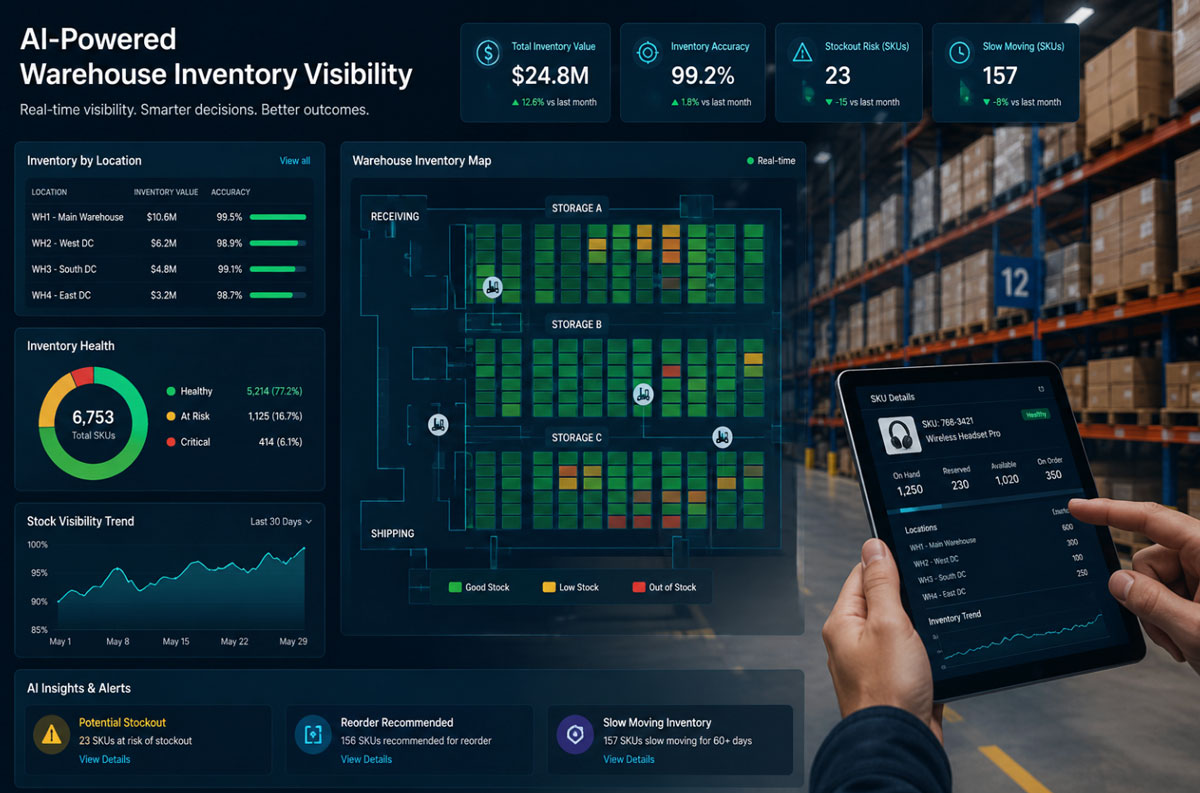
For most of retail and logistics history, the warehouse floor and the executive suite operated on entirely different information cycles. Inventory counts, fulfillment speed, and equipment performance lived in operational systems that rarely made it into strategic planning in real time — by the time a warehouse trend showed up in a quarterly board deck, it was already months old. That gap is closing fast, and the pace of change happening at the ai in warehousing market level is a big part of why: real-time forecasting, robotics, and computer vision systems are now generating operational data rich enough to actually inform strategic decisions, if the systems connecting floor to boardroom are built to carry it.
The technology to make this connection is largely available today. What’s often missing is the playbook for actually wiring it together — the systems architecture and organizational discipline that turns floor-level data into boardroom-ready insight, rather than two disconnected reporting streams that happen to share a company name.
Why the Old Model Doesn’t Work Anymore
The traditional structure — warehouse management systems reporting operational metrics up through a chain of monthly and quarterly summaries — was built for a world where warehouse decisions moved slowly and executive attention was reserved for major capital allocation questions. Two things have broken that model.
Warehouse decisions now move at machine speed. Slotting adjustments, robotic routing, and demand-driven inventory placement happen continuously, informed by algorithms reacting to real-time data. A reporting cadence built around monthly summaries can’t capture, let alone influence, decisions happening at that pace.
Executives increasingly need warehouse data to make unrelated decisions well. Pricing, supply chain contracting, and customer commitment decisions all depend on an accurate, current picture of fulfillment capacity and inventory position — information that used to be too stale by the time it reached the boardroom to be genuinely useful.
What the New Playbook Actually Requires
Connecting the floor to the boardroom in a way that’s genuinely useful, rather than just technically possible, requires attention to a few specific layers.
A shared data backbone, not parallel reporting streams. Warehouse operational data and executive dashboards need to draw from the same underlying source of truth — typically the ERP system, synchronized in near real time with the WMS and any robotics or automation platforms — rather than being reconciled manually or reported through separate, disconnected pipelines that inevitably drift out of sync with each other.
Metrics translated for two different audiences from one dataset. A floor supervisor needs granular, real-time operational metrics. An executive needs the same underlying data aggregated into strategic indicators — fulfillment capacity trends, cost-per-order shifts, service-level risk. Building both views from a single consistent data source, rather than two separately maintained reports, is what keeps the two audiences looking at the same reality.
Governance over what counts as “real time.” Not every metric needs to update every second, and treating everything as equally urgent creates noise rather than clarity. A deliberate decision about which metrics need genuine real-time visibility versus daily or weekly rollups keeps the system usable rather than overwhelming.
Where This Usually Breaks Down
The most common failure point in building this connection isn’t the analytics layer or the executive dashboard — it’s the underlying ERP integration that’s supposed to feed both. Warehouse automation and robotics investments often get planned and budgeted around visible operational technology, while the ERP work required to actually connect that technology to broader business systems gets treated as an implementation afterthought.
This is precisely the gap that dedicated ERP Advisory Services are built to close — assessing whether an organization’s ERP architecture can genuinely support real-time data flow between warehouse systems and executive reporting, and designing that integration deliberately before automation investments are locked in, rather than discovering the gap after robots are already deployed and the promised visibility never quite materializes.
Building the Playbook in Practice
A few steps consistently show up in organizations that get this connection right rather than leaving it to chance.
Start with a data audit, not a dashboard project. Before building any executive-facing view, confirm that the underlying ERP and WMS integration can actually deliver accurate, timely data — a polished dashboard on top of unreliable data sources creates false confidence rather than genuine visibility.
Define which metrics actually need real-time treatment. Distinguish between operational metrics that genuinely benefit from real-time monitoring and strategic indicators that are just as useful reviewed daily or weekly, and architect accordingly rather than defaulting everything to “real time.”
Design one data model, two views. Build executive dashboards as an aggregated layer on top of the same operational data warehouse feeding floor-level systems, rather than as a separately maintained reporting pipeline that requires manual reconciliation.
Treat the connection as an ongoing capability, not a one-time project. As warehouse automation and AI capabilities continue to evolve, the integration connecting them to executive systems needs periodic reassessment — a connection built for today’s data volume and complexity can degrade in usefulness as both scale.
The Bottom Line
The technology to connect warehouse-floor intelligence to boardroom decision-making has largely arrived — the constraint now is systems architecture and organizational discipline, not raw capability. Organizations that get this right treat the ERP layer as the foundation of that connection, invest deliberately in it before automation projects scale, and build a single coherent data model that serves both a floor supervisor and a CFO. That’s the playbook, and it’s considerably less flashy than the robots getting most of the attention — but it’s what actually makes the robots’ data worth something at the strategic level.
About the Contributor
Nishkam Batta Editor-in-Chief, HonestAI Magazine | AI Consultant, GrayCyan AI Solutions
Nish leads an applied AI company that helps manufacturing and related companies automate operations with human-in-the-loop AI that integrates into ERPs, WMS, CRMs, and other enterprise tools, with an emphasis on no black box AI (explainable AI), clear audit trails, driving efficiency, and measurable outcomes. His team builds agentic ERP systems that execute multi-step tasks inside approved guardrails so humans keep accountability, approvals, and override control.